
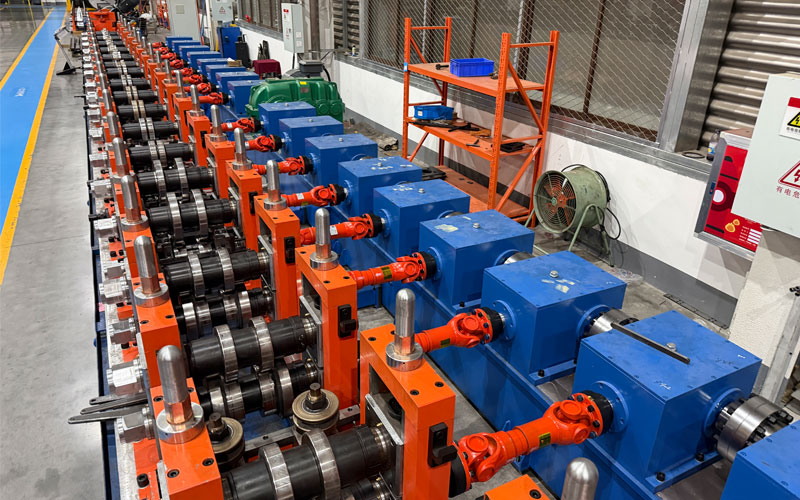
Roll forming systems
Roll forming machines are advanced industrial systems designed for the continuous production of uniform metal profiles with high dimensional accuracy. These machines play a vital role in modern manufacturing industries such as construction, automotive, energy, storage systems, and infrastructure development. By utilizing a series of precision-engineered rollers, roll forming machines transform flat metal strips or coils into complex cross-sectional profiles efficiently and consistently.
Working Principle of Roll Forming Machines
The roll forming process is a continuous cold forming method. Metal coils—typically steel, galvanized steel, stainless steel, or aluminum are fed into the machine and progressively shaped through multiple forming stations. Each station contains a pair of rollers that gradually bend the material without altering its thickness.
Key stages of the roll forming process include:
Decoiling and feeding
Progressive forming through roll stands
In line punching or embossing (optional)
Cutting to length
Stacking or automatic packing
This gradual forming process minimizes internal stress, reduces material waste, and ensures excellent surface quality.
Main Components of Roll Forming Machines
A standard roll forming machine consists of several critical components:
Uncoiler: Holds and feeds the metal coil smoothly into the line
Guiding System: Ensures accurate strip alignment
Roll Forming Stands: Precision rollers that shape the profile step by step
Transmission System: Gearbox or chain driven mechanism providing stable power
Cutting System: Flying shear, hydraulic press, or cold saw for accurate length control
PLC Control System: Automates speed, length, and production parameters
Each component is engineered to work synchronously for maximum production efficiency.
Types of Roll Forming Machines
Roll forming machines are classified based on application and profile complexity:
Roofing Sheet Roll Forming Machines
C & Z Purlin Roll Forming Machines
Tube and Pipe Roll Forming Lines
Cable Tray Roll Forming Machines
Floor Deck Roll Forming Machines
Custom Profile Roll Forming Machines
Customized solutions are often required to meet specific structural or industrial standards.
Technical Advantages of Roll Forming Technology
Roll forming machines offer several technical and economic advantages:
High production speed with continuous operation
Excellent repeatability and dimensional accuracy
Low material waste compared to stamping processes
Capability to form long and complex profiles
Reduced labor costs through automation
Compatibility with high strength steel materials
These advantages make roll forming the preferred solution for large-scale metal profile manufacturing.
Industrial Applications
Roll forming machines are widely used across multiple industries, including:
Steel construction and building systems
Automotive structural components
Solar mounting systems
Warehouse storage and racking systems
Highway guardrails and infrastructure
Electrical enclosures and cable management
The versatility of roll forming technology enables manufacturers to adapt quickly to market demands.
Roll Forming Machine Manufacturer
At LOTOSFORMING, roll forming machines are engineered with a strong focus on durability, precision, and long term performance. Advanced CNC machining, high quality raw materials, and strict quality control ensure that each machine meets international production standards. Customized roll tooling design and intelligent automation systems allow LOTOSFORMING to deliver reliable solutions for global industrial applications.
Conclusion
Roll forming machines represent a cornerstone of modern metal manufacturing. Their ability to produce high quality, complex profiles with speed and consistency makes them indispensable in today’s industrial environment. With continuous advancements in automation and tooling technology, roll forming machines will remain a critical solution for efficient and scalable metal production.