
Why Roll Pass Design Is the Backbone of Quality Roll Forming
If you have ever struggled with twisted profiles, edge waves, or dimensional inaccuracies on your roll forming line, the root cause is almost always poor roll pass design. No matter how expensive your machine is, if the roll pass design is flawed, the final profile will be defective.
Roll pass design (also called roll tooling design or flower pattern design) is the engineering process of determining:
- How many forming stations are needed
- How much bending occurs at each station
- The sequence of bends from flat strip to final profile
- The geometry of each roller
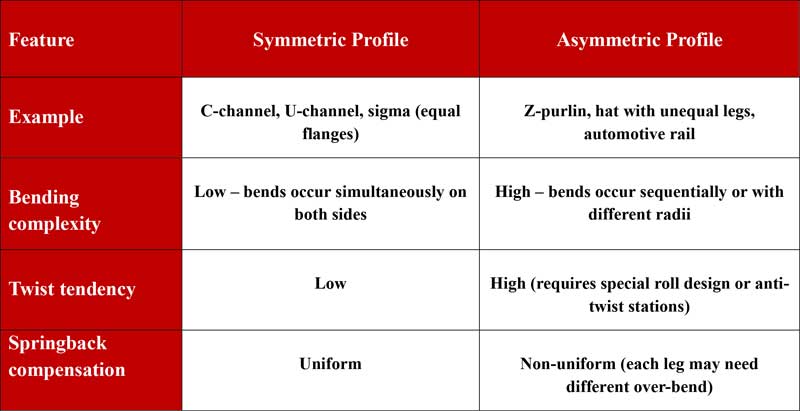
For symmetric profiles (e.g., C-channel, U-channel, sigma channel with equal flanges), the design is relatively straightforward. But for asymmetric profiles (e.g., Z-purlin, hat channel with different leg lengths, automotive side sills), the complexity increases significantly.
This step-by-step guide will walk you through the entire roll pass design process. Whether you are a roll forming engineer, a maintenance technician, or a buyer evaluating a roll forming machine supplier, understanding these principles will help you avoid costly mistakes.
Part 1: Basic Concepts Every Roll Pass Designer Must Know
Before diving into the step-by-step process, let’s clarify key terms.
1.1 Flower Pattern
The flower pattern is a graphical representation of the strip’s cross-section at each forming station. It “blooms” from a flat strip at station 0 to the final profile at the last station. The name comes from the way the strip gradually opens and bends, resembling a flower opening.
1.2 Forming Station (Stand)
Each station consists of a pair (top and bottom) of rollers that progressively bend the strip. A typical roll forming line has 12 to 30 stations, depending on profile complexity and material thickness.
1.3 Bend Angle Progression
The bend angle should increase gradually from station to station. A common rule: maximum bend angle per station is 20–30 degrees for mild steel, and 10–15 degrees for high-strength steel. Exceeding these values causes edge cracking or excessive springback.
1.4 Neutral Axis and Springback
When bending, the outer fibers stretch and inner fibers compress. After bending, the material tries to return to its original shape – this is springback. Roll pass design must compensate for springback by over-bending slightly (typically 0.5–2 degrees extra per bend).
Part 2: Step by Step Roll Pass Design Process
Step 1: Define Final Profile Geometry
Start with a detailed drawing of the finished profile. You need:
- Overall width and height
- Flange lengths (left and right, if asymmetric)
- Inside bend radii (typically 1.5× to 3× material thickness)
- Thickness of material
- Tolerances (e.g., ±0.5 mm on critical dimensions)
Example (symmetric C-channel):
Height = 80 mm, flange width = 40 mm, thickness = 2.0 mm, bend radius = 3 mm.
Example (asymmetric Z-purlin):
Top flange = 60 mm, bottom flange = 40 mm, web = 100 mm (angled), thickness = 2.5 mm.
Step 2: Calculate Developed Width (Flat Strip Width)
The flat strip width is calculated by adding all straight sections and the arc lengths of bends.
Formula:
Developed width = sum of straight lengths + (π × bend angle in radians × (inside radius + k × thickness))
Where *k* is the neutral axis factor (typically 0.33 to 0.5 for cold forming). For simplicity, many designers use: bend allowance = 0.5 × thickness per 90° bend for radii 1.5× thickness.
Example (C-channel 80×40×2 mm, 90° bends):
Straight sections: bottom = 80 mm, two webs (from bottom to flanges) = 40 mm each? Actually careful: For C-channel, flat strip = 2× flange + 2× (web – thickness?) Better to use known formula. But for guide, we skip exact math – focus on process.
Step 3: Determine Number of Forming Stations
A common rule of thumb: one station per 10–15° of total bend per bend line.
For a profile with four 90° bends (total 360° of bending), you need approximately 18–24 stations if each station bends 15–20° per bend line. For asymmetric profiles with different bend angles on each side, you may need more stations because bends cannot be applied simultaneously.
Typical station counts:
- Simple C-channel (12–16 stations)
- Standard sigma channel (18–22 stations)
- Complex asymmetric profile with lips (24–30 stations)
Step 4: Create the Flower Pattern
This is the most critical step. Draw the cross-section at each station (or every 2nd station) showing how the strip gradually bends.
For symmetric profiles:
- Station 1: 15° bend on both sides
- Station 2: 30° bend
- Station 3: 45° bend
- Continue until 90° (final bend angle).
After 90°, you may add an over-bend station (e.g., 92°) to compensate for springback, then a final sizing station that brings it back to 90°.
For asymmetric profiles:
- Bends are often applied sequentially: first bend the longer flange, then the shorter one.
- The flower pattern becomes unbalanced. You may need additional guide rollers or anti-twist stations to prevent the profile from twisting.
Practical tip: Use roll forming simulation software (COPRA FEA, AutoForm, etc.) to validate the flower pattern before cutting metal for rollers. It saves thousands of dollars in tooling corrections.
Step 5: Design Individual Rollers
Once the flower pattern is fixed, you design the roller geometry for each station. Each roller pair (top and bottom) must:
- Match the cross-section at that station
- Have sufficient clearance (typically 0.1–0.3 mm per side for material thickness up to 3 mm)
- Provide smooth transition to the next station
Roller material and hardness:
- Cr12 or D2 steel, hardened to HRC 58–62
- Surface finish Ra ≤ 0.8 µm to reduce friction and marking
- For high-volume or abrasive materials (e.g., galvanized with zinc spangle), consider chrome plating (25–50 µm thickness)
Step 6: Compensate for Springback
Springback varies with material grade, thickness, and bend radius. General guidelines:
- Mild steel (Q235, ST37): over-bend 0.5–1° per 90° bend
- High-strength steel (Q345, ST52, DP600): over-bend 1.5–2.5° per 90° bend
- Aluminum (6061-T6): over-bend 2–3° per 90° bend
- Stainless steel (304): over-bend 2–3° per 90° bend
Implement over-bend in the last 2–3 forming stations, then add a final sizing station that brings the profile back to nominal geometry. The sizing station typically has little or no bend – just calibration.
Step 7: Add Sizing and Straightening Sections
After the last forming station, the profile may have residual twist or bow. A straightening unit (often called a straightener or leveler) with multiple small rollers (e.g., 7–9 pairs) corrects these defects. The straightening unit is critical for asymmetric profiles.
Step 8: Validate with Simulation or Trial Run
Before manufacturing the rollers, run a Finite Element Analysis (FEA) simulation. If simulation is not available, request the roll forming machine manufacturer to run a sample using soft tooling (e.g., 3D-printed or machined plastic inserts) on a test line.
What to check in validation:
- No edge cracking or excessive thinning (>10% thickness reduction)
- No wrinkling or buckling between bends
- Final dimensions within tolerance (±0.5 mm)
- Twist less than 1 mm per meter
Part 3: Common Mistakes in Roll Pass Design (And How to Avoid Them)
Mistake 1: Too Few Forming Stations
Consequence: Excessive bending per station causes edge cracking, high residual stress, and poor profile straightness.
Solution: Increase number of stations. If limited by machine length, use larger diameter rollers to allow more gradual bending.
Mistake 2: Ignoring Springback
Consequence: Profile opens up after forming (e.g., 90° flange becomes 87°).
Solution: Measure springback on sample material and add over-bend accordingly. Keep records for different material grades.
Mistake 3: Symmetric Flower Pattern for Asymmetric Profile
Consequence: Profile twists severely after exiting the last station.
Solution: Use sequential bending and add anti-twist stations (roller pairs mounted at an angle) or a straightening unit.
Mistake 4: Sharp Bend Radii
Consequence: Cracking on outer fiber, especially for high-strength steel or thick material.
Solution: Minimum inside bend radius should be 1.5× thickness for mild steel, 3× thickness for AHSS, and 5× thickness for aluminum.
Mistake 5: Poor Roller Clearance
Consequence: Scratches on coated surfaces, excessive roller wear, and high power consumption.
Solution: Use clearance of 0.1–0.3 mm per side. For pre-galvanized or painted material, increase to 0.3–0.5 mm to avoid coating damage.
Part 4: Roll Pass Design for Specific Profile Types
4.1 C-Channel (Symmetric, Simple)
- Stations: 12–16
- Flower pattern: both flanges bend simultaneously
- Springback: uniform, easy to compensate
- Straightening: minimal
4.2 Z-Purlin (Asymmetric)
- Stations: 18–24
- Flower pattern: bends applied sequentially – first top flange, then web, then bottom flange
- Critical: anti-twist stations or a straightener with adjustable rollers
- Springback: different on each flange, may require individual over-bend
4.3 Sigma Channel (Symmetric or Slightly Asymmetric)
- Stations: 18–22
- Flower pattern: angled web requires careful bend sequence
- Common issue: web distortion if bend progression is not smooth
- Simulation highly recommended
4.4 Automotive Side Sill (Highly Asymmetric, Closed Section)
- Stations: 24–30+
- May require pre-notching and welding after forming
- Roll pass design often integrated with Finite Element Analysis from the start
- Straightening is critical
Part 5: How to Evaluate a Roll Pass Design When Buying a Roll Forming Machine
If you are a buyer (not a designer), you can still ask the right questions to ensure the supplier has done proper roll pass design.
Conclusion: Good Roll Pass Design Saves Money and Headaches
Roll pass design is not magic – it is a systematic engineering process. Following the steps outlined in this guide will help you achieve:
- Straight, twist-free profiles
- Consistent dimensions within tolerance
- Longer roller life
- Lower scrap rates
- Higher production speeds
For symmetric profiles, the design is relatively forgiving. For asymmetric profiles, invest extra time in simulation and validation. And if you are buying a roll forming machine, always ask the supplier to demonstrate their roll pass design capability.