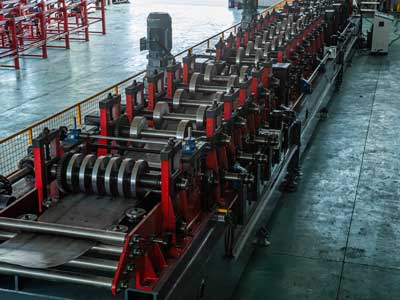
How Does the Cold Forming Process Work?
Cold roll forming is a continuous metal shaping method in which flat coils are transformed into accurate profiles at room temperature. Because the material is not heated, the process provides excellent dimensional precision, a smooth finish, and efficient material usage. It has become a preferred manufacturing technique in construction, automotive parts, storage systems, and other industrial sectors that require large volume, consistent production.
How the Process Works
Production begins by feeding a steel coil into a decoiler, where it is straightened and prepared for profiling. The strip then passes through multiple forming stations, each applying a gradual bend until the final shape is reached. A cutting unit trims the product to length, allowing continuous operation. This controlled deformation minimizes internal stress, reduces scrap, and ensures uniform geometry.
Advantages of This Manufacturing Method
This forming technology provides several benefits, including tight tolerances, high throughput, and excellent repeatability. It supports automated workflows, lowers labor requirements, and results in reduced operating costs. In addition, the cold working effect enhances strength, making the finished parts durable and suitable for structural applications.
Suitable Materials
Various metals can be shaped using this technique, such as galvanized steel, stainless steel, aluminum, and copper-based alloys. Selection depends on corrosion resistance, mechanical performance, and cost considerations. The ability to process coated or pre-painted materials without damaging their surface makes it a strong option for visible architectural components.
Industrial Applications
Profiles produced through this method are widely used in steel framing, solar mounting systems, warehouse shelving, roadside barriers, doors and windows, and automotive reinforcements. Common shapes include C and U sections, Sigma profiles, cable support channels, roofing panels, and components for greenhouse structures. Their strength-to-weight ratio supports modern infrastructure and engineered installations.
Automation and Digital Control
Modern production lines often feature PLC systems, servo motors, automated punching units, and monitoring software. These digital tools reduce setup time, enhance accuracy, and allow operators to adjust parameters through intuitive interfaces. Such automation aligns with smart manufacturing trends and improves overall productivity and consistency.
Industrial Applications
Profiles produced through this method are widely used in steel framing, solar mounting systems, warehouse shelving, roadside barriers, doors and windows, and automotive reinforcements. Common shapes include C and U sections, Sigma profiles, cable support channels, roofing panels, and components for greenhouse structures. Their strength to weight ratio supports modern infrastructure and engineered installations.
Automation and Digital Control
Modern production lines often feature PLC systems, servo motors, automated punching units, and monitoring software. These digital tools reduce setup time, enhance accuracy, and allow operators to adjust parameters through intuitive interfaces. Such automation aligns with smart manufacturing trends and improves overall productivity and consistency.
Quality and Surface Performance
Quality assurance focuses on dimensional accuracy, mechanical stability, and visual finish. Inspection systems monitor thickness, profile geometry, hole position, and cut length. Since no heating is involved, the risk of warping or metallurgical alteration is low. Proper tooling design and maintenance ensure long-term machine reliability and high-quality components.
LotosForming as a Reliable Equipment Supplier
LotosForming is a recognized manufacturer in China, offering advanced profiling equipment tailored to industrial needs. The company provides customized machine design, robust construction, and automated controls to support efficient production. Installation, operator training, spare parts availability, and long term technical service make LotosForming a trusted partner for global customers seeking dependable metal forming solutions.
FAQ :
Key benefits include high dimensional accuracy, smooth surface finish, fast production speed, low material waste, and improved strength due to cold working. It also supports full automation and cost-efficient manufacturing.
Cold roll forming provides tight tolerances and exceptional repeatability. With proper tooling and machine calibration, profiles maintain consistent geometry across long production runs.
No heating is needed. The metal is shaped at room temperature, which reduces energy consumption and minimizes distortion or metallurgical changes.
The process is suitable for galvanized steel, carbon steel, stainless steel, aluminum, and copper alloys. Coated and pre-painted metals can also be formed without damaging the surface.