

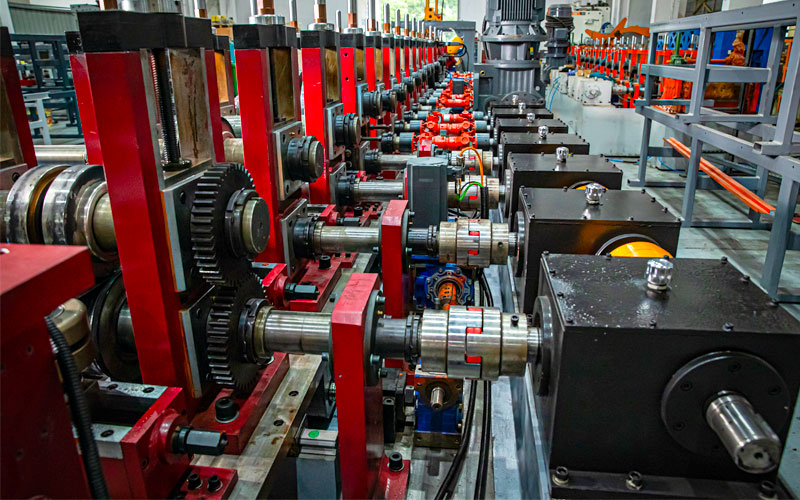
Forming Systems
Forming machines are essential industrial systems used to shape metal materials into precise geometries through controlled mechanical processes. These machines are fundamental to modern manufacturing, enabling high efficiency production of structural components, profiles, and functional parts across construction, automotive, energy, and infrastructure industries.
By applying mechanical force without material removal, forming machines ensure optimal material utilization, consistent quality, and high production rates.
Definition and Working Principles of Forming Machines
Forming machines operate by applying compressive, tensile, or bending forces to metal sheets, strips, tubes, or coils, reshaping them into predefined forms. Unlike machining processes, forming maintains material continuity and strength while achieving accurate dimensions.
Depending on the forming method, the process may be:
Cold forming, performed at room temperature for high dimensional accuracy
Hot forming, conducted at elevated temperatures for complex or heavy duty shapes
The selection of forming technology depends on material properties, profile complexity, and production volume.
Main Types of Forming Machines
Forming machines can be classified according to their forming methods and applications:
Roll Forming Machines
Used for continuous production of long metal profiles through sequential forming stations, ideal for high volume manufacturing.
Press Forming Machines
Employ hydraulic or mechanical presses to shape metal sheets using dies, commonly used in automotive and appliance industries.
Tube and Pipe Forming Machines
Designed to form round, square, or rectangular tubes from metal strips through progressive bending and welding processes.
Sheet Metal Forming Machines
Used to create angular shapes and flanges with high precision, especially in sheet metal fabrication.
Stretch Forming Machines
Apply tensile forces to shape large or curved components with uniform stress distribution.
Core Components of Forming Machines
A typical forming machine consists of several integrated systems:
Material Feeding System: Ensures smooth and accurate material entry
Forming Units or Tooling: Dies, rollers, or molds that define the final shape
Drive System: Motors, gearboxes, or hydraulic units delivering forming force
Control System (PLC): Automates speed, pressure, and positioning
Cutting or Trimming System: Ensures accurate final dimensions
Safety and Monitoring Systems: Protect operators and maintain process stability
High quality component integration directly impacts machine performance and service life.
Technical Advantages of Forming Machines
Forming machines offer numerous technical and operational benefits:
High material efficiency with minimal waste
Excellent repeatability and dimensional consistency
Strong mechanical properties due to work hardening
Capability to process high strength and coated metals
Reduced production cost in mass manufacturing
Compatibility with automated production lines
These advantages make forming machines indispensable in modern industrial production.
Metal Forming Industrial
Forming machines are widely used in:
Steel construction and building systems
Automotive structural and safety components
Solar mounting and energy support structures
Storage racks and warehouse systems
Highway guardrails and infrastructure projects
Electrical enclosures and industrial equipment
Their adaptability allows manufacturers to respond efficiently to evolving market requirements.
Manufacturing Expertise in Forming Machines
At LOTOSFORMING, forming machines are designed with a focus on structural rigidity, precision tooling, and long term operational reliability. Advanced engineering design, CNC manufactured components, and strict quality control ensure stable performance under demanding industrial conditions. Customized forming solutions are developed to meet specific customer standards and international certifications.
Conclusion
Forming machines represent a core technology in metal manufacturing, providing efficient, precise, and scalable solutions for shaping metal components. With continuous advancements in automation, control systems, and tooling design, forming machines will continue to play a critical role in industrial production worldwide.Choosing a professionally engineered forming machine ensures consistent quality, high productivity, and long term operational success.
FAQ :
Forming machines are industrial systems used to shape metal materials into specific profiles or components by applying mechanical force without removing material. They ensure high dimensional accuracy, efficient material usage, and consistent product quality in mass production environments.
Forming machines reshape metal through deformation, maintaining material continuity and strength, while machining processes remove material through cutting. Forming generally offers higher productivity and lower material waste.
Modern forming machines achieve high dimensional precision through CNC machined tooling, servo controlled drives, and PLC automation systems. Consistent tolerances can be maintained over long production runs.
Routine maintenance includes lubrication, inspection of forming rollers or dies, checking hydraulic and electrical systems, and monitoring alignment to ensure consistent performance.