

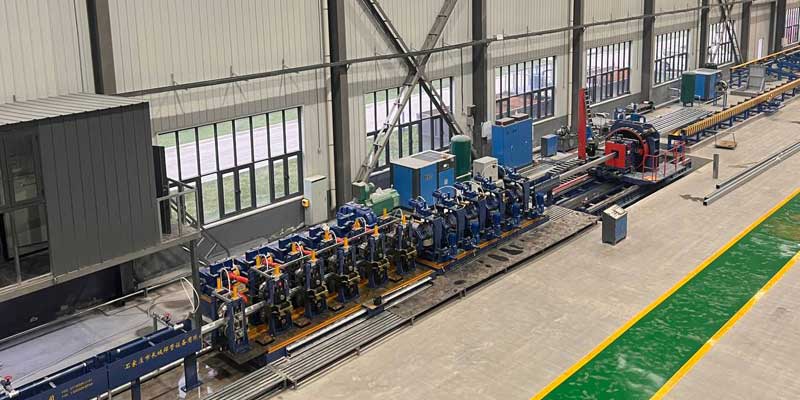
How to Maintain tube mill Equipment?
Proper Tube Mill Maintenance & Services are essential to ensure consistent product quality, stable production speed, and long equipment lifespan. A tube mill line operates under continuous mechanical load, high temperature in the welding zone, and strict dimensional accuracy requirements. Therefore, preventive maintenance is necessary to avoid unexpected downtime and maintain optimal performance.
For high precision manufacturing lines supplied by Lotosforming, maintenance procedures should follow a structured schedule including daily, weekly, and monthly inspections.
Importance of Tube Mill Maintenance
A well maintained tube mill provides:
- Stable welding quality and seam integrity
- Reduced mechanical wear of rolls and bearings
- Lower risk of unexpected machine stoppages
- Improved dimensional accuracy of tubes
- Extended lifetime of motors, gearboxes, and forming rolls
- Consistent production efficiency
Regular servicing also reduces operational costs by preventing major repairs and protecting critical components such as forming stands, welding units, cooling systems, and drive systems.
Daily Maintenance Procedures
Daily inspection ensures that the most sensitive components of the tube mill operate safely and efficiently.
- Cleaning and Polishing of Rolls After Each Roll Change
After every roll change, all forming rolls should be carefully cleaned to remove metal dust, oil residues, and particles generated during production.
Recommended procedure:
- Clean the external surface of rolls with a soft industrial cloth
- Apply gentle polishing on roll surfaces
- Clean internal roll surfaces softly to prevent micro scratches
- Avoid aggressive abrasive materials that may damage roll coating
- Ensure no debris remains that could affect tube surface quality
Proper cleaning helps maintain smooth strip forming and prevents marking or scratching on finished tubes.
- Daily Inspection of Initial Welding Section
The welding section is one of the most critical parts of the tube mill line.
Operators should:
- Inspect alignment of strip edges before welding
- Check electrode condition and positioning
- Ensure welding pressure is properly adjusted
- Monitor temperature consistency
- Confirm proper seam formation
Stable welding conditions improve seam strength and reduce reject rates.
- Daily Inspection of Cooling Water Tanks
Cooling systems play a vital role in maintaining temperature stability.
Inspection checklist:
- Check water tank level
- Ensure proper circulation of cooling water
- Inspect filters for blockage
- Confirm pump performance
- Verify absence of leakage in pipes and connectors
Proper cooling prevents overheating of rolls, welding units, and strip material.
- Daily Inspection of Welding Wire and Welding Parameters
Welding quality strongly depends on proper welding material and correct machine settings.
Operators should:
- Check welding wire condition
- Ensure correct wire diameter
- Confirm stable feeding of welding wire
- Verify welding voltage and current settings
- Inspect contact tips and guides
Consistent welding settings ensure uniform seam quality and prevent defects.
Weekly Maintenance Procedures
Inspection of Motors and Gearboxes
Drive systems must be inspected weekly to ensure smooth power transmission.
Inspection includes:
- Checking gearbox oil level
- Monitoring unusual noise or vibration
- Inspecting motor temperature during operation
- Verifying bolt tightness and coupling alignment
- Checking lubrication condition
Proper maintenance of motors and gearboxes ensures stable forming speed and reduces mechanical wear.
Monthly Maintenance Procedures
Inspection of Hydraulic and Pneumatic Systems
Hydraulic and pneumatic components control machine movements and pressure systems.
Monthly inspection checklist:
- Check hydraulic oil level and quality
- Inspect hoses for leakage or cracks
- Verify pressure stability
- Inspect pneumatic valves and regulators
- Clean or replace air filters if required
- Ensure cylinders operate smoothly
Reliable hydraulic and pneumatic systems maintain accurate roll positioning and consistent forming pressure.

Conclusion
Professional Tube Mill Maintenance & Services ensure consistent production quality, reduced downtime, and long machine life. By following systematic inspection schedules, manufacturers can maintain high efficiency and protect critical components of the tube mill line.
Lotosforming recommends implementing a preventive maintenance program to achieve stable production performance and ensure long term operational reliability. Proper servicing not only improves product accuracy but also increases overall equipment productivity.

FAQ:
The following items should be inspected daily:
- Alignment of strip edges before welding
- Welding pressure stability
- Electrode condition
- Welding temperature consistency
- Seam formation quality
- Welding wire condition and feeding system
- Welding voltage and current settings
Daily inspection ensures strong weld seams and reduces production defects.
Cooling water tanks and circulation systems must be checked daily to prevent overheating of rolls, welding units, and strip material. Stable cooling improves machine durability and ensures consistent welding temperature.
Common issues include:
- Poor weld seam quality
- Roll surface damage
- Tube dimensional inaccuracy
- Overheating of components
- Hydraulic pressure instability
- Increased machine downtime
- Higher repair costs
Regular maintenance ensures stable production quality, prevents unexpected downtime, and extends the service life of machine components. Preventive servicing helps maintain welding accuracy, forming precision, and consistent tube dimensions.