

What is a Solar Roll Forming Machine ?
In the rapidly expanding solar energy industry, the efficiency and throughput of manufacturing processes directly influence project timelines, costs, and overall competitiveness. Among these processes, roll forming particularly for solar racking and mounting components plays a critical role. While the nominal speed of a solar roll forming line may be advertised in meters per minute (m/min), the actual achievable speed in production is governed by a complex interplay of mechanical, hydraulic, material, and operational variables. This article examines the key factors that impact the speed of solar roll forming lines, with a focus on both hydraulic and mechanical punching systems a core competency of LotosForming.
1. Punching System Type and Integration
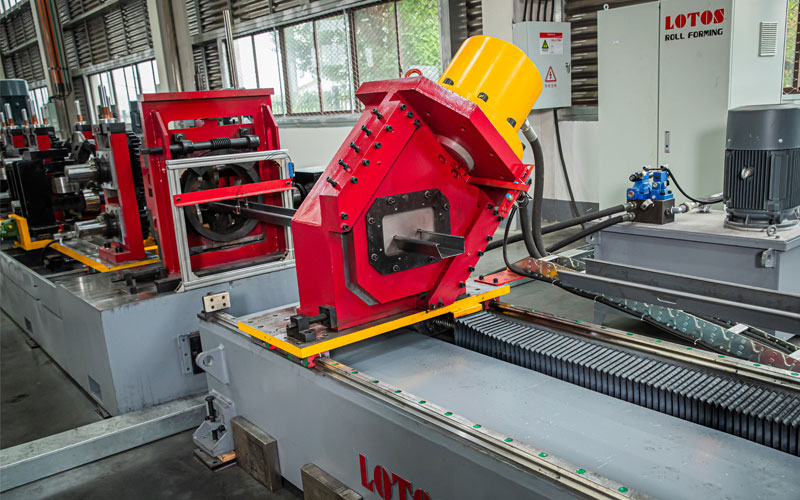
Punching operations are often integrated into roll forming lines to create mounting holes, grounding slots, or other functional features in solar profiles. The choice between hydraulic and mechanical punching systems significantly affects line speed:
- Hydraulic Punching Systems
Hydraulic systems offer high force with precise control, ideal for thick materials or complex hole patterns. However, their cycle time is typically slower due to the nature of fluid dynamics (acceleration/deceleration of fluid, valve response time). While robust and versatile, hydraulic punches may limit overall line speed unless equipped with high-response servo-hydraulic valves or accumulator-assisted rapid cycling. - Mechanical Punching Systems
Mechanical presses, driven by servo motors or crank mechanisms, provide faster cycle times often synchronized directly with the strip speed. Modern servo-mechanical punch units can achieve punching at line speeds exceeding 30 m/min without stopping the material flow (“flying punch”). This makes them preferable for high-volume solar profile production where speed is paramount.
At LotosForming, our advanced servo mechanical punching modules are engineered for seamless integration with roll formers, enabling non-stop punching at industry leading speeds while maintaining micron-level positional accuracy.
2. Material Properties and Thickness
The physical characteristics of the incoming coil stock exert direct influence on forming speed:
- Material Grade: Higher strength steels (e.g., G550, G300) require more forming power and slower feed rates to avoid springback, edge buckling, or roll wear. Softer grades (e.g., DX51D) can often be processed faster.
- Thickness: Thicker materials (e.g., 2.0–3.0 mm for structural solar rails) demand greater torque, slower acceleration, and more robust tooling, inherently limiting maximum line speed compared to thinner profiles (1.0–1.5 mm).
- Coil Quality: Variations in coil flatness, width tolerance, or edge condition can trigger automatic slowdowns or stops to prevent misfeeds or tool damage.
3. Roll Tooling Design and Profile Complexity
The geometry of the solar profile dictates the number of forming stands required and the severity of each bending step:
- Simple C or U Sections: Fewer stands and gentler bends allow higher speeds.
- Complex Multi Leg or Interlocking Profiles: Require more stands, tighter radii, and intermediate straightening each adding time and limiting feed rate.
- Tooling Precision: High precision, hardened tooling designed with progressive forming strategies minimizes material stress and enables smoother, faster throughput. Poorly designed tooling causes material hesitation, chatter, or distortion, forcing speed reductions.
LotosForming employs finite element analysis (FEA) during tooling design to optimize forming sequences for both quality and velocity.
4. Drive System and Motor Technology
The backbone of any high-speed roll former lies in its drive architecture:
- Individual Motor Drive per Stand: Modern lines use AC servo motors with independent closed-loop control on each forming station. This eliminates gear train limitations, allows dynamic speed synchronization, and supports rapid acceleration/deceleration during punching or cutting.
- Main Drive Power: Insufficient motor power leads to speed droop under load, especially during cold starts or when forming thick materials.
Our roll forming lines feature fully servo-driven stands with real-time torque monitoring, ensuring consistent speed even under variable load conditions
5. Cutting Mechanism Flying vs Stop Cut
The cutoff system must match line speed:
- Stop Cut Systems: Require full deceleration and stopping before each cut dramatically reducing average throughput.
- Flying Cutoffs (Rotary or Flying Shear): Cut on the fly without interrupting material flow. Servo synchronized flying shears are essential for maintaining high average speeds (>25 m/min).
LotosForming integrates high-precision flying cutoffs capable of clean, burr-free cuts at speeds up to 40 m/min, tailored for solar rail lengths.
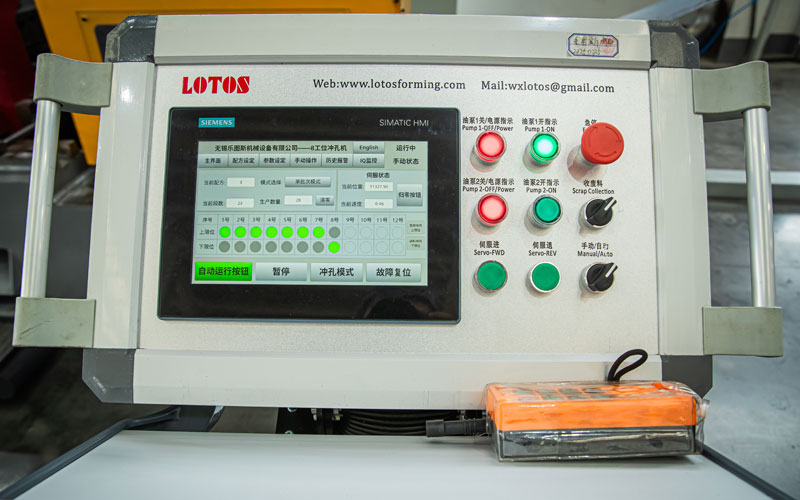
6. Automation and Control System
Advanced PLC and HMI systems with motion control integration are vital:
- Real time feedback from encoders and sensors enables adaptive speed control.
- Automated setup and recipe management reduce downtime between runs.
- Integrated safety interlocks and diagnostic systems prevent unscheduled stops.
Our lines feature Industry 4.0-ready control platforms with remote monitoring and predictive maintenance capabilities.
7. Tooling Changeover Time and Quick Setup Systems
While maximum continuous speed is critical, overall equipment effectiveness (OEE) is equally dependent on minimizing non-productive time. Frequent product changeovers—common in solar manufacturing due to regional racking standards (e.g., Nextracker, Array Technologies, or custom OEM designs)—can severely erode throughput if setups are manual and time-consuming.
- Quick-Change Tooling Cartridges: LotosForming’s modular tooling system allows rapid roll set replacement in under 30 minutes, drastically reducing downtime.
- Laser-Guided Alignment & Auto Calibration: Integrated vision systems ensure precise roll positioning without trial runs, maintaining consistent speed from the first meter.
- Digital Twin Integration: Pre-validated forming simulations enable offline setup verification, ensuring that once the line starts, it runs at target speed immediately.
Efficient changeovers translate directly into higher average line speeds over a production shift.
8. Cooling, Lubrication, and Roll Wear Management
At elevated speeds, friction and heat buildup between the strip and forming rolls increase significantly:
- Dry Forming vs Lubricated Forming: Most modern solar lines employ dry forming to avoid post-processing cleaning. However, without proper roll surface treatment (e.g., nitriding, PVD coatings), friction can cause galling or edge cracking, forcing speed reductions.
- Active Roll Cooling: High-speed lines may incorporate internal coolant channels in critical stands to stabilize temperature and maintain dimensional accuracy.
- Predictive Roll Wear Monitoring: Vibration sensors and thickness gauges can detect early signs of tool degradation, allowing scheduled maintenance before speed-compromising defects occur.
LotosForming’s tooling uses wear-resistant coatings and optimized roll pass design to sustain high speeds over extended production runs without quality loss.

9. Material Feed and Decoiler Dynamics
The upstream section of the line sets the pace:
- Decoiler Braking Precision: Poor tension control causes strip looping or snaking, triggering emergency slowdowns. Servo-controlled decoilers with dancer arms maintain constant back tension.
- Straightener Efficiency: An integrated precision straightener ensures consistent flatness before forming. Any residual curvature forces slower feed rates to avoid misalignment in the first forming stands.
- Accumulator Loops for Synchronization: When integrating punching or notching, accumulator systems store material during brief pauses (e.g., for index punching), allowing the main line to run continuously at full speed.
Our standard solar roll forming lines include servo-synchronized decoilers and entry straighteners calibrated for galvanized and Galvalume® coils—a staple in solar racking.
10. Environmental and Facility Constraints
Often overlooked, plant level factors can impose hard limits on speed:
- Power Supply Stability: Servo motors and hydraulic systems demand clean, stable three-phase power. Voltage sags or harmonics can trigger protective shutdowns.
- Ambient Temperature & Humidity: Extreme conditions affect material behavior (e.g., thermal expansion) and lubrication performance, indirectly influencing viable line speeds.
- Floor Rigidity and Vibration Damping: High speed operation amplifies mechanical resonance. Proper foundation design is essential to prevent chatter and tool damage.
Conclusion
Maximizing the speed of a solar roll forming line is not merely about pushing the feed rate to its mechanical limit. It requires a holistic engineering approach that balances punching technology (hydraulic vs. mechanical), material behavior, tooling design, drive dynamics, and automation intelligence. At LotosForming, we specialize in designing and manufacturing high speed, high precision roll forming solutions specifically optimized for the solar industry ensuring our clients achieve both productivity and part quality.
FAQ :
Thicker materials require higher forming forces and increased motor torque, which limits line speed. Lighter-gauge steel or aluminum allows faster operation, while heavy-gauge solar mounting profiles typically run at reduced speeds to maintain dimensional tolerance.
Advanced automation, including PLC control, automatic length adjustment, and real-time monitoring, significantly improves speed efficiency. Automated systems reduce setup time, minimize operator error, and maintain optimal speed throughout production runs.
Yes. A rigid machine frame, precision shafts, and high quality bearings reduce vibration at high speeds.Strong mechanical structure is essential for maintaining dimensional accuracy during high-speed solar roll forming.