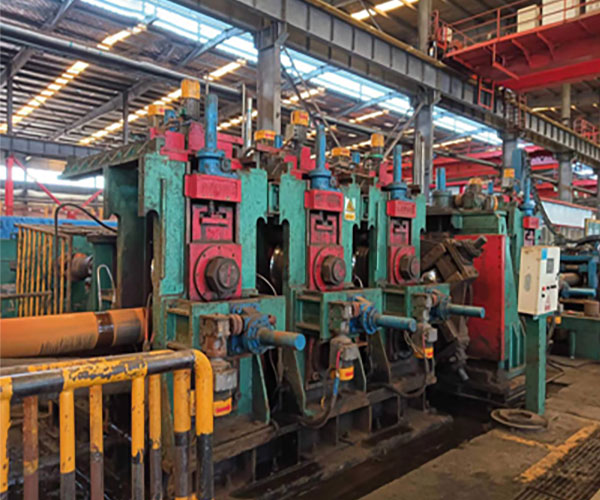
What is the Tube Mill Process?
A Tube Mill is an advanced industrial machine used to manufacture metal pipes and tubes from flat metal strips. It operates through a continuous rolling and welding process, converting raw materials into precise tubular products. Tube mills are widely used across construction, automotive, oil, gas, and furniture industries due to their efficiency and accuracy.
Components of a Tube Mill
A typical tube mill consists of several key components, including a decoiler, leveling machine, roll forming section, welding unit, sizing mill, and cutting system. Each component works in sequence to shape, weld, and cut tubes to the required dimensions, ensuring consistent quality and smooth production flow.
How a Tube Mill Works
The tube mill process begins with a metal coil that is uncoiled, flattened, and formed into a U or V shape by the roll forming section. The edges of the metal are then welded together using high frequency (HF) welding, followed by sizing and straightening before the tubes are cut to the desired length.
Materials Used in Tube Mills
Tube mills can process a variety of materials such as carbon steel, stainless steel, galvanized steel, and aluminum. The choice of material depends on the application requirements, such as corrosion resistance, strength, and surface finish.
Types of Tube Mills
There are several types of tube mills including ERW (Electric Resistance Welding) tube mills, Seamless tube mills, and CNC tube mills. ERW tube mills are the most commonly used for producing lightweight structural tubes with high efficiency and precise dimensions.
Applications of Tubes Produced
Tubes manufactured by tube mills are used in a wide range of industries. Typical applications include structural supports, pipelines, automotive frames, furniture, scaffolding, and industrial equipment, highlighting the versatility and importance of tube mills in modern manufacturing.
Advantages of Using Tube Mills
Tube mills offer numerous advantages such as high production speed, accurate dimensions, consistent quality, and minimal material waste. They are also capable of producing tubes in various diameters, wall thicknesses, and lengths, making them highly adaptable to industrial needs.
Pipe Mill Line
In summary, a tube mill is a critical piece of industrial machinery for manufacturing high-quality metal tubes efficiently. Its ability to process diverse materials with precision and speed makes it an essential tool in multiple sectors. LotosForming provides custom tube mill solutions tailored to meet specific production requirements, ensuring optimal performance and reliability.
FAQ :
The line begins with a metal coil that is uncoiled, leveled, and roll-formed into a U or V shape. The edges are welded using high-frequency (HF) welding, then straightened, sized, and cut to the desired length.
The line begins with a metal coil that is uncoiled, leveled, and roll-formed into a U or V shape. The edges are welded using high Mfrequency (HF) welding, then straightened, sized, and cut to the desired length.
Tube Mill Lines can process carbon steel, stainless steel, galvanized steel, aluminum, and other alloys, depending on the application requirements.
Key components include a decoiler, leveling machine, roll forming section, welding unit, sizing mill, and cutting system, each ensuring smooth and precise production.