

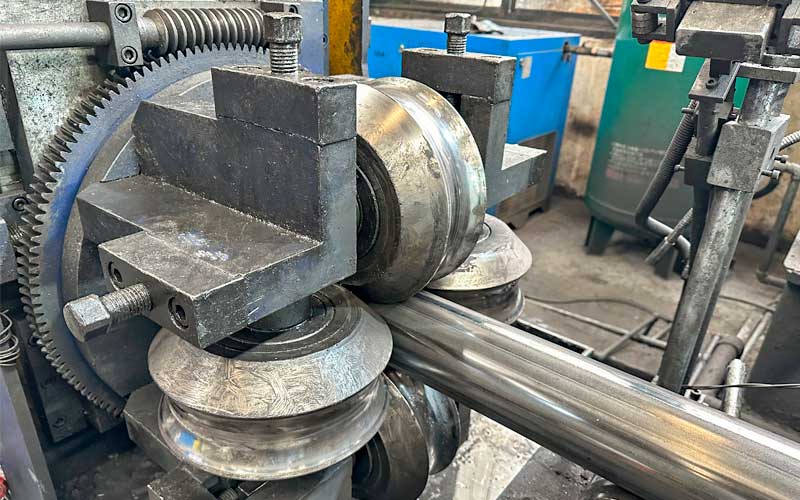
STRAIGHTENING ROLLS FOR WELDED TUBE
Straightening rolls are essential mechanical components used in metal processing and roll forming lines to eliminate residual stresses, coil set, and strip deformation. Their primary function is to improve flatness and dimensional stability of metal strips, sheets, and profiles before or during forming operations. Properly designed straightening rolls play a decisive role in achieving high quality finished products and stable production performance.
Definition of Straightening Rolls
Straightening rolls are a series of precision machined rollers arranged in an alternating upper and lower configuration. As the metal strip passes through these rolls, controlled bending and reverse bending forces are applied to remove curvature, waves, and internal stress caused by previous processes such as coiling, slitting, or welding.
Structural Design and Configuration
Straightening rolls are typically manufactured from high grade alloy steel and undergo heat treatment to ensure wear resistance and long service life. Key design characteristics include:
Precisely ground roll surfaces for uniform contact
Optimized roll diameter and spacing for different material thicknesses
Adjustable upper rolls for accurate straightening force control
Rigid roll frames to maintain alignment under load
The number of straightening rolls varies depending on material thickness, yield strength, and flatness requirements.
Working Principle
The straightening process relies on repeated elastic plastic deformation. As the material is alternately bent above and below its neutral axis, internal stresses are redistributed and minimized. This process results in a flat, stress relieved strip that is suitable for high precision downstream operations such as roll forming, punching, or welding.
Technical Performance Parameters
Key technical parameters that define the effectiveness of straightening rolls include:
Maximum and minimum material thickness capacity
Yield strength range of processable materials
Roll surface hardness and finish
Adjustment accuracy and repeatability
Straightening speed compatibility with production lines
Advanced systems may include motorized adjustment, digital position indicators, and synchronized control with the main line speed.
Applications in Roll Forming Lines
In roll forming lines, straightening rolls are commonly positioned at the entry section to prepare the strip before forming. They are also used after welding in tube mills or before cutting units to ensure dimensional accuracy and prevent profile distortion. Consistent straightening significantly reduces tooling wear and improves overall product quality.
Importance of Proper Straightening
Insufficient or improper straightening can cause profile twisting, uneven forming, poor weld quality, and cutting inaccuracies. High quality straightening rolls ensure stable material feeding, precise profile geometry, and reduced scrap rates, making them a critical element in efficient metal forming operations.
Conclusion
Straightening rolls are a fundamental component of modern roll forming and metal processing lines. Their correct design, adjustment, and integration directly affect product quality, operational stability, and production efficiency. For manufacturers aiming to achieve reliable and high precision forming results, investing in well engineered straightening roll systems is essential.