
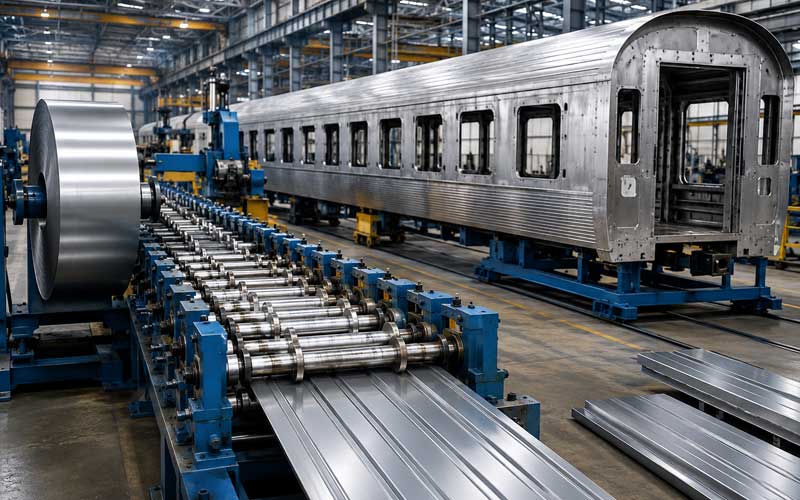
Why Rail Industry Needs Advanced Roll Forming
Railway car bodies (passenger coaches, freight wagons, locomotives, and metro cars) require long, lightweight, high strength structural profiles. Traditional fabrication methods extrusion, press braking, or hot rolling – are either too expensive, too heavy, or too slow. Cold roll forming has emerged as a superior alternative for producing many rail car components.
Roll forming offers:
- Consistent cross-sections over long lengths (up to 25 meters)
- High strength-to weight ratio (ideal for lightweight rail vehicles)
- Lower tooling costs compared to extrusion
- Faster production speeds than press braking
This article covers:
- Key roll formed profiles used in railway car bodies
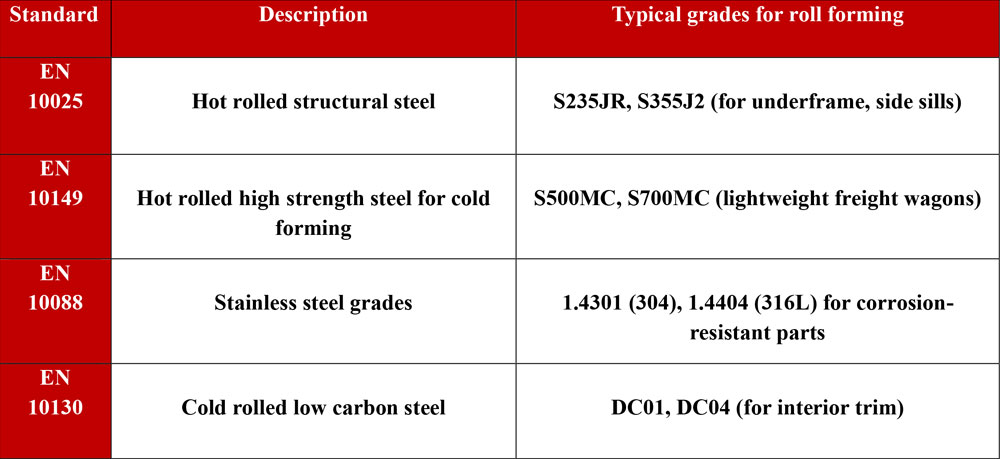
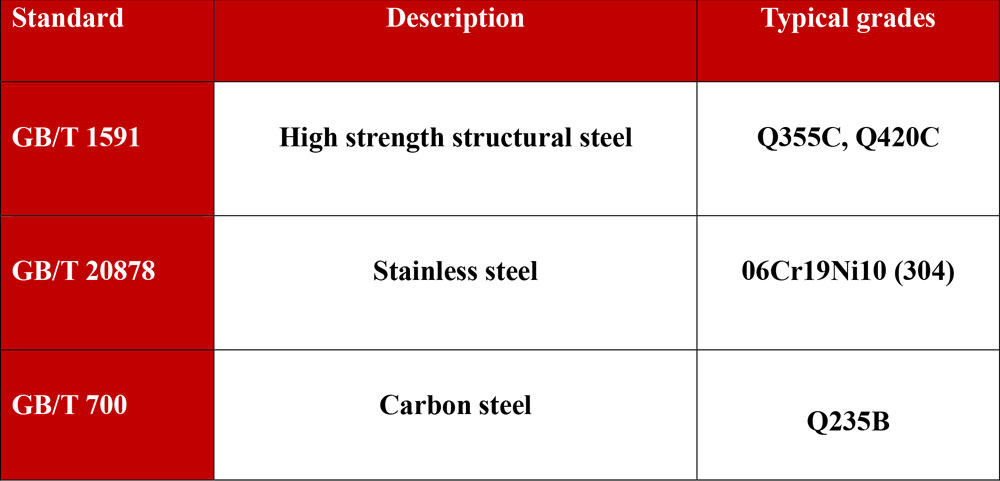
- Material grades and standards for rail applications
- Production standards and certifications (EN 12663, UIC, DIN 5510, etc.)
- Technical requirements for roll forming lines serving the rail industry
- How leading Chinese manufacturers like LOTOS supply rail-grade equipment
By the end, you will understand the specifications and standards needed to produce roll formed components for railway car bodies.
Part 1: Roll Formed Profiles in Railway Car Bodies
Railway car bodies consist of an underframe, side walls, roof, and end walls. Several components are ideal for cold roll forming:
1.1 Side Sills (Lower Side Members)
Function: Longitudinal beams at the bottom of side walls, transferring loads from body to bogies.
Typical cross-section: C-channel, hat channel, or closed box section (sometimes roll formed and seam welded).
Material thickness: 3–8 mm (heavy-duty freight) or 2–4 mm (passenger).
Length: Up to 25 meters (car body length). Roll forming lines must accommodate such lengths with straightening and cutting systems.
1.2 Roof Bows (Cantrails / Roof Sticks)
Function: Transverse arches supporting the roof panel.
Typical cross-section: Z-purlin, sigma channel, or custom curved profile (pre-curved before or after forming).
Material thickness: 1.5–3 mm.
Challenge: Curvature. Some roof bows are straight; others have a slight crown. Roll forming can produce straight profiles, then a secondary bending operation adds curvature.
1.3 Door Frames and Window Frames
Function: Framing for passenger doors, cargo doors, and windows.
Typical cross-section: Hat channel, U-channel, or closed tubular section.
Material thickness: 1.5–2.5 mm (stainless steel or mild steel with coating).
Tolerance: High precision (±0.3 mm) for door sealing and automation.
1.4 Underframe Cross Bearers
Function: Transverse beams supporting the floor.
Typical cross-section: C-channel, I-beam (roll formed from two C-sections welded back-to-back), or rectangular tube.
Material thickness: 3–6 mm high-strength steel.
1.5 Interior Trim Profiles
Function: Trim, seat rails, luggage rack supports, and cable trays inside passenger cars.
Typical cross-section: Small C-channels, U-channels, angle sections.
Material thickness: 0.8–2 mm (often stainless steel or pre-coated).
Aesthetic requirement: Smooth surface, no sharp burrs.
2.1 European Standards (EN)
2.2 Chinese Standards (GB/T)
Part 3: Production Standards and Certifications for Rail Components
Roll formed parts for railway car bodies are not generic – they must comply with safety and quality standards specific to the rail industry.
3.1 EN 12663 (Structural requirements of railway vehicle bodies)
Applies to the structural integrity of car bodies. Roll formed profiles used as primary structural members (side sills, underframe bearers) must meet the strength and fatigue requirements of EN 12663.
Relevant clauses: Static strength, fatigue life, and crashworthiness.
Implication for roll forming: Material must have certified mechanical properties; welding (if profiles are joined) must follow EN 15085.
3.2 EN 15085 (Welding of railway vehicles)
If roll formed profiles are welded together to form larger assemblies, the manufacturer must be certified to EN 15085 (levels CL1 to CL4).
For roll forming lines: Not directly applicable, but buyers may require the roll former to be welded by EN 15085-certified personnel.
3.3 DIN 5510 (Fire protection for railway vehicles) – partially replaced by EN 45545
EN 45545-2 specifies fire behavior of materials. Roll formed profiles must use steel grades and coatings that meet the required hazard level (HL1 to HL3).
Coating considerations: Painted or galvanized profiles may need fire-retardant coatings.
3.4 UIC (International Union of Railways) standards
Various UIC leaflets apply to specific profile dimensions and tolerances. For example, UIC 861-1 covers standard profiles for freight wagons.
3.5 ISO 9001 and IRIS (International Railway Industry Standard)
Many buyers require roll forming suppliers to be IRIS certified (ISO/TS 22163). This ensures quality management specific to rail.
LOTOS can provide roll forming lines that produce profiles meeting these standards, but the end manufacturer (profile producer) must obtain the certifications. LOTOS machines are designed to achieve the required tolerances (typically ±0.5 mm on critical dimensions).
Part 4: Technical Requirements for Roll Forming Lines Serving Rail Industry
Producing rail car profiles demands specific machine capabilities beyond standard construction profiles.
4.1 Long Profile Handling (Up to 25 meters)
Rail car bodies are long. A roll forming line must handle input coils and output profiles up to 25 meters.
Key features:
- Long runout tables (roller conveyors) of 25–30 meters.
- Multiple support stands to prevent sagging and twisting.
- Flying cut-off saw that cuts long lengths precisely (servo-driven for ±1 mm tolerance).
- Automatic stacker for long profiles (bundling without bending).
4.2 High-Strength Material Capability
Rail underframe components often use high-strength steel (S500MC, S700MC, Q420C). The roll forming line must have:
- Higher main motor power (22–37 kW or more).
- More forming stations (24–32 stations) to avoid cracking.
- Hardened rollers (Cr12MoV, HRC 60–62) to resist wear.
- Heavy-duty shafts (material 40Cr or 42CrMo, larger diameters).
4.3 Straightening and Straightness Tolerance
Rail profiles require exceptional straightness – typically ≤1 mm per meter and ≤3 mm total over 20 meters.
Required equipment:
- In-line straightener (multiple small rollers) after the forming mill.
- Post-cut straightening (optional separate straightening press for long profiles).
4.4 Precision Punching (Hole Patterns)
Many rail profiles require holes for bolted connections, riveting, or attachment of interior fittings. A CNC flying punch or servo-driven multi-axis punch is essential.
Typical holes: Round (10–20 mm diameter), slotted (20×30 mm), or custom patterns. Position tolerance ±0.5 mm on long lengths.
4.5 Material Traceability and Documentation
Rail industry demands traceability. The roll forming line should integrate with a production data logging system (MES) to record:
- Coil ID and material certificate number.
- Production date and time.
- Length and quantity produced.
- Quality inspection results.
LOTOS can equip lines with barcode scanners and PLC data export for full traceability.
4.6 Surface Protection (No Scratches)
Roll formed profiles for visible interior applications (trim, seat rails) must be scratch-free. Coated materials (pre-painted, galvanized) are common.
Design considerations:
- Roller surface finish ≤ Ra 0.4 µm (polished).
- Roller material with chrome plating (25–50 µm) to reduce friction.
- Urethane-coated rollers for delicate finishes (optional).
Part 5: Example Profiles and Roll Forming Specifications
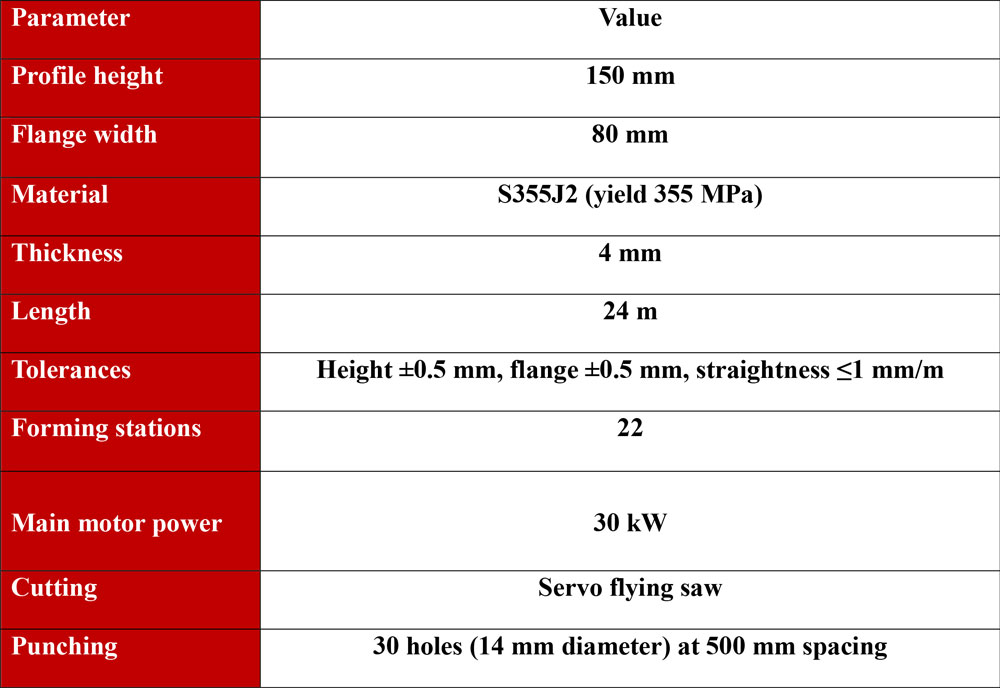
Example 1: Side Sill for Passenger Coach (C-channel, S355J2, 4 mm thick)
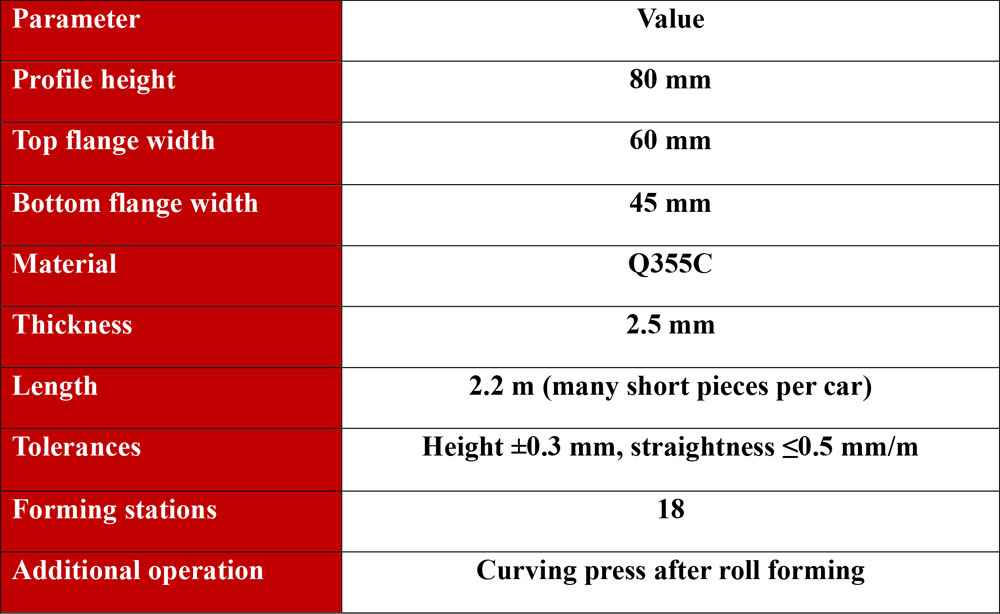
Example 2: Roof Bow for Metro Car (Sigma channel, Q355C, 2.5 mm thick)
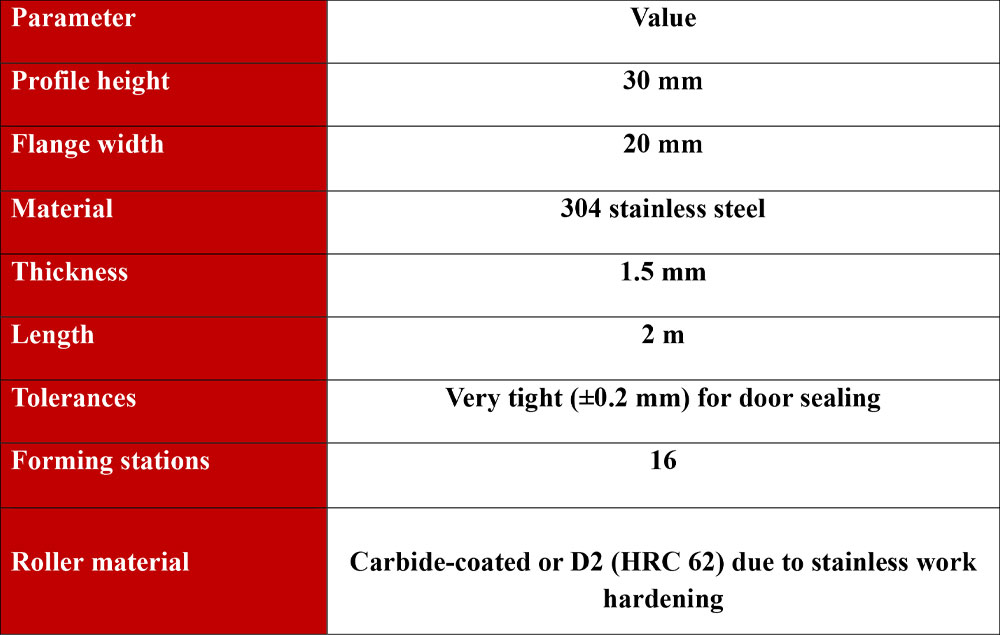
Example 3: Stainless Steel Door Frame (U-channel, 304, 1.5 mm thick)
Part 6: How LOTOS Supports Railway Industry Roll Forming
As a leading Chinese roll forming machine manufacturer, LOTOS has delivered lines for railway car body profiles to customers in Asia, Middle East, and Europe.
6.1 Customization for Rail Applications
LOTOS offers:
- Long-profile handling systems (runout tables up to 30 meters).
- High-strength steel capabilities (up to 700 MPa yield).
- Servo flying cutting with ±1 mm accuracy over 25 meters.
- CNC flying punching for hole patterns along long profiles.
- PLC with recipe storage for quick changeover between different rail profiles.
6.2 Quality Assurance
Each roll forming line from LOTOS undergoes:
- FEA simulation of flower pattern to prevent edge cracking (especially for high-strength steel).
- Roller hardness testing (HRC 58–62).
- Test run at factory using sample material (if provided by customer).
- Straightness verification on long samples.
6.3 Compliance Support
While LOTOS does not certify rail components, the machines are designed to produce profiles that can meet:
- EN 12663 structural requirements (through material choice and forming accuracy).
- EN 15085 welding compatibility (profiles have consistent geometry for welding).
- Dimensional requirements of UIC or customer drawings.
6.4 After-Sales Services
- Installation and commissioning on-site.
- Operator training on production of long profiles and quality control.
- Spare parts (rollers, shafts, cutting blades) available with short lead time.
Conclusion: Roll Forming Is Ready for Rail
The railway industry is increasingly adopting cold roll forming for car body profiles because it offers:
- Lightweight structures (high strength-to-weight)
- Cost-effective long-length production
- Consistent quality and tight tolerances
From side sills to roof bows, from door frames to interior trim, roll formed profiles are replacing extruded and pressed components.
For rail component manufacturers: Investing in a dedicated roll forming line from an experienced supplier like LOTOS gives you a competitive advantage – faster production, lower tooling costs, and the ability to meet demanding standards (EN 12663, etc.).
For rolling stock OEMs: Specifying roll formed profiles reduces weight and cost compared to hot-rolled or extruded alternatives.
LOTOS stands ready to design and build roll forming lines tailored to railway car body production – with long-length handling, high-strength capability, and precision punching.