
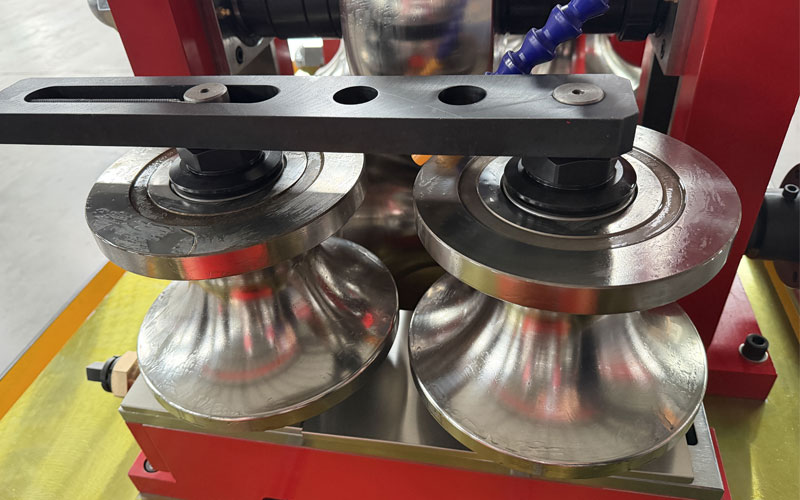
Device for automatic adjustment of roll gap in mill stand
The Most Critical Adjustment on a Tube Mill
In a tube mill (ERW tube mill, API tube mill, or any roll forming line for pipes), the gap between the top and bottom rolls – often called the roll gap – is arguably the most critical adjustment. Too tight, and you crush the strip, overwork the mill, and accelerate roll wear. Too loose, and the strip wanders, the edges fail to meet properly for welding, and the tube comes out oval or undersized.
Getting the roll gap right is not a “set‑once‑and‑forget” task. Material thickness varies, rolls wear, and even temperature changes affect the ideal gap. This article explains:
- What roll gap means in a tube mill context
- Why precise gap setting is essential for weld quality and dimensional accuracy
- How to adjust roll gaps manually (practical steps)
- Advanced automatic gap control systems (closed‑loop, servo‑driven)
- Common defects caused by incorrect gap and how to fix them
- How LOTOS integrates precision gap adjustment into modern tube mills
By the end, you will understand why roll gap adjustment is the foundation of consistent tube production and how to achieve it.
What Is Roll Gap in a Tube Mill?
Definition
The roll gap is the distance between the working surfaces of a pair of forming rolls (top and bottom) at the point where they contact the steel strip. In a typical tube mill, there are multiple roll stands:
- Breakdown section (first 4–8 stands) – gradually forms the flat strip into a round shape.
- Fin section (next 4–8 stands) – closes the strip edges together for welding.
- Sizing section (last 2–4 stands) – calibrates the final outside diameter.
Each stand has its own roll gap setting. The gap in the fin section – where the two edges meet – is the most sensitive because it directly affects weld quality.
Why Gap Is Not Simply “Material Thickness”
A common mistake is to set the roll gap equal to the nominal strip thickness. In reality, the gap must be slightly less than the thickness to create compression – the rolls must squeeze the strip to control its shape and to force the edges together for welding. However, too much compression causes:
- Thinning of the tube wall (reduces strength)
- Increased mill load (motor current spikes)
- Rapid roll wear and scoring
The optimal gap is typically 90–98% of the strip thickness, depending on material grade and mill design. For high‑strength steels, the gap may need to be closer to 100% to avoid over‑working the material.
Why Roll Gap Adjustment Matters Effect on Weld Quality
In ERW tube mills, high‑frequency welding requires that the two edges of the strip meet under controlled pressure. If the roll gap in the fin section is too large, the edges may not touch or may only touch intermittently, causing:
- Lack of fusion – weak weld, leakage in pressure applications.
- Open seams – visible gap along the weld line.
- Inconsistent weld bead – variable penetration.
If the roll gap is too small, the edges are forced together too aggressively, creating:
- Excessive upset (outside flash too large) – more scarfing required.
- Internal flash (I.D. bead) that can restrict flow.
- Cracking in the heat‑affected zone.
Effect on Outside Diameter (OD) and Roundness
The sizing section rolls control the final outside diameter. A gap that is too tight in the sizing stands will produce an undersized tube. A gap that is too loose will produce an oversized, often oval, tube. In API pipe production, OD tolerance can be as tight as ±0.5 mm, so accurate gap setting is mandatory.
Effect on Tool Life
Excessive roll gap compression increases friction and normal force. This accelerates wear on the roll surface, especially on the fin passes where the strip edges contact the roll grooves. Premature wear leads to frequent regrinding or replacement, increasing downtime and cost.
Conversely, too loose a gap causes the strip to “bounce” between rolls, creating impact marks and uneven wear patterns.
Effect on Mill Power Consumption
A mill running with overtight rolls consumes significantly more power. Operators often notice higher motor currents. Over time, this increases electricity costs and stresses the drive system.
Manual Roll Gap Adjustment – Step by Step
Most tube mills still rely on manual gap setting using screw‑down mechanisms or wedge blocks. Here is a practical procedure.
Tools Required
- Feeler gauges (tapered or standard)
- Dial indicator (magnetic base)
- Vernier caliper or micrometer
- Torque wrench (for screw‑down mechanisms with locking nuts)
- Sample strip of the actual material (clean, no oil)
Procedure for a Single Stand
- Clean the rolls – remove any debris, oil, or old lubricant from the roll surfaces.
- Run the mill without strip – set the gap to just touch (zero gap). Use a thin feeler gauge (0.05 mm) to detect contact.
- Back off – open the gap by the desired amount. For breakdown stands, initial setting = nominal strip thickness minus 0.1–0.3 mm. For fin stands, start at 90% of thickness.
- Check with feeler gauge – insert a tapered feeler gauge from both sides. The resistance should be equal left and right. Uneven resistance indicates a roll tilt problem.
- Tighten locking nuts – if your stands have locking hardware, torque to specification.
- Run a test strip – feed a short length and inspect the formed shape, edge alignment, and weld condition. Measure the tube OD at least 5 meters after the weld.
- Fine‑tune – adjust gap by 0.05–0.1 mm increments until dimensions and weld are within spec.
Balancing Top and Bottom Rolls (Paralleling)
If the top roll is not parallel to the bottom roll, the strip will track to one side. To check parallelism:
- Place a dial indicator on the top roll shaft at the drive side and operator side.
- Lower the top roll until it contacts the bottom roll (or a master bar).
- Read the indicator values. The difference should be less than 0.05 mm across the roll face.
Many mills have independent adjustment on each side to correct tilt.
Part 4: Advanced Automatic Gap Control (AGC)
Manual gap setting is operator‑dependent and cannot react to real‑time variations. Modern tube mills – especially those from leading manufacturers like LOTOS – incorporate automatic gap control (AGC) systems.
How AGC Works
An AGC system uses:
- Hydraulic or electric servo actuators on each roll stand.
- Linear position sensors (magnetostrictive or LVDT) that measure the actual gap with 0.01 mm resolution.
- Load cells that measure the forming force.
- A closed‑loop controller (PLC or CNC) that compares the actual gap to the setpoint and adjusts the actuator.
The operator enters the target gap or the target tube OD. The AGC system then maintains that gap despite material thickness variations, roll wear, or temperature drift.
Benefits of AGC
- Consistent weld quality – the fin stand gap stays within ±0.02 mm.
- Reduced scrap – less time wasted on manual adjustments.
- Faster changeovers – recall stored gap settings for each product (recipe).
- Remote monitoring – the control system logs gap trends and can alert if something drifts.
- Lower operator skill requirement – the system handles the fine adjustments.
LOTOS AGC Implementation
LOTOS tube mills can be equipped with:
- Servo‑motor driven screw‑downs with absolute encoders (for cost‑sensitive applications).
- Hydraulic gap control with proportional valves and position feedback (for high‑speed or heavy‑gauge mills).
- Integrated weld box where the fin stand gap is automatically adjusted based on weld power or edge alignment sensors.
LOTOS also offers a recipe management system that stores gap settings for up to 500 different tube sizes. Changeover from 60 mm to 76 mm is done by recalling a recipe – the system moves all stands to the correct gaps automatically.
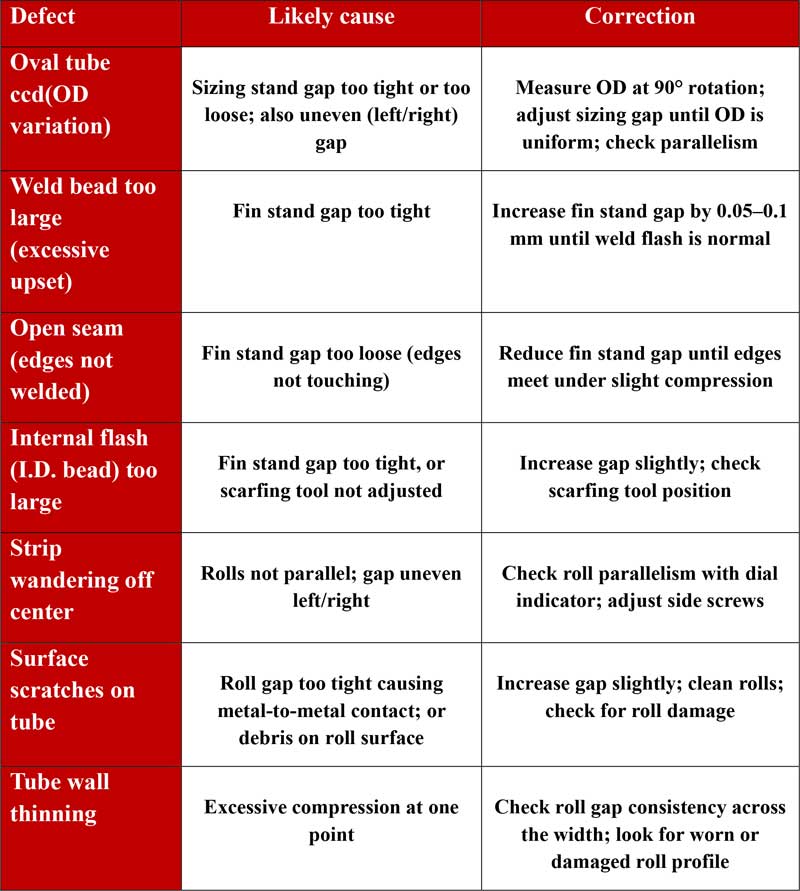
Common Defects Caused by Incorrect Roll Gap and How to Fix Them
Practical Tips from LOTOS Engineers
Start with the Fin Stand
The fin stand (where the strip edges first come together) is the most critical. Set it first, then adjust upstream breakdown stands to deliver a well‑shaped strip to the fin section. Downstream sizing stands should only correct minor deviations – they cannot fix a bad shape from the fin.
Use the “Paper Pull” Method
For a quick check of roll gap uniformity, place a strip of paper (or thin plastic) between the rolls. Tighten until the paper can just be pulled with moderate resistance. If the paper pulls easier on one side, the rolls are not parallel.
Keep a Gap Log
Record the gap settings for each product and each stand. Over time, you will notice that gaps need to decrease slightly as rolls wear. A log helps predict when rolls need regrinding.
Never Assume “Default” Thickness
Actual strip thickness can vary by ±5% from the nominal value. Always measure the incoming strip with a micrometer and adjust your gap settings accordingly. LOTOS lines with AGC do this automatically via an upstream thickness gauge.
Watch the Motor Currents
A sudden increase in main motor current often indicates a roll gap that is too tight. Conversely, erratic current can mean a loose gap causing strip flutter. Modern PLCs can alert operators when current deviates from normal.
How LOTOS Ensures Precision Roll Gap Adjustment
At LOTOS, we design tube mills with roll gap adjustment as a core feature – not an afterthought.
Robust Mechanical Design
- Heavy‑duty screw‑down mechanisms with anti‑backlash nuts.
- Hardened and ground roll shafts (40Cr or 42CrMo) to maintain parallelism.
- Tapered roller bearings that handle both radial and axial loads.
Easy‑Access Indicators
Every LOTOS tube mill comes with:
- Graduated dials showing gap in 0.01 mm increments.
- Separate left/right adjustment for each stand (for quick paralleling).
- Locking system that holds the setting even under heavy vibration.
Optional Automatic Gap Control (AGC)
For customers requiring high precision or frequent changeovers, LOTOS offers:
- Servo‑electric gap control with recipe storage.
- Hydraulic gap control for large mills (above 100 mm tube OD).
- Closed‑loop OD feedback – a laser micrometer measures tube OD and automatically adjusts the sizing stand gaps.
Training and Support
LOTOS provides on‑site training for operators covering:
- How to set roll gaps manually (for backup).
- How to use the AGC system and recipe manager.
- Troubleshooting gap‑related defects.
Conclusion: Small Gap, Big Impact
Roll gap adjustment may seem like a minor detail, but it directly controls weld integrity, tube dimensions, tool life, and energy consumption. A mill with poorly set gaps will never produce consistent quality, no matter how expensive the forming rolls or welding system.
Mastering roll gap adjustment requires understanding the material, the mill dynamics, and a disciplined procedure. For those who want to eliminate guesswork, automatic gap control (AGC) is the answer.
LOTOS builds tube mills with precision gap adjustment – from reliable manual systems to fully automatic closed‑loop control. Whether you produce standard pipes or API‑grade tubes, we ensure your roll gaps are set correctly, every time.
FAQ:
No. Only use feeler gauges when the mill is stopped and the rolls are clean. For dynamic adjustment during production, rely on AGC or experienced operators using OD feedback.
Assuming the top and bottom rolls are parallel. Always verify with a dial indicator or the paper pull method.
Check at every tooling change and after any line stoppage longer than 2 hours. With AGC, the system monitors continuously.
No. High‑strength steels (e.g., API X65) require less compression than mild steel because they work‑harden faster. Start with a wider gap and reduce gradually.