
What Is Load Matching?
Load Matching in HF Welding Machines is one of the most critical technologies in modern ERW tube mill production lines. It ensures efficient power transfer from the high-frequency generator to the welding point, maximizing welding quality while minimizing energy loss. Whether the welding system uses solid state IGBT, MOSFET, or vacuum tube technology, an effective load matching system is essential for achieving stable and reliable welds.
At LOTOSFORMING, we understand that optimized HF welding performance depends not only on the generator but also on the efficiency of the load matching circuit.
Why the correct matching of high frequency welding machine
Load matching is the process of adjusting the electrical impedance between the high frequency (HF) welder and the welding load so that maximum power is transferred to the weld seam.
In an HF welding system, the electrical characteristics of the load continuously change due to variations in:
- Tube diameter
- Wall thickness
- Steel grade
- Production speed
- Coil positioning
- Impeder condition
- Temperature
Without proper impedance matching, a significant portion of the generated power is reflected back toward the power supply instead of reaching the weld point.
Why Is Load Matching Important?
A properly matched HF welding system provides several advantages:
- Maximum welding efficiency
- Stable welding temperature
- Lower power consumption
- Reduced reflected power
- Improved weld quality
- Longer equipment lifespan
- Higher production speed
- Reduced maintenance costs
Poor load matching can result in overheating, unstable welding, excessive current, and frequent machine alarms.
Working Principle of Load Matching
The HF generator produces electrical energy at frequencies typically ranging from 100 kHz to 500 kHz.
This energy passes through the load matching circuit before reaching the induction coil or contact welding assembly.
The load matching unit adjusts the circuit impedance using capacitors and inductors until resonance is achieved.
At resonance:
- Power transfer reaches its highest efficiency.
- Reactive power is minimized.
- Current flows efficiently into the welding zone.
- Generator stress is significantly reduced.
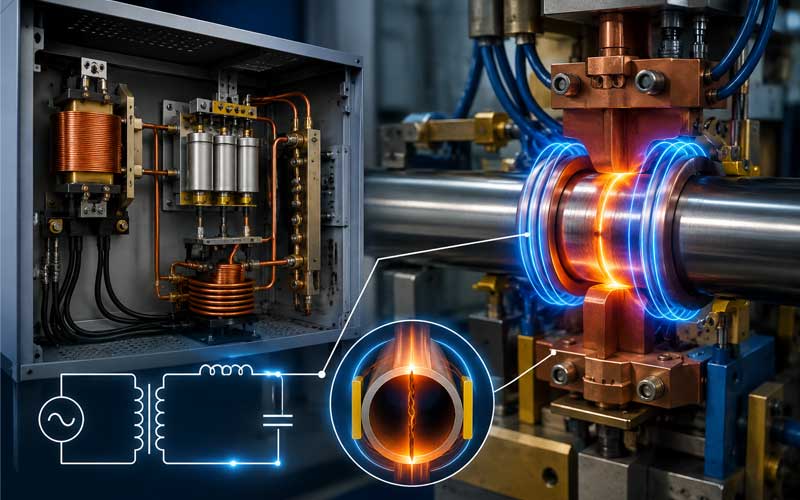
Basic Load Matching Circuit
A typical HF welding load matching system consists of:
- HF Generator
- Matching Transformer
- Capacitor Bank
- Matching Inductor
- Output Bus Bars
- Induction Coil or Contact Tips
- Impeder
- Tube Vee Section
Together, these components create a resonant circuit capable of delivering concentrated heating directly to the tube edges.
Main Components of a Load Matching System
1. Matching Transformer
The matching transformer adjusts voltage and current levels between the HF generator and the welding load.
Its functions include:
- Voltage transformation
- Current balancing
- Impedance adaptation
- Electrical isolation
2. Matching Capacitors
Capacitors compensate for inductive reactance within the welding circuit.
Their benefits include:
- Resonance tuning
- Improved power factor
- Reduced reactive losses
- Stable output voltage
3. Matching Inductor
The inductor works together with the capacitor bank to create resonance.
Proper inductance allows:
- Smooth current flow
- Stable welding power
- Efficient energy transfer
4. Automatic Tuning Mechanism
Modern HF welders often include servo controlled automatic tuning systems.
The controller continuously monitors:
- Output current
- Output voltage
- Reflected power
- Generator frequency
It automatically adjusts the matching network whenever production conditions change.
Factors Affecting Load Matching
Several production variables influence impedance during welding.
Tube Diameter
Larger tubes require different current distribution compared to smaller tubes.
Wall Thickness
Thicker materials absorb more energy and require higher welding power.
Material Grade
Carbon steel, stainless steel, and high strength steel all exhibit different electrical characteristics.
Welding Speed
As production speed increases, the required welding power also changes.
Induction Coil Position
Incorrect coil positioning alters the inductance of the welding circuit.
Impeder Condition
A worn or damaged impeder reduces magnetic concentration and negatively affects matching performance.
Common Symptoms of Poor Load Matching
Operators may observe the following issues:
- Excessive reflected power
- Generator overload alarms
- High output current
- Low welding efficiency
- Poor weld penetration
- Tube seam defects
- Coil overheating
- Contact tip wear
- Increased energy consumption
Ignoring these symptoms may eventually damage expensive HF welding components.
Load Matching and Resonance
HF welding systems are designed to operate near electrical resonance.
When resonance is achieved:
- Current reaches maximum value.
- Voltage remains stable.
- Power transfer becomes highly efficient.
- Heat is concentrated precisely at the V-point.
If resonance shifts due to production changes, the load matching circuit compensates automatically in modern systems.
Load Matching in ERW Tube Mills
In ERW tube mill production, load conditions constantly change when manufacturers switch:
- Tube sizes
- Material thicknesses
- Steel grades
- Production speeds
Automatic load matching enables rapid adaptation without lengthy manual adjustments.
This increases:
- Production uptime
- Product consistency
- Weld strength
- Machine reliability
Benefits of Automatic Load Matching
Modern automatic matching technology offers significant advantages:
- Maximum generator efficiency
- Lower electricity consumption
- Improved weld consistency
- Reduced operator intervention
- Faster product changeover
- Longer service life of HF components
- Lower maintenance costs
- Stable production under varying conditions
Maintenance Tips
To maintain optimal matching performance:
- Inspect capacitor banks regularly.
- Check bus bar connections.
- Monitor transformer temperature.
- Clean induction coils frequently.
- Replace worn contact tips.
- Verify impeder condition.
- Tighten electrical terminals.
- Inspect cooling water flow.
- Calibrate automatic tuning systems periodically.
Preventive maintenance ensures long term system stability and minimizes unexpected downtime.
Why Choose LOTOSFORMING HF Welding Solutions?
LOTOSFORMING provides advanced ERW Tube Mill solutions equipped with high-performance HF welding technology designed for maximum efficiency and reliability.
Our systems feature:
- Intelligent load matching technology
- Stable high-frequency power output
- High-speed tube production
- Low energy consumption
- Reliable automatic tuning
- Durable electrical components
- Comprehensive after-sales technical support
With years of experience in tube mill manufacturing, LOTOSFORMING delivers complete production solutions that help customers achieve superior weld quality, improved productivity, and lower operating costs.
Conclusion
Load matching is the foundation of efficient HF welding machines. By continuously optimizing the electrical relationship between the generator and the welding load, it ensures maximum energy transfer, stable welding conditions, and consistent tube quality. As production demands continue to increase, automatic load matching systems have become indispensable for modern ERW tube mills, enabling manufacturers to improve productivity, reduce energy consumption, and extend equipment life. Investing in an advanced load matching system is a key step toward achieving reliable, high quality tube production.
FAQ:
Improper Load Matching may cause:
- High reflected power
- Generator overload alarms
- Poor weld penetration
- Increased power consumption
- Overheating of components
- Shortened equipment life
- Inconsistent weld quality
A Load Matching system continuously adjusts the impedance of the welding circuit using capacitors, inductors, and transformers. Modern HF welders automatically tune the circuit to maintain resonance, ensuring efficient energy transfer to the weld seam.
Proper Load Matching ensures:
- Maximum power transfer
- Stable welding performance
- Lower energy consumption
- Reduced reflected power
- Improved weld strength
- Longer service life of HF welding components
Without proper matching, welding quality and machine efficiency can decline significantly.
Routine maintenance should include checking capacitor banks, transformers, bus bar connections, cooling systems, induction coils, contact tips, and impeders. Preventive inspections help maintain stable welding performance and extend equipment life.