
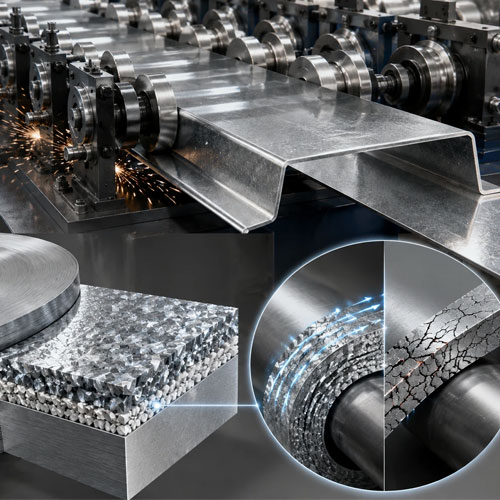
Why Coating Choice Matters in Roll Forming
Roll forming is a cold forming process that pushes steel strip through a series of rollers to create long profiles. The interaction between the strip’s surface and the roller surface determines not only the quality of the finished profile but also the longevity of the tooling. When the strip is coated with zinc (Zn), aluminum-zinc (Al-Zn), or zinc-aluminum-magnesium (ZAM) – the coating fundamentally changes the tribology of the process.
Choosing the wrong coating for your roll forming line can lead to:
- Accelerated roller wear (short tool life)
- Galling (material transfer from strip to roller)
- Surface defects on the finished profile (scratches, flaking, dullness)
- Higher energy consumption due to increased friction
- Frequent line stops for roller cleaning or replacement
This article explains how three common metallic coatings – Zn (traditional galvanized), Al-Zn (Galvalume), and ZAM (zinc‑aluminum‑magnesium) – behave during roll forming. It also provides practical recommendations for tooling materials, lubrication, and machine settings to minimize wear and maximize profile quality.
Part 1: Overview of the Three Coating Types
Before discussing their effects on roll forming, it is useful to understand what each coating is and where it is typically used.
Zn coating (galvanized) – Pure zinc applied by hot‑dip galvanizing. Thickness typically 20–275 g/m² (Z100 to Z450). Common in construction, HVAC, and general fabrication. Offers good corrosion protection at low cost but has a relatively soft, ductile surface that can be sticky under pressure.
Al-Zn coating (Galvalume) – Approximately 55% aluminum, 43.5% zinc, and 1.5% silicon. Marketed as Galvalume or similar. Thickness usually AZ50 to AZ200. Provides superior corrosion resistance to pure zinc, especially in marine and industrial environments. The surface is harder and more slippery than pure zinc, but the coating is more brittle.
ZAM coating (zinc‑aluminum‑magnesium) – A newer alloy with roughly 88–95% zinc, 5–11% aluminum, and 1–3% magnesium. Also called ZAM, SuperDyma, or similar. Thickness typically 50–200 g/m². Offers excellent corrosion protection (better than both Zn and Al-Zn in salt spray tests) and unique self‑healing properties at cut edges. The surface is hard, smooth, and very resistant to galling.
Part 2: How Coatings Affect Roll Forming Behavior
The behavior of a coated strip during roll forming is governed by three main factors: friction coefficient, galling tendency, and coating adhesion.
2.1 Friction Coefficient
Friction between the strip and the forming rollers affects forming forces, energy consumption, and the risk of surface marking.
- Zn coating – Relatively high and variable friction. The soft zinc can deform locally and create micro‑welds with the roller surface, leading to stick‑slip behavior. Friction coefficient typically 0.20–0.35 depending on surface finish and lubrication.
- Al-Zn coating – Lower friction than pure zinc because of the harder, more slippery aluminum phase. Typical coefficient 0.15–0.25. However, if the coating cracks (due to its brittleness), exposed steel can increase friction locally.
- ZAM coating – Lowest friction among the three. The magnesium‑rich surface provides excellent lubricity. Coefficient often 0.10–0.20, even without additional lubrication. This reduces forming forces and energy consumption.
2.2 Galling Tendency
Galling occurs when particles of the coating transfer to the roller surface, then stick to subsequent strip, creating scratches and build‑up.
- Zn coating – High galling tendency, especially at high contact pressures and speeds. Zinc is soft and adhesive. Without proper lubrication, zinc will quickly build up on rollers, causing surface defects.
- Al-Zn coating – Moderate galling tendency. The hard aluminum phase reduces adhesion, but if the coating cracks, the exposed steel can cause severe galling.
- ZAM coating – Very low galling tendency. The magnesium content forms a stable oxide layer that prevents adhesion. ZAM is often chosen specifically to reduce tool wear and eliminate galling in difficult roll forming applications.
2.3 Coating Adhesion and Cracking
During bending, the coating must stretch or compress without detaching from the steel substrate.
- Zn coating – Excellent ductility. It can elongate 30–40% without cracking. Ideal for tight bend radii.
- Al-Zn coating – More brittle. Cracks may appear at bends with R/t ratio below 3–4. These cracks expose the steel substrate to corrosion, but they do not usually flake off during roll forming.
- ZAM coating – Good ductility, better than Al-Zn but slightly less than pure zinc. Typical safe bend radius R/t = 2–3. Cracks are fine and do not propagate.
Part 3: Effect on Tool Wear
Tool wear is a major cost factor in roll forming lines. Coating type directly influences how fast rollers wear out.
3.1 Abrasive Wear
Hard coatings can act like abrasives if they contain hard phases or if the coating delaminates and becomes trapped between strip and roller.
- Zn coating – Low abrasive wear. The soft zinc does not scratch hardened steel rollers (HRC 58–62). However, zinc build‑up causes adhesive wear, which is different from abrasion.
- Al-Zn coating – Moderate abrasive wear due to hard aluminum‑silicon phases. Over long production runs, rollers may show fine polishing or micro‑abrasion.
- ZAM coating – Very low abrasive wear. The magnesium‑rich surface is self‑lubricating and does not abrade roller steel.
3.2 Adhesive Wear and Roller Build‑up
Adhesive wear (galling) is the bigger problem for Zn coatings. Zinc transfers to the roller, builds up, and then marks the strip. This build‑up must be removed by polishing or replacing rollers.
- Zn coating – High adhesive wear. Regular roller cleaning (every 50–200 hours of production) is needed.
- Al-Zn coating – Low to moderate adhesive wear. May require occasional cleaning.
- ZAM coating – Negligible adhesive wear. Rollers stay clean for thousands of hours.
3.3 Roller Material Selection for Each Coating
To extend tool life, match the roller material and coating to the strip coating.
- For Zn coating – Use standard Cr12 or Cr12MoV rollers (HRC 58–60) with chrome plating (25–50 µm). Avoid uncoated rollers. Lubrication is essential.
- For Al-Zn coating – Use harder rollers (HRC 60–62) with PVD coating (TiN, CrN) to resist abrasion. Chrome plating also works but may wear faster.
- For ZAM coating – Standard hardened rollers (HRC 58–60) are usually sufficient. Chrome plating is optional. ZAM is the most tool‑friendly coating.
Part 4: Practical Recommendations for Roll Forming Each Coating
Based on the above, here are practical guidelines for running each coating type on a roll forming line.
4.1 Zn (Galvanized)
Lubrication – Essential. Use a low‑viscosity roll forming oil or emulsion. Without lubrication, galling will occur within minutes.
Roller finish – Polished (Ra ≤ 0.2 µm) to reduce adhesion. Chrome plating strongly recommended.
Bend radii – No restriction; Zn can handle very tight radii (R/t as low as 1.5).
Line speed – Can run at high speed (30–60 m/min) with proper lubrication.
Cleaning schedule – Clean rollers every 8 hours of production. Use a soft brass brush or plastic scraper to remove zinc build‑up.
Common issues – White rust if lubricant is not removed after forming; galling if lubrication fails.
4.2 Al-Zn (Galvalume)
Lubrication – Recommended but less critical than for Zn. A light oil or dry film lubricant works well.
Roller finish – Polished (Ra ≤ 0.2 µm). Chrome plating or PVD coating extends roller life.
Bend radii – Avoid sharp bends. Minimum R/t = 3–4 to prevent coating cracks. If cracks are acceptable, R/t = 2 may be used.
Line speed – 20–40 m/min to reduce abrasive wear.
Cleaning schedule – Clean rollers weekly (or every 200 hours) depending on production volume.
Common issues – Cracking at bends (cosmetic only, but may reduce corrosion life); abrasive wear on rollers over long runs.
4.3 ZAM
Lubrication – Optional. Many ZAM lines run dry. If lubrication is used, a small amount of dry film lubricant further reduces wear.
Roller finish – Standard polished (Ra ≤ 0.4 µm) is fine. Chrome plating not required but can be added for extra safety.
Bend radii – Minimum R/t = 2–3. Good for most profiles.
Line speed – Can run at high speed (up to 60 m/min) without issues.
Cleaning schedule – Rollers stay clean. Clean only during routine maintenance (monthly).
Common issues – Almost none. ZAM is the most roll forming friendly coating available today.
Part 5: How LOTOS Designs Roll Forming Lines for Different Coatings
As a leading Chinese roll forming machine manufacturer, LOTOS tailors each line to the coating type specified by the customer.
5.1 Custom Roller Finishes and Coatings
LOTOS offers three levels of roller surface treatment:
- Standard polished (Ra 0.4 µm) – For bare steel or ZAM.
- Chrome plated (25 µm) + polished (Ra 0.2 µm) – For Zn and Al‑Zn.
- PVD coated (TiN or CrN) + mirror polish – For high‑volume Al‑Zn or abrasive applications.
5.2 Lubrication Systems
- For Zn coatings, LOTOS integrates a spray lubrication system that applies oil evenly across the strip before the forming mill. The system includes recirculation and filtration.
- For Al-Zn, a dry film lubricant system (wax or polymer-based) is recommended.
- For ZAM, no lubricant is required, but an optional dry lubricant unit can be added.
5.3 Roller Cleaning Access
LOTOS designs the forming mill with easy access to each roller pair. Quick release covers and hinged guards allow operators to clean rollers without dismantling the machine.
5.4 Testing Before Shipment
When a customer specifies a coating type, LOTOS can run a test using sample material supplied by the customer. The test confirms:
- No galling occurs at the intended speed.
- Coating adhesion remains intact after forming.
- Roller wear after a defined production run is within acceptable limits.
Part 6: Economic Comparison – Coating Cost vs. Tool Wear Cost
Many buyers focus only on the purchase price of coated steel, ignoring the impact on tool life and line uptime. Here is a simplified comparison for a medium‑volume production line running 2000 hours per year.
Zn coating – Low material cost (baseline). But requires frequent roller cleaning (every 8 hours), which costs labor and downtime. Roller re‑polishing or replacement needed every 6–12 months. Lubricant cost is significant.
Al-Zn coating – Material cost about 10–20% higher than Zn. However, cleaning is only weekly, and roller life is longer (12–24 months). Lubrication cost is lower.
ZAM coating – Material cost about 20–30% higher than Zn. But no lubrication needed, no cleaning downtime, and roller life extends to 3–5 years. The total cost of ownership (TCO) often makes ZAM the cheapest when tool wear and downtime are included.
For high speed lines or expensive roller sets (e.g., large‑diameter or PVD‑coated rollers), choosing ZAM can save tens of thousands of dollars per year in tooling and maintenance.
Choose the Right Coating for Your Roll Forming Operation
Zn, Al‑Zn, and ZAM coatings each have distinct behaviors in roll forming. Zn is cheap but tool‑unfriendly, requiring frequent cleaning and lubrication. Al‑Zn offers a balance of corrosion resistance and reasonable tool wear, but it is brittle. ZAM is the premium choice – lowest friction, negligible galling, longest tool life, and no lubrication needed. Its higher material cost is quickly offset by lower maintenance and higher uptime.
When you purchase a roll forming line from LOTOS, you can specify the coating type up front. LOTOS will recommend the optimal roller material, surface finish, coating, and lubrication system. The result is longer tool life, better profile quality, and lower total cost of ownership.
Don’t let coating choice be an afterthought. Plan it early and enjoy trouble‑free roll forming.
FAQ :
ZAM welds similarly to galvanized steel. Magnesium may produce more spatter, but standard MIG or spot welding works. The coating has excellent edge corrosion protection, which is a major advantage.
Yes. LOTOS can replace rollers with chrome‑plated or PVD‑coated ones, add lubrication if needed, and adjust the straightener settings for the different material properties. Most retrofits are completed in one week on‑site.
ZAM offers the highest corrosion resistance, especially at cut edges. Al-Zn is also very good. Zn (galvanized) is acceptable for dry climates but may rust at cut edges in humid or coastal areas.