
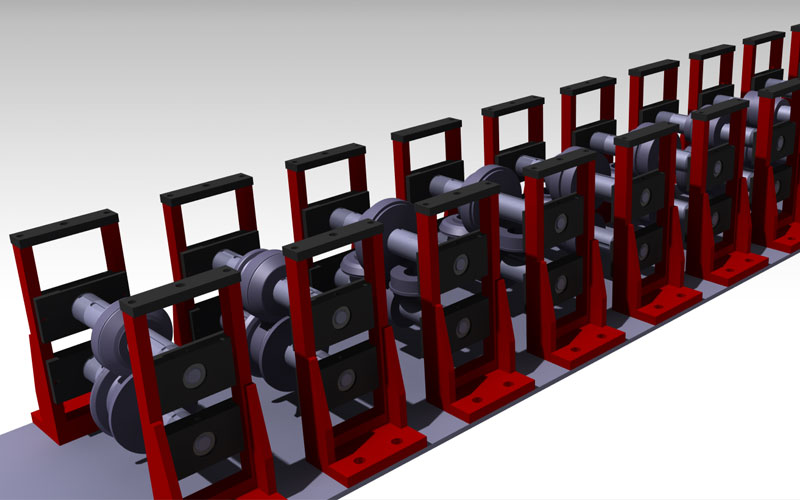
Roll Forming Advanced High Strength Steels (AHSS)
Roll forming Advanced High Strength Steels (AHSS) comes with challenges like springback, edge cracking, and high tool wear. This article presents proven solutions for DP, TRIP, and Martensitic steels, and shows how leading Chinese roll forming manufacturers like LOTOS master AHSS.
What Are Advanced High Strength Steels (AHSS)?
AHSS are steels with complex microstructures achieved through controlled cooling and alloying. Unlike conventional high strength steels (HSS) that rely on solid solution or precipitation hardening, AHSS uses multiphase structures (ferrite, martensite, bainite, retained austenite) to achieve high strength with reasonable formability.
1.1 Common AHSS Grades for Roll Forming
The following are common AHSS grades, their mechanical properties, and typical applications:
- DP450 / DP500: Yield strength 450–550 MPa, tensile strength 500–700 MPa, elongation 20–25%. Used for structural parts and chassis.
- DP600: Yield 600–700 MPa, tensile 700–850 MPa, elongation 15–20%. Used for bumpers, side sills, and rails.
- DP800: Yield 800–900 MPa, tensile 900–1100 MPa, elongation 10–15%. Used for crash boxes and door beams.
- DP1000: Yield 1000–1200 MPa, tensile 1200–1400 MPa, elongation 5–10%. Used for reinforcements.
- TRIP700: Yield 700–800 MPa, tensile 800–900 MPa, elongation 20–30%. Used for complex shapes and energy absorption.
- MS1180 (Martensitic): Yield 1100–1300 MPa, tensile 1300–1600 MPa, elongation 3–5%. Used for ultra-high-strength beams.
- CP800: Yield 800–900 MPa, tensile 900–1100 MPa, elongation 10–15%. Used for edge stretch applications.
1.2 Why AHSS Is Attractive for Roll Forming
- Weight reduction: Up to 30–40% thinner than mild steel for the same load capacity.
- Crash performance: Higher energy absorption, especially with TRIP steels.
- Fatigue resistance: Better than conventional steels.
- Cost efficiency: Lighter structures reduce shipping and support costs.
However, the same properties that make AHSS strong also make it challenging to form.
Part 2: Key Mechanical Properties That Affect Roll Forming
To understand the challenges, you must understand how AHSS behaves differently from mild steel.
2.1 High Yield Strength → High Springback
Springback is proportional to yield strength divided by elastic modulus (σᵧ/E). Since AHSS has σᵧ two to five times higher than mild steel, springback increases dramatically.
Typical springback for a 90° bend:
- Mild steel (250 MPa): 0.5–1.0°
- DP600 (600 MPa): 1.5–2.5°
- DP800 (800 MPa): 2.5–4.0°
- MS1180 (1200 MPa): 5.0–7.0°
2.2 Low Uniform Elongation → Edge Cracking Risk
AHSS grades have lower total and uniform elongation. DP600 elongates about 15–20% versus mild steel’s 25–30%. DP800 drops to 10–15%, and MS1180 only 3–5%. This means the material cannot stretch as much before cracking. The outer fiber of a bend experiences strain. If that strain exceeds the material’s forming limit, edge cracking occurs.
2.3 High Work Hardening Rate
AHSS hardens rapidly during forming. The material becomes stronger and less ductile after each bend. This affects roll pass design: later stations experience higher forces, and the risk of cracking increases progressively.
2.4 High Forces → Machine Rigidity and Power Requirements
Forming AHSS requires significantly higher tonnage per station. A roll forming line designed for mild steel (250 MPa) will be underpowered and insufficiently rigid for DP800 (800 MPa). Expect:
- Higher main motor power (two to three times).
- Heavier shafts and bearings.
- Thicker frame plates.
- More forming stations to spread the load.
2.5 Rapid Tool Wear
AHSS is abrasive. The hard microstructures (martensite, bainite) wear down standard rollers quickly. Signs include loss of profile accuracy, increased surface marks, and frequent roller replacement.
Part 3: Specific Challenges in Roll Forming AHSS
3.1 Challenge 1: Excessive Springback
Uncompensated springback leads to open flanges, incorrect profile angles, and assembly issues. For complex profiles with multiple bends, springback interacts nonlinearly. For example, a C-channel made of DP800 may have both flanges spring back three to four degrees. If the roll pass does not over‑bend, the flanges will measure 86–87° instead of 90°.
3.2 Challenge 2: Edge Cracking
Cracks appear along the outer edge of bends, especially at tight radii. This is the most visible and costly defect. Higher‑strength grades (DP800, DP1000, Martensitic) are most susceptible. The cause is bending strain at the outer fiber exceeding the material’s uniform elongation. Thin materials with small bend radii are worst.
3.3 Challenge 3: Twist and Bow
Asymmetric springback causes the profile to twist along its length. This is especially problematic for open sections like C‑channels and Z‑purlins made from AHSS. A twisted profile cannot be used in automated assembly lines.
3.4 Challenge 4: Tool Wear and Galling
Hard AHSS particles can adhere to roller surfaces (galling), creating scratch marks on subsequent parts. Rollers may need frequent re‑polishing or replacement.
3.5 Challenge 5: Straightening Difficulty
Even after forming, AHSS profiles retain high residual stresses. Conventional straightening with a small roller leveler may not be sufficient. Some applications require post form straightening presses or thermal stress relief.
3.6 Challenge 6: Welding (if profiles are welded after forming)
AHSS has different weldability characteristics. For roll formed profiles that are later welded (e.g., into closed sections), the welding process must be carefully controlled to avoid softening or cracking.
Part 4: Solutions for Roll Forming AHSS
Here are proven techniques to successfully roll form AHSS, organized by category.
4.1 Material Preparation and Selection
- Choose AHSS grades with higher elongation (e.g., TRIP over DP for complex shapes) because more ductile means less cracking.
- Use pickled and oiled (P&O) surface; a clean surface reduces friction and tool wear.
- Pre‑slit edges with minimal burrs, because burrs act as crack initiators.
- Consider edge conditioning (deburring or rounding) to remove stress raisers.
- Warm forming (heating the strip to 100–200°C) increases ductility and reduces springback, though it is rare in roll forming.
4.2 Roll Pass Design Optimization
- Increase the number of forming stations – 30–40% more than for mild steel – to reduce strain per station.
- Use larger bend radii – minimum R/t of 3 to 5 (versus 1.5–2 for mild steel) to lower peak tensile strain.
- Apply bend sequence carefully – for asymmetric profiles, bend the side with the larger radius first to balance forces and reduce twist.
- Add pre‑forming stations that shape the edge region gradually to prevent edge cracking.
- Over‑bend aggressively – use FEA to predict springback, then add 2–5° of over‑bend to compensate.
- Include multiple sizing stations – two to four calibration stations after the final bend to correct springback variation.
- Use FEA simulation – mandatory for AHSS; analytical methods are unreliable.
4.3 Tooling (Rollers) Upgrades
- Harder roller material – use Cr12MoV, D2, or PM‑grade tool steel to resist wear.
- Higher hardness – HRC 60–62 (versus 58–60 for mild steel) for longer tool life.
- Chrome plating (25–50 µm thickness) or PVD coating (TiN, TiAlN, CrN) to reduce friction and galling.
- Polished surface finish (Ra ≤ 0.2 µm) to minimize marking.
- Larger roller diameters to reduce contact pressure.
- Tungsten carbide rollers for extreme wear applications (very high cost) provide maximum wear resistance.
4.4 Machine Upgrades for AHSS
A roll forming line for AHSS must be significantly more robust than a standard line. Compare:
- Main motor power: mild steel line 15–22 kW, AHSS line 30–55 kW.
- Shaft material: 45# steel for mild steel, 40Cr or 42CrMo for AHSS.
- Shaft diameter: 50–60 mm for mild steel, 70–90 mm for AHSS.
- Frame plate thickness: 20–25 mm for mild steel, 35–50 mm for AHSS.
- Bearing rating: standard for mild steel, heavy‑duty spherical roller for AHSS.
- Drive system: chain or gearbox for mild steel, gearbox (higher torque) for AHSS.
- Straightener: 7 rolls for mild steel, 9–11 rolls with higher capacity for AHSS.
- Cutting: flying shear for mild steel, servo flying saw (cleaner cut) for AHSS.
4.5 Lubrication and Cooling
- Use high‑performance roll forming lubricants (not general oils) to reduce friction and heat.
- Apply lubricant with a spray system for uniform coverage to prevent localized galling.
- Cool the strip between stations with air or mist to prevent heat buildup that softens the material.
- Use dry film lubricants for pre coated materials to avoid contamination.
4.6 Process Control and Monitoring
- PLC with force monitoring – detect overload per station to prevent tool damage.
- Inline thickness measurement – adjusts for material variation.
- Straightness feedback with laser sensors enables dynamic straightener adjustment.
- Data logging for traceability – record forming parameters per coil for quality documentation.
4.7 Post‑Form Operations
- In line straightening with a high capacity leveler removes twist and bow.
- Optional post‑cut straightening press for very tight straightness specifications.
- Thermal stress relief (annealing) for very high‑strength grades reduces residual stress before welding.
- Deburring of cut ends removes sharp edges from AHSS.
Part 5: Recommended AHSS Roll Pass Design Example
Consider a C‑channel made of DP800, 2.0 mm thick, 80 mm height, 50 mm flanges, target angle 90° ± 0.5°. Recommended parameters:
- Total stations: 26 (6 more than a mild steel equivalent).
- Initial bend angle per side per station: 10–12° (gradual).
- Final bend angle before over‑bend: 94° (over‑bend by 4°).
- Sizing stations: 2 (to calibrate to 90°).
- Inside bend radius: 8 mm (R/t = 4), larger than standard R/t = 2.
- Roller material: Cr12MoV, HRC 60, with chrome plating.
- FEA simulation: required, using COPRA FEA or LS‑DYNA.
- Expected springback after sizing: 90° ± 0.3° (acceptable).
Part 6: How LOTOS Masters AHSS Roll Forming
As a leading Chinese roll forming machine manufacturer, LOTOS has extensive experience supplying lines for DP600, DP800, TRIP, and even Martensitic steels for automotive, railway, and heavy truck customers.
6.1 LOTOS AHSS Capabilities
- Maximum material yield strength: 1200 MPa (MS1180).
- Maximum thickness for AHSS: 5 mm (depending on profile).
- Forming stations: up to 36 stations.
- Main motor power: up to 75 kW.
- Roller hardness: HRC 60–62.
- Coating options: Cr12MoV + chrome plating or PVD coating.
- FEA simulation: COPRA FEA standard, LS‑DYNA upon request.
- Sizing stations: 2–4 stations.
- Straightening: 11‑roll heavy‑duty leveler.
6.2 LOTOS Standard Workflow for AHSS Projects
- Customer provides profile drawing, AHSS grade, thickness, production volume, and tolerance requirements.
- LOTOS engineers run FEA simulation to predict springback, edge cracking risk, and forming forces.
- Iterate the flower pattern until simulation shows no defects.
- Design rollers with compensated geometry, larger radii, and wear‑resistant materials.
- Manufacture rollers (CNC ground, hardened, coated).
- Build the machine with a heavy‑duty frame, high‑power motor, and enhanced straightener.
- Run a test at the LOTOS factory using sample AHSS supplied by the customer (or an equivalent grade).
- Provide a simulation report and test results to the customer.
- Ship and commission on‑site with operator training.
6.3 Success Story: Automotive Side Sill in DP800
- Profile: closed hat section (later seam welded).
- Material: DP800, 2.5 mm thick.
- Challenge: edge cracking at tight radii (R/t = 2.5).
- LOTOS solution: increased R/t to 4.5, added eight extra forming stations, applied PVD‑coated rollers.
- Result: zero cracking, springback within ±0.3°, production speed 15 m/min.
6.4 After‑Sales Support for AHSS Lines
- Spare parts inventory for wear‑prone components (rollers, cutting blades).
- Remote troubleshooting via PLC connection.
- Operator training on AHSS‑specific adjustment procedures.
Part 7: Buyer’s Checklist for AHSS Roll Forming Lines
When purchasing a roll forming line for AHSS, ask your supplier these questions and look for the corresponding answers:
- What is the maximum yield strength your line can handle? Must match your target AHSS grade.
- Do you use FEA simulation for springback and cracking prediction? Essential for AHSS; analytical methods are insufficient.
- What is the minimum R/t ratio you recommend for this grade? Shows their understanding of forming limits.
- What roller material and hardness do you use? Should be at least HRC 60 with a wear‑resistant coating.
- How many forming stations and sizing stations? More stations mean lower strain per step.
- What is the main motor power? Must be two to three times stronger than a mild steel line.
- Can you run a test with our material before shipment? Validation eliminates risk.
- Do you provide a simulation report? Indicates transparency and engineering proof.
- What spare parts do you recommend for AHSS production? Rollers and cutting blades wear faster.
LOTOS answers yes to all these questions and provides references for AHSS lines already in production.
AHSS Roll Forming Is Achievable with the Right Approach
Roll forming Advanced High Strength Steels is challenging but not impossible. The key steps are:
- Understand the material: high springback, low elongation, high forces, rapid wear.
- Use FEA simulation – do not guess; simulate the flower pattern and springback.
- Optimise roll pass design: more stations, larger radii, over‑bend, sizing stations.
- Upgrade tooling and machine: harder rollers, coatings, higher power, heavier frame.
- Plan for post‑forming: heavy‑duty straightening and possible stress relief.
Leading Chinese manufacturers like LOTOS have invested in simulation tools, hardened tooling, and high‑power machines to successfully roll form AHSS grades up to 1200 MPa. For automotive, railway, and heavy construction projects, AHSS roll forming is the path to lighter, stronger, and more competitive products.
Don’t be intimidated by AHSS. Partner with a supplier who understands the challenges and has proven solutions.