
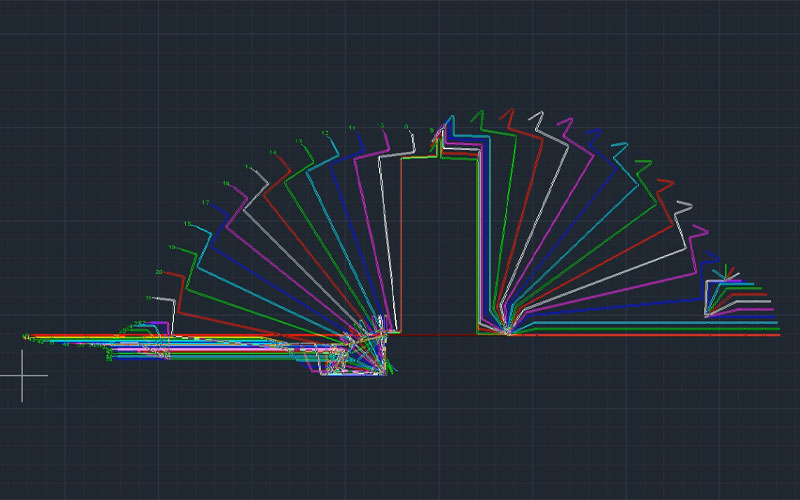
Metal forming processes
Metal forming is one of the most essential manufacturing processes in modern industry, enabling the transformation of raw metal into functional components through controlled deformation. Unlike machining processes that remove material, metal forming reshapes the material while preserving its volume, making it highly efficient and cost-effective for large scale production.
At LOTOSFORMING, advanced forming technologies are developed to support high-precision industrial applications, especially in sheet and coil processing industries.
What Is Metal Forming?
Metal forming refers to a group of manufacturing processes in which metal is shaped by applying mechanical force. The material is plastically deformed to achieve a desired geometry without cutting or waste generation.
This process is widely used in industries that require consistent quality, high production speed, and structural integrity.
Metal Forming Processes
There are several key metal forming processes used in industrial manufacturing:
- Roll forming
- Forging
- Extrusion
- Drawing
- Bending
- Press forming
Each process is selected based on material type, product design, and production requirements. Among these, roll forming is especially effective for continuous production of long metal profiles.
Sheet Metal Forming
Sheet metal forming is a specialized branch of metal forming that focuses on thin metal sheets. It is widely used in automotive, construction, and energy industries.
Common sheet metal forming methods include:
- Bending operations
- Deep drawing
- Stretch forming
- Roll forming
These processes allow manufacturers to create complex shapes with high accuracy and repeatability.
The Importance of Sheet Metal Forming
Sheet metal forming plays a critical role in modern manufacturing due to its efficiency and flexibility. Key advantages include:
- High production efficiency
- Minimal material waste
- Strong structural performance
- Ability to produce complex geometries
- Cost effective mass production
This makes it an essential process for industrial scale applications.
Basics of Metal Forming Process
The basic principle of metal forming involves applying stress to exceed the material’s yield strength, causing permanent deformation. The process must be carefully controlled to avoid defects such as cracking, wrinkling, or springback.
Key factors influencing the process include:
- Material properties
- Temperature conditions
- Tooling design
- Forming speed
- Lubrication and friction control
Proper engineering design ensures high quality and stable production results.
Industrial Applications of Metal Forming
Metal forming is widely used across multiple industries, including:
- Construction and infrastructure
- Automotive manufacturing
- Renewable energy systems (solar structures)
- Industrial machinery production
- Transportation equipment
Its versatility makes it a core technology in modern manufacturing systems.
Advanced Engineering at LOTOSFORMING
LOTOSFORMING focuses on delivering advanced forming solutions designed for precision, durability, and efficiency. Modern production lines incorporate:
- CNC controlled roll stations
- Automated production systems
- High strength forming tools
- Custom profile design capabilities
- Real time monitoring systems
These technologies ensure stable performance even in high-speed production environments.
Conclusion
Metal forming remains a foundational process in industrial manufacturing, offering an efficient and reliable method for producing high quality metal components. With continuous advancements in engineering and automation, forming technologies are becoming more precise and productive.
FAQ:
Key processes include roll forming, forging, extrusion, drawing, bending, and press forming, each used for different industrial applications.
Sheet metal forming refers to processes that shape thin metal sheets into specific forms, commonly used in automotive, construction, and industrial manufacturing.
Material properties, temperature, tooling design, lubrication, and forming speed all influence the final product quality.
Roll forming allows continuous production of long profiles with high precision, consistency, and efficiency.
It provides high efficiency, low material waste, strong structural performance, and cost-effective mass production of metal components.