
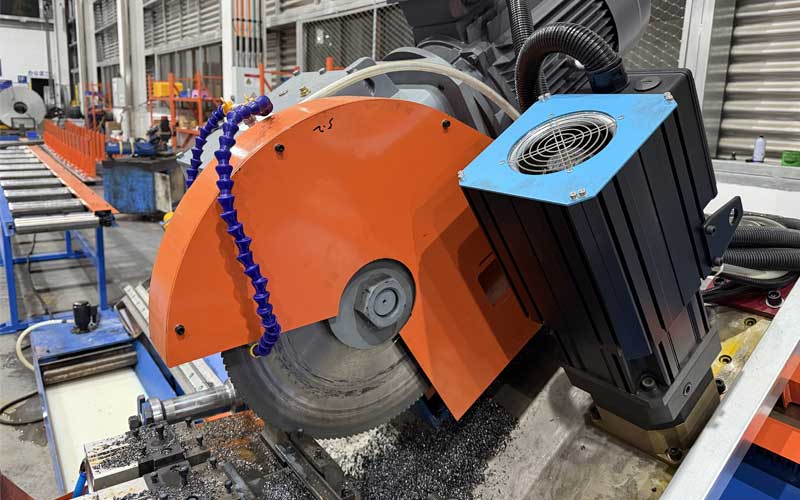
Choosing the Right Cutting Technology in Roll Forming
In modern industrial manufacturing, productivity, precision, and automation are no longer optional. Manufacturers operating in industries such as construction, automotive, solar energy, warehousing, steel fabrication, and infrastructure require production systems capable of delivering high output with minimal downtime. One of the most critical technologies enabling this level of efficiency in roll forming lines is the Servo Flying Cut system.
A servo flying cut mechanism allows continuous profile production without stopping the roll forming process during cutting operations. Instead of stopping the strip movement for each cut length, the cutting unit synchronizes with the moving material and performs the cut while traveling at the same speed as the profile. This significantly improves production speed, dimensional accuracy, and overall manufacturing efficiency.
Today, servo flying cut systems are widely used in:
- C and Z purlin roll forming machines
- Solar structure production lines
- Cable tray manufacturing lines
- Tube mill lines
- Guardrail roll forming systems
- Roofing sheet production lines
- Rack and shelving profile machines
- Slitting and downstream processing systems
As global competition intensifies, manufacturers face increasing pressure to reduce scrap, improve precision, lower labor costs, and maximize machine uptime. Traditional stop-cut systems are often unable to meet these modern industrial requirements.
This article explains how servo flying cut technology works in roll forming machines, including its engineering principles, machine components, synchronization systems, industrial challenges, optimization strategies, and key considerations when purchasing a production line.
What Is a Servo Flying Cut System?
A servo flying cut system is an automated cutting mechanism installed at the end of a roll forming line. Its primary function is to cut continuously moving profiles into precise lengths without stopping the production line.
Unlike conventional hydraulic stop cut systems, the flying cut unit moves together with the profile during the cutting cycle. This synchronized movement eliminates line stoppage and allows continuous production at high speed.
The term “servo” refers to the servo motor technology controlling the movement of the cutting carriage. High precision servo motors combined with encoder feedback and PLC automation ensure exact synchronization between the cutting system and the profile speed.
Main Functions of Servo Flying Cut Technology
The system performs several important industrial tasks:
- Continuous profile cutting
- High speed synchronization
- Accurate length control
- Reduction of material deformation
- Increased production efficiency
- Lower cycle time
- Automated operation
This technology is especially important for manufacturers producing large quantities of steel profiles where production speed directly impacts profitability.
How Servo Flying Cut Works in Roll Forming Machines
Basic Operating Principle
The working principle of a servo flying cut system is based on synchronized motion.
The steel strip passes through multiple roll forming stations where the desired profile shape is gradually formed. As the finished profile exits the forming section, it continues moving forward at a constant speed.
The flying cut unit detects the profile position and speed using an encoder system. The servo motor then accelerates the cutting carriage to match the profile speed exactly. Once synchronized, the cutting tool performs the cut while moving together with the profile.
After cutting is completed, the carriage rapidly returns to its starting position to prepare for the next cycle.
The process occurs in milliseconds and allows uninterrupted production.
Main Components of a Servo Flying Cut System
Servo Motor System
The servo motor is the heart of the flying cut mechanism.
It controls:
- Carriage acceleration
- Speed synchronization
- Position accuracy
- Return movement
High quality servo motors provide:
- Fast response time
- Smooth motion control
- High positioning accuracy
- Stable operation at high speed
Industrial-grade servo systems are essential for maintaining cutting precision during continuous production.
Flying Carriage Assembly
The flying carriage is the moving platform carrying the cutting tool.
Typical carriage components include:
- Linear guide rails
- Servo drive mechanism
- Ball screw or rack-and-pinion drive
- Hydraulic or mechanical cutter
- Position sensors
The carriage must maintain high rigidity to prevent vibration during operation.
Poor carriage design can result in:
- Inaccurate cutting lengths
- Blade wear
- Profile deformation
- Mechanical instability
Encoder Synchronization System
Encoders continuously monitor strip speed and position.
The encoder sends real-time data to the PLC controller, enabling precise synchronization between:
- Material movement
- Servo carriage speed
- Cutting timing
High resolution encoders significantly improve length accuracy.
In advanced systems, servo drives and encoders communicate through industrial fieldbus protocols such as:
- EtherCAT
- PROFINET
- Modbus
- CANopen
PLC Automation Control
The PLC system manages the entire cutting process.
It controls:
- Length programming
- Speed coordination
- Cutting timing
- Servo positioning
- Error monitoring
- Production recipes
Modern PLC systems also support:
- Remote diagnostics
- Production data tracking
- HMI touchscreen operation
- Integration with factory automation systems
Cutting Unit
The cutting mechanism can vary depending on profile type and material thickness.
Common cutting technologies include:
Hydraulic Cutting
Widely used for:
- Thick steel profiles
- Structural sections
- Heavy-duty applications
Advantages:
- High cutting force
- Reliable operation
- Lower initial investment
Mechanical Punch Cutting
Suitable for:
- Thin-gauge steel
- High speed applications
Advantages:
- Faster cycle time
- Lower maintenance
- Reduced oil usage
Servo Saw Cutting
Common in tube mill lines.
Advantages:
- Smooth cutting surface
- Reduced burr formation
- High precision for tubular profiles
Servo Flying Cut Workflow
Step 1: Material Feeding
Steel coil is loaded into the decoiler and fed into the roll forming machine.
The strip moves continuously through leveling and forming stations.
Step 2: Profile Forming
Roll forming stations gradually shape the material into the required profile.
The strip speed remains constant during production.
Step 3: Encoder Detection
The encoder measures line speed and profile position.
The PLC calculates the exact cutting point.
Step 4: Servo Synchronization
The servo carriage accelerates and matches the profile speed.
This synchronization is critical for maintaining cutting accuracy.
Step 5: Flying Cut Operation
The cutting tool performs the cut while moving together with the profile.
The line continues running without interruption.
Step 6: Return Cycle
After cutting, the carriage rapidly returns to its starting position.
The system immediately prepares for the next cut cycle.
Advantages of Servo Flying Cut Systems
Higher Production Speed
Traditional stop-cut systems reduce overall line efficiency because the line must stop for every cut.
Servo flying cut systems eliminate this downtime.
Manufacturers can achieve significantly higher production speeds, especially for shorter product lengths.
Improved Cutting Accuracy
Servo synchronization ensures highly precise length control.
Typical tolerance levels can reach:
- ±0.5 mm
- ±0.3 mm in advanced systems
This precision is essential for industries requiring tight dimensional control.
Reduced Material Damage
Stopping and restarting material movement can create:
- Surface scratches
- Edge deformation
- Shape distortion
Flying cut systems minimize these problems by maintaining continuous movement.
Better Automation
Servo systems integrate easily with smart factory automation technologies.
Benefits include:
- Recipe storage
- Automatic length adjustment
- Production tracking
- Industry 4.0 compatibility
Lower Production Cost
Although initial investment is higher, servo flying cut systems reduce long-term manufacturing costs through:
- Higher productivity
- Lower scrap rate
- Reduced labor
- Improved consistency
- Less downtime
Common Industrial Applications
Solar Structure Manufacturing
Servo flying cut systems are widely used in solar mounting structure production.
Profiles often require:
- High dimensional consistency
- Precise hole positioning
- High-speed manufacturing
Continuous cutting improves efficiency for large scale solar projects.
C and Z Purlin Production
Construction profiles require accurate lengths and high output volume.
Flying cut technology allows rapid production with minimal dimensional variation.
Tube Mill Lines
In tube manufacturing, flying saw systems provide continuous pipe cutting without interrupting the welding process.
This is essential for high-speed ERW tube mills.
Cable Tray Manufacturing
Cable tray profiles often contain punching operations combined with continuous forming and cutting.
Servo flying cut systems help maintain synchronization across the production line.
Automotive Components
Automotive roll formed parts require:
- Tight tolerances
- High repeatability
- Excellent edge quality
Servo-controlled cutting systems support these demanding requirements.
Common Production Challenges
Synchronization Errors
One of the most common issues is improper synchronization between the carriage and profile speed.
Causes may include:
- Encoder signal problems
- Servo tuning errors
- PLC communication delays
- Mechanical backlash
Solutions
- Use high-resolution encoders
- Calibrate servo parameters
- Improve PLC response time
- Maintain mechanical components regularly
Blade Wear
Cutting blades gradually wear during production.
Worn blades can cause:
- Burr formation
- Rough edges
- Inaccurate cuts
- Increased scrap
Solutions
- Use high-quality tool steel
- Schedule regular sharpening
- Monitor cutting force
- Use proper lubrication
Vibration Problems
High speed movement can create vibration in the carriage assembly.
This affects cutting precision.
Solutions
- Increase frame rigidity
- Improve linear guide quality
- Optimize acceleration curves
- Use balanced mechanical design
Servo Overload
Improper system sizing may overload the servo motor during acceleration.
Solutions
- Select correct servo capacity
- Reduce carriage weight
- Optimize cutting cycle
- Improve motion programming
Optimization Methods for Better Performance
Increase Line Speed Safely
Many manufacturers attempt to increase line speed without improving synchronization systems.
This often creates instability.
Recommended improvements include:
- Faster PLC processors
- High-performance servo drives
- Lightweight carriage design
- Advanced motion control algorithms
Improve Length Accuracy
Length accuracy depends on multiple factors:
- Encoder quality
- Servo response time
- Mechanical stability
- Material consistency
Using closed-loop control systems significantly improves precision.
Reduce Maintenance Downtime
Preventive maintenance is critical.
Recommended maintenance tasks:
- Inspect guide rails weekly
- Lubricate moving parts
- Check encoder alignment
- Monitor servo temperature
- Inspect cutting blades regularly
Implement Smart Automation
Modern roll forming factories increasingly use smart manufacturing systems.
Useful automation upgrades include:
- Remote monitoring
- Automatic diagnostics
- Predictive maintenance
- Production analytics
- ERP integration
Servo Flying Cut vs Stop Cut System
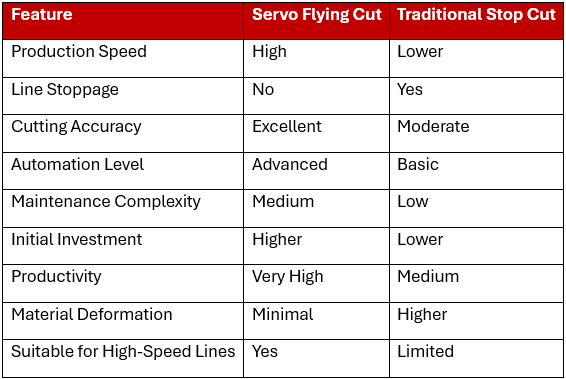
For manufacturers focused on high-volume production, servo flying cut systems offer significantly better long-term value.
Engineering Considerations When Selecting a Servo Flying Cut System
Material Thickness
The cutting force requirement changes based on material thickness.
Thicker materials require:
- Stronger hydraulic systems
- Higher servo torque
- Reinforced machine frame
Profile Geometry
Complex profiles may require specialized cutting dies.
Engineers must evaluate:
- Profile shape
- Edge sensitivity
- Deformation risk
- Punching integration
Production Speed Requirements
Higher production speed increases synchronization demands.
Machine builders should select:
- High-speed servo motors
- Fast-response PLC systems
- Industrial communication networks
Future Automation Expansion
Manufacturers should consider future scalability.
Modern systems should support:
- MES integration
- Smart factory communication
- Additional automation modules
- Remote technical support
Buyer Guide: What to Consider Before Purchasing
Evaluate Supplier Engineering Experience
Not all roll forming manufacturers have strong servo motion expertise.
Choose suppliers with:
- Proven industrial references
- In-house automation engineering
- Experience with high-speed production lines
- International installation capability
Check Servo Brand Quality
Reliable servo brands improve long-term stability.
Popular industrial brands include:
- Siemens
- Yaskawa
- Mitsubishi
- Delta
- Schneider
- Panasonic
Analyze Production Requirements Carefully
Before purchasing, manufacturers should define:
- Material specifications
- Maximum line speed
- Profile dimensions
- Daily production volume
- Future expansion plans
Request Real Production Testing
Always request production testing using actual material specifications.
Testing should verify:
- Length accuracy
- Cutting quality
- Line stability
- Speed capability
Evaluate After-Sales Support
Industrial machinery requires ongoing technical support.
Important support factors include:
- Spare parts availability
- Remote troubleshooting
- PLC backup support
- Servo parameter assistance
- Installation training
Future Trends in Servo Flying Cut Technology
The future of roll forming automation is increasingly intelligent.
Emerging technologies include:
- Predictive maintenance systems
- Digital twin simulation
- Smart sensor integration
- Cloud based production monitoring
Servo flying cut systems will continue evolving toward:
- Faster synchronization
- Lower energy consumption
- Greater precision
- Fully autonomous operation
Manufacturers investing in advanced automation today will gain significant competitive advantages in global markets.
Conclusion
Servo flying cut technology has become an essential part of modern roll forming production lines. By enabling continuous cutting without stopping the line, manufacturers achieve higher productivity, better dimensional accuracy, lower scrap rates, and improved automation efficiency.
As industries demand faster production and tighter tolerances, traditional stop-cut systems are increasingly unable to meet modern manufacturing expectations. Servo flying cut systems provide the precision, flexibility, and scalability required for competitive industrial production.
For manufacturers investing in roll forming lines, selecting the right servo flying cut solution is critical for long-term operational success. Proper engineering design, high-quality automation components, and reliable supplier support all play important roles in maximizing machine performance.
Contact LOTOS Forming for Advanced Roll Forming Solutions
LOTOS Forming specializes in high-performance roll forming machines, tube mill lines, slitting lines, and fully automated production systems for global industrial manufacturers.
Our engineering team provides:
- Custom roll forming solutions
- High-speed servo flying cut systems
- Turnkey production lines
- PLC automation integration
- International technical support
- Production optimization consultation
Whether you are manufacturing solar structures, steel profiles, cable trays, tubes, or industrial components, LOTOS Forming can help you build a more efficient and competitive production line.
Contact LOTOS Forming today to request:
- Machine quotation
- Technical consultation
- Factory layout planning
- Turnkey production solutions
- Customized automation systems
FAQ:
A servo flying cut system is an automated cutting mechanism that cuts moving profiles without stopping the roll forming line. The cutting carriage synchronizes with the profile speed using servo motors and encoder feedback.
Servo flying cut systems improve production speed, reduce downtime, increase cutting accuracy, and minimize profile deformation compared to traditional stop-cut systems.
Key factors include encoder quality, servo motor tuning, carriage rigidity, PLC response time, and blade condition.
Yes. Properly designed systems can process thick steel profiles using reinforced frames, hydraulic cutting systems, and high-torque servo motors.
Regular maintenance includes lubrication, guide rail inspection, encoder calibration, blade sharpening, and servo system monitoring.