
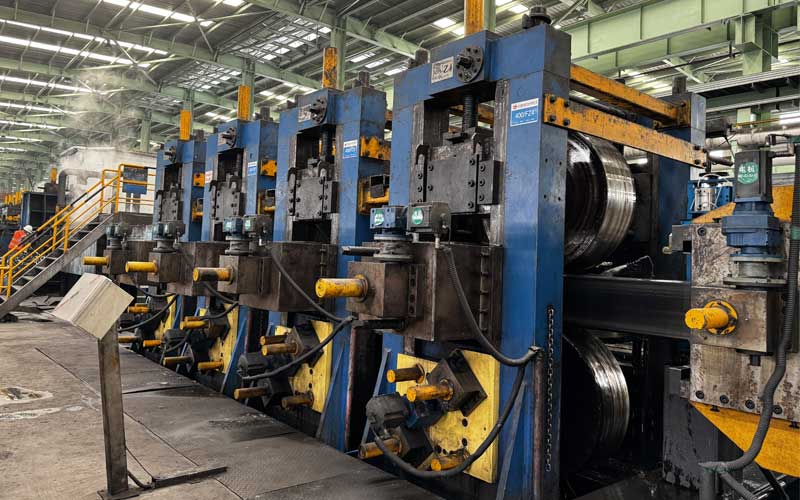
Steel Tube Mill Working Principle
Steel tubes and pipes are indispensable in industries such as construction, automotive, energy, furniture, infrastructure, and mechanical engineering. Behind every precision-welded tube is a highly engineered Tube Mill Machine that transforms flat steel strip into round, square, rectangular, or special-shaped tubes through a continuous production process.
Understanding how a tube mill machine works helps manufacturers select the right equipment, improve production efficiency, and achieve superior weld quality. This article explains how tube and pipe mills work, the production process of a tube mill machine, and the advantages of modern high speed tube mill machines.
What Is a Tube Mill?
A Tube Mill Machine is an automated production line designed to manufacture welded steel tubes from continuous steel coils. The machine gradually forms steel strip into a tubular shape before joining the edges using High Frequency (HF) Induction Welding or High-Frequency Contact Welding.
After welding, the tube passes through sizing, straightening, cutting, inspection, and collection systems to produce finished products with precise dimensions.
Modern tube mills can manufacture:
- Round tubes
- Square tubes
- Rectangular tubes
- Oval tubes
- Structural tubing
- Furniture tubing
- Automotive tubing
- Mechanical tubing
- API pipes
- Solar structure tubes
Tube Mill Technology
A tube mill operates through a continuous production process in which steel strip moves through multiple stations without interruption. Each section of the production line performs a specific function to ensure dimensional accuracy and weld integrity.
The basic workflow includes:
Steel Coil → Decoiler → Strip Accumulator → Forming Section → HF Welding →Bead Removal →Cooling →Sizing Section →Straightening → Flying Cut-Off → Run Out Table → Finished Tubes
Main Components of a Tube Mill Machine
1. Coil Loading System
The production process begins with loading a steel coil onto the hydraulic decoiler.
Its functions include:
- Supporting heavy coils
- Maintaining strip tension
- Feeding material continuously
- Preventing strip deformation
2. Decoiler
The decoiler unwinds the steel strip at a controlled speed while synchronizing with the entire production line.
Highquality decoilers feature:
- Hydraulic expansion
- Automatic braking
- Variable speed control
- Heavy-duty construction
3. Strip End Shear and Welder
When one coil finishes, the strip end is automatically welded to the beginning of the next coil.
This enables:
- Continuous production
- Reduced downtime
- Higher productivity
4. Horizontal and Vertical Accumulator
The accumulator stores steel strip temporarily while the next coil is prepared.
Advantages include:
- Continuous mill operation
- Stable strip feeding
- Reduced production interruptions
- Improved welding consistency
5. Forming Section
The forming section is the heart of the tube mill.
A series of precision-engineered rolls gradually bend the flat strip into a circular tube profile without creating excessive stress.
Modern mills use multiple forming stands to distribute deformation evenly.
Benefits include:
- Smooth forming
- High dimensional accuracy
- Reduced edge damage
- Stable material flow
High Frequency Welding Process
Once the strip edges meet, the tube enters the High= Frequency Welding (HF Welding) station.
HF welding generates localized heat through high frequency electrical current, causing the strip edges to reach forging temperature.
Pressure rolls immediately compress the heated edges together, producing a solid-state weld without filler metal.
Advantages include:
- High welding speed
- Strong weld seam
- Minimal heat-affected zone
- Excellent production efficiency
- Low operating cost
External Bead Removal
After welding, excess weld material forms an external bead.
A precision scarfing tool removes this bead while the material remains hot.
Benefits:
- Smooth tube surface
- Better appearance
- Improved dimensional accuracy
- Easier downstream processing
Some production lines also remove the internal weld bead depending on product requirements.
Cooling Section
The welded tube is cooled using circulating water before entering the sizing section.
Proper cooling:
- Stabilizes the weld
- Prevents distortion
- Improves dimensional consistency
Sizing Section
The sizing section gradually adjusts the tube to its final dimensions.
Functions include:
- Diameter control
- Wall stabilization
- Shape correction
- Size precision
For square and rectangular tubes, this section also performs the shape transformation.
Modern Direct Square Forming (DSF) technology forms square tubes directly from round profiles or directly from strip, reducing tooling requirements and improving efficiency.
Straightening Section
Precision rolls remove any remaining bending or twisting.
Straight tubes provide:
- Better appearance
- Easier fabrication
- Improved product quality
Flying Cut Off Machine
A flying saw synchronizes with the moving tube and cuts it to the required length without stopping production.
Advantages:
- Continuous operation
- High cutting accuracy
- Increased productivity
- Smooth cut surfaces
Tube Collection System
Finished tubes move to:
- Run out tables
- Automatic stacking systems
- Bundling machines
- Packaging stations
Automatic handling reduces labor while improving production efficiency.
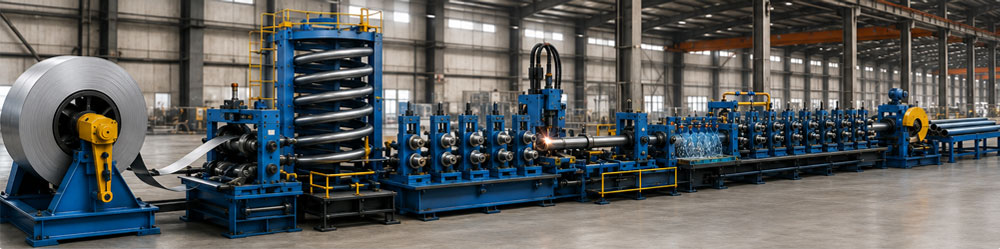
What Is the Production Process of a Tube Mill Machine?
Production Stage | Function |
Coil Loading | Load steel coil |
Decoiling | Unwind strip |
End Welding | Join consecutive coils |
Strip Accumulation | Maintain continuous feeding |
Forming | Shape strip into round tube |
HF Welding | Weld strip edges |
Bead Removal | Remove excess weld |
Cooling | Stabilize weld area |
Sizing | Final diameter control |
Straightening | Improve tube straightness |
Flying Cut-Off | Cut to required length |
Collection | Bundle finished tubes |
High Speed Tube Mill Machine
Modern manufacturers increasingly require high speed tube mill machines to maximize output while maintaining consistent quality.
High speed tube mills are capable of producing tubes at speeds exceeding 120 m/min, depending on tube size, material grade, and wall thickness.
Typical features include:
- Servo-controlled flying saw
- Precision roll forming
- Automatic roll adjustment
- Digital PLC control
- Intelligent HMI interface
- Automatic fault diagnosis
- Energy-efficient drive systems
- High-frequency solid-state welder
These technologies significantly improve productivity and reduce operating costs.
Advantages of Modern Tube Mill Machines
Modern tube mill production lines offer numerous advantages:
- Continuous automatic production
- High production speed
- Excellent dimensional accuracy
- Strong weld quality
- Low maintenance requirements
- Reduced material waste
- Flexible product changeover
- High automation
- Stable long-term operation
Applications of Tube Mill Machines
Tube mill production lines manufacture products for numerous industries, including:
- Construction
- Automotive
- Oil and Gas
- Furniture Manufacturing
- Agricultural Equipment
- Steel Structures
- Solar Mounting Systems
- Mechanical Engineering
- Infrastructure Projects
- Industrial Machinery
Choosing the Right Tube Mill Machine
When selecting a tube mill, manufacturers should evaluate:
- Tube diameter range
- Wall thickness capacity
- Production speed
- Welding technology
- Automation level
- Roll tooling quality
- Energy consumption
- Spare parts availability
- After-sales service
- Future expansion capability
A properly designed production line delivers higher productivity, lower operating costs, and superior product quality.
Why Choose LOTOSFORMING Tube Mill Machines?
LOTOSFORMING specializes in manufacturing advanced ERW Tube Mill Machines, Direct Square Forming Tube Mills, and complete welded tube production lines for global customers.
Our solutions feature:
- High-speed production up to 120 m/min (model-dependent)
- Precision roll forming technology
- Advanced HF welding integration
- Intelligent PLC automation
- Customized mill configurations
- Reliable mechanical design
- Global installation and commissioning
- 1-year warranty
- 10 years of technical support
From standard round tubes to precision square and rectangular profiles, LOTOSFORMING delivers reliable tube mill solutions tailored to diverse industrial applications.
Conclusion
Understanding how a tube mill machine works is essential for selecting the right production equipment and optimizing manufacturing efficiency. From decoiling and precision forming to high-frequency welding, sizing, and flying cut-off, every stage contributes to producing high-quality welded steel tubes with exceptional accuracy.
As demand for precision tubing continues to grow, investing in a modern high-speed tube mill machine equipped with intelligent automation and advanced forming technology enables manufacturers to improve productivity, reduce operating costs, and remain competitive in the global steel industry. LOTOSFORMING provides comprehensive tube mill solutions engineered for reliable, efficient, and long-term performance.
FAQ :
A tube and pipe mill continuously feeds steel strip from a coil, forms it into a tube, welds the seam using high-frequency welding, sizes the tube, and cuts it to the required length without stopping production.
The process includes coil loading, decoiling, strip accumulation, roll forming, HF welding, bead removal, cooling, sizing, straightening, flying cut-off, and finished tube collection.
Tube mill machines are widely used in construction, automotive, furniture, oil and gas, solar mounting systems, agriculture, mechanical engineering, and infrastructure projects.
Yes. Modern tube mills use sizing rolls or Direct Square Forming (DSF) technology to manufacture square and rectangular tubes efficiently with high dimensional accuracy.