
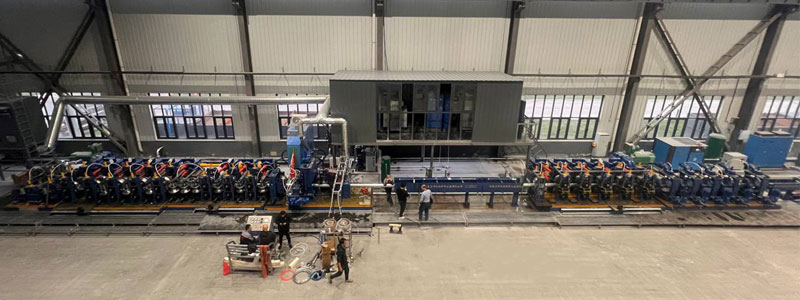
Stainless Steel Welded Pipe Manufacturing Process
Stainless steel pipes and tubes are widely used in industries that require high corrosion resistance, excellent strength, and long service life. From construction and food processing to automotive, chemical plants, and oil & gas, stainless steel tubing plays a vital role in modern manufacturing.
Understanding the Stainless Steel Pipe and Tube Manufacturing Process helps manufacturers select the right equipment, improve production efficiency, and maintain consistent product quality. Modern tube mill production lines combine precision forming, high quality welding, advanced sizing, and automated inspection to produce pipes that meet international standards.
What Is Stainless Steel Pipe Manufacturing?
The stainless steel pipe manufacturing process converts flat stainless steel strip coils into round, square, rectangular, or special shaped welded tubes through a continuous production line.
The process includes several stages:
- Coil preparation
- Strip forming
- Welding
- Weld bead treatment
- Sizing
- Straightening
- Cutting
- Inspection
- Packaging
High-quality stainless steel tube mills ensure precise dimensions, smooth weld seams, and excellent mechanical properties.
Raw Material Selection
The manufacturing process begins with high-quality stainless steel coils.
Common stainless steel grades include:
- 201 Stainless Steel
- 202 Stainless Steel
- 304 Stainless Steel
- 304L Stainless Steel
- 316 Stainless Steel
- 316L Stainless Steel
- 409 Stainless Steel
- 430 Stainless Steel
The material selection depends on the application, corrosion requirements, and mechanical strength.
Typical coil specifications include:
| Parameter | Typical Range |
|---|---|
| Coil Width | 20–800 mm |
| Thickness | 0.3–6.0 mm |
| Coil Weight | 3–25 Tons |
Step 1 – Coil Loading and Decoiling
The process begins with loading a stainless steel coil onto the hydraulic decoiler.
The decoiler:
- Supports heavy coils
- Rotates continuously
- Feeds material into the production line
- Maintains constant strip tension
Modern tube mills use automatic loading systems to reduce downtime.
Step 2 – Leveling and Straightening
Before forming begins, the strip passes through a leveling machine.
Its functions include:
- Removing coil set
- Eliminating strip curvature
- Improving flatness
- Preparing the strip for accurate forming
Proper leveling greatly improves tube roundness and weld quality.
Step 3 – End Shearing and Strip Welding
When one coil finishes, the strip end is sheared and welded to the next coil.
Advantages include:
- Continuous production
- Reduced machine stoppage
- Higher productivity
- Better material utilization
Automatic strip welding minimizes downtime.
Step 4 – Accumulator
The accumulator stores a reserve of strip material while strip welding is performed.
Benefits include:
- Continuous tube production
- Stable strip feeding
- Higher line efficiency
- Reduced production interruptions
Accumulators are essential for high-speed tube mills.
Step 5 – Roll Forming
The roll forming section gradually bends the flat strip into a round tube.
Several forming stands progressively shape the strip without creating excessive stress.
During this stage:
- The strip edges are aligned accurately.
- Forming pressure is evenly distributed.
- Material deformation is carefully controlled.
High precision roll tooling is critical for producing high-quality stainless steel tubes.
Step 6 – Tube Welding
Once the strip edges meet, they are permanently joined.
Several welding technologies are used.
TIG Welding
TIG (Tungsten Inert Gas) welding is widely used for stainless steel tubing because it provides:
- Excellent weld quality
- Smooth weld appearance
- Strong corrosion resistance
- Precise heat control
Applications include:
- Food industry
- Pharmaceutical tubing
- Decorative tubes
- Medical equipment
Laser Welding
Laser welding offers:
- Very narrow heat-affected zone
- High production speed
- Excellent dimensional accuracy
- Minimal distortion
Laser tube mills are increasingly used in precision manufacturing.
High Frequency Welding
For certain stainless steel applications, High Frequency (HF) welding provides:
- High production efficiency
- Strong weld strength
- Continuous production
- Lower manufacturing costs
Step 7 – Weld Bead Grinding
The external weld bead is removed using grinding equipment.
Optional internal bead removal can also be performed.
Advantages include:
- Smooth pipe surface
- Improved appearance
- Better flow characteristics
- Easier polishing
This step is especially important for decorative and sanitary tubing.
Step 8 – Sizing Section
The welded tube passes through sizing rolls that precisely control:
- Outside diameter
- Wall thickness consistency
- Roundness
- Dimensional accuracy
Modern servo-controlled sizing sections ensure excellent product consistency.
Step 9 – Straightening
The straightening machine removes residual bending.
Benefits include:
- Better pipe alignment
- Reduced deformation
- Improved dimensional stability
- Higher finished product quality
Step 10 – Flying Cut Off
The flying cut-off cuts the continuously moving tube into preset lengths without stopping the production line.
Advantages include:
- High cutting accuracy
- Smooth cut surfaces
- Increased productivity
- Reduced material waste
Typical cutting lengths range from 3 to 12 meters, depending on customer requirements.
Step 11 – Inspection and Quality Control
Quality inspection ensures every tube meets industry standards.
Inspection methods include:
- Diameter measurement
- Wall thickness inspection
- Surface inspection
- Weld quality inspection
- Eddy current testing
- Ultrasonic testing
- Hydrostatic pressure testing
- Straightness measurement
- Length verification
Automated inspection systems improve production reliability.
Step 12 – Packing
Finished stainless steel tubes are bundled and packed for transportation.
Packing methods include:
- Plastic wrapping
- Woven bags
- Wooden cases
- Steel strapping
- End caps
- Protective film
Proper packaging protects the tubes from scratches, moisture, and transportation damage.
Types of Stainless Steel Tubes
A modern tube mill can produce various tube profiles, including:
- Round tubes
- Square tubes
- Rectangular tubes
- Oval tubes
- Elliptical tubes
- Customized special profiles
Applications of Stainless Steel Pipes and Tubes
Stainless steel tubing is used across many industries.
Common applications include:
- Construction
- Furniture manufacturing
- Automotive components
- Heat exchangers
- Food processing equipment
- Pharmaceutical production
- Chemical processing plants
- Oil and gas pipelines
- Water treatment systems
- Solar energy structures
- Architectural decoration
- Handrails and railings
Advantages of Modern Stainless Steel Tube Mills
Modern stainless steel tube mills offer numerous production advantages.
- High production speed
- Stable welding quality
- Excellent dimensional accuracy
- Low material waste
- Automatic PLC control
- Servo synchronization
- Reduced labor requirements
- Fast roll change
- Continuous production
- High equipment reliability
- Low maintenance costs
- Energy-efficient operation
Why Choose LOTOSFORMING Stainless Steel Tube Mill?
LOTOSFORMING designs and manufactures advanced stainless steel tube mill production lines engineered for high productivity, precision, and long-term reliability.
Our tube mills feature:
- High precision roll forming technology
- Stable TIG, Laser, or High Frequency welding integration
- Intelligent PLC control systems
- Automatic flying cut-off
- Precision sizing and straightening
- Custom solutions for various tube sizes and stainless steel grades
- Easy operation and maintenance
- Comprehensive installation, commissioning, and operator training
- 1-year warranty
- 10 years of technical support and after-sales service
With years of experience in tube mill manufacturing, LOTOSFORMING provides complete solutions that help customers achieve consistent product quality, maximize production efficiency, and reduce operating costs.
Conclusion
The Stainless Steel Pipe and Tube Manufacturing Process combines precision engineering, advanced welding technology, and automated quality control to produce high-performance tubes for demanding industrial applications. Every stage—from coil preparation and roll forming to welding, sizing, inspection, and packaging plays a crucial role in ensuring dimensional accuracy, structural integrity, and corrosion resistance.
By investing in a modern stainless steel tube mill, manufacturers can improve productivity, reduce waste, and consistently produce premium-quality stainless steel pipes that meet international standards. LOTOSFORMING delivers reliable tube mill solutions designed to support efficient, continuous production and long-term operational success.