
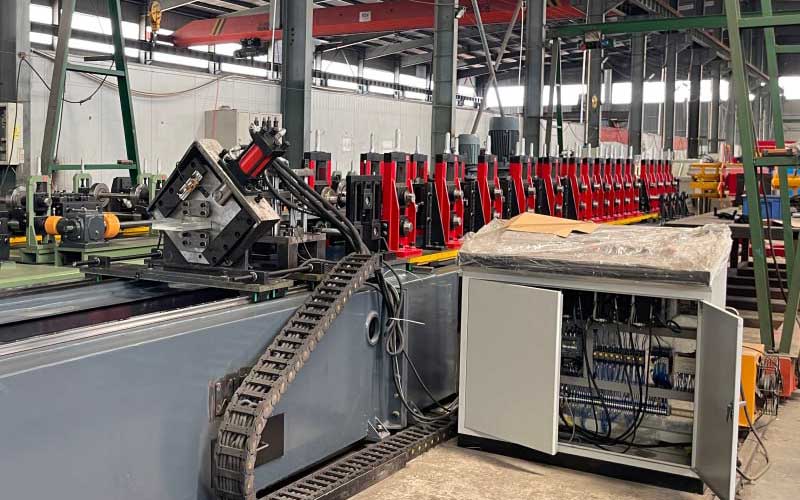
What is stud and track roll forming machine?
Modern steel framing requires precision, speed, and consistency. A CU Stud Channel Roll Forming Machine is designed to manufacture high-quality steel stud channels used in light steel framing (LSF), drywall partition systems, ceiling frameworks, and commercial construction. By continuously forming steel coils into precise channel profiles, this equipment delivers high production efficiency while maintaining strict dimensional accuracy.
In this guide, we explain how a CU Stud Channel Roll Forming Machine works, its main components, applications, advantages, and the factors to consider when selecting the right production line.
What Is a CU Stud Channel Roll Forming Machine?
A CU Stud Channel Roll Forming Machine is an automated production system that converts galvanized steel coils into C-shaped or U-shaped stud channels through a continuous cold roll forming process.
The machine gradually bends the steel strip through multiple forming stations until the required profile is achieved. Depending on the production requirements, the line can also integrate punching, embossing, servo feeding, and automatic cutting systems.
These machines are widely used by manufacturers producing:
- Drywall metal studs
- Ceiling channels
- Light steel framing components
- Interior partition systems
- Commercial building structures
- Residential steel framing profiles
How Does a CU Stud Channel Roll Forming Machine Work?
A complete production line generally follows these manufacturing stages:
1. Decoiling
The galvanized steel coil is mounted on a hydraulic or manual decoiler. The decoiler feeds the material smoothly into the production line while maintaining constant tension.
2. Leveling and Feeding
The leveling unit removes coil stress and improves strip flatness before entering the roll forming section.
Servo feeding systems ensure precise material positioning for punching operations.
3. Punching Station
If the product requires service holes, installation slots, or connection holes, the punching station performs these operations before forming.
Modern machines may include:
- Hydraulic punching
- Servo punching
- High-speed punching
- Multiple punching dies
4. Roll Forming Section
This is the core of the production line.
Multiple roll forming stations gradually shape the steel strip into the required CU stud profile without damaging the galvanized surface.
The number of forming stations depends on:
- Material thickness
- Profile complexity
- Required production speed
- Dimensional tolerance
5. Cutting System
After forming, the profile is cut to the required length.
Common cutting options include:
- Hydraulic flying cut
- Servo tracking cut
- Stop cutting
- Shear cutting
Servo tracking cutting allows continuous production without stopping the line, significantly improving productivity.
6. Product Collection
Finished profiles are transferred onto an automatic receiving table or stacking system for packaging and shipment.
Main Components of a CU Stud Channel Roll Forming Machine
A standard production line typically includes:
- Hydraulic decoiler
- Leveling system
- Servo feeding unit
- Hydraulic punching system
- Roll forming machine
- Gearbox or transmission system
- Hydraulic cutting system
- PLC control cabinet
- Touch screen HMI
- Automatic receiving table
Optional equipment may include:
- Automatic packing system
- Barcode labeling
- Robotic stacking
- Online inspection system
- Remote monitoring
Applications of CU Stud Channels
CU stud channels are essential components in modern construction projects.
Typical applications include:
- Drywall partition systems
- Office buildings
- Hotels
- Shopping malls
- Hospitals
- Schools
- Warehouses
- Residential buildings
- Industrial facilities
- Modular construction
Their lightweight design, corrosion resistance, and fast installation make them ideal for steel framing systems.
Advantages of a CU Stud Channel Roll Forming Machine
High Production Efficiency
Continuous roll forming enables stable, high-speed production with minimal downtime.
Excellent Dimensional Accuracy
Precision-engineered rollers ensure consistent profile dimensions throughout long production runs.
Reduced Material Waste
Servo controlled feeding and cutting systems minimize scrap while maximizing raw material utilization.
Low Labor Requirements/025
Automatic production significantly reduces manual intervention, improving workplace safety and operational efficiency.
Flexible Production
Many modern machines support quick size changes by adjusting roller positions or replacing tooling, allowing manufacturers to produce multiple profile specifications.
Stable Product Quality
Automated control systems ensure consistent hole positioning, profile dimensions, and cutting accuracy.
Materials That Can Be Processed
A CU Stud Channel Roll Forming Machine can process various metal materials, including:
- Galvanized steel
- Cold rolled steel
- Pre-painted steel
- Zinc-coated steel
- High-strength structural steel
Material thickness generally ranges from 0.5 mm to 2.5 mm, depending on machine design and customer requirements.
Key Features to Consider When Purchasing
Before investing in a production line, manufacturers should evaluate several technical factors.
Production Speed
Higher-speed machines improve productivity while maintaining profile quality.
Material Thickness Range
The machine should match current production needs while allowing future product expansion.
Punching Flexibility
Machines with programmable punching systems offer greater manufacturing flexibility.
Automation Level
Advanced PLC systems simplify operation and reduce setup time.
Roll Material
High-quality rollers manufactured from hardened alloy steel provide longer service life and better forming performance.
Cutting Accuracy
Servo tracking cutting systems improve length precision while maintaining continuous production.
After Sales Support
Reliable technical support, spare parts availability, installation assistance, and operator training are important for long-term production stability.
Stud and Track Steel Frame Roll Forming Machine
LOTOSFORMING designs and manufactures advanced CU Stud Channel Roll Forming Machines for customers worldwide.
Our solutions are engineered to deliver:
- High-speed production
- Precision roll forming
- Durable machine construction
- Intelligent PLC control
- Flexible profile customization
- Reliable hydraulic punching systems
- Accurate servo cutting technology
- Comprehensive technical support
- Global installation and after-sales service
Each production line can be customized according to profile dimensions, material specifications, production capacity, and factory layout.
Conclusion
A CU Stud Channel Roll Forming Machine is a vital investment for manufacturers producing steel framing components. Its automated roll forming technology delivers high production efficiency, excellent dimensional accuracy, and consistent product quality while reducing labor costs and material waste.
Whether manufacturing drywall studs, ceiling channels, or light steel framing profiles, selecting a reliable and customizable roll forming machine helps increase productivity and maintain a competitive advantage in today’s construction industry. By partnering with an experienced manufacturer such as LOTOSFORMING, businesses can obtain a production line tailored to their exact technical and production requirements.
FAQ:
The machine can process various materials, including:
- Galvanized steel
- Cold rolled steel
- Pre-painted steel
- Zinc-coated steel
- High-strength steel
Yes. LOTOSFORMING customizes each production line according to the customer’s profile drawings, material thickness, production speed, punching pattern, and automation requirements.
Yes. Hydraulic or servo punching systems can be integrated to create service holes, slots, and fixing holes with high accuracy before the roll forming process.
A CU Stud Channel Roll Forming Machine is an automated production line that continuously forms galvanized steel coils into C and U stud channels used in drywall systems, light steel framing, and ceiling structures.