
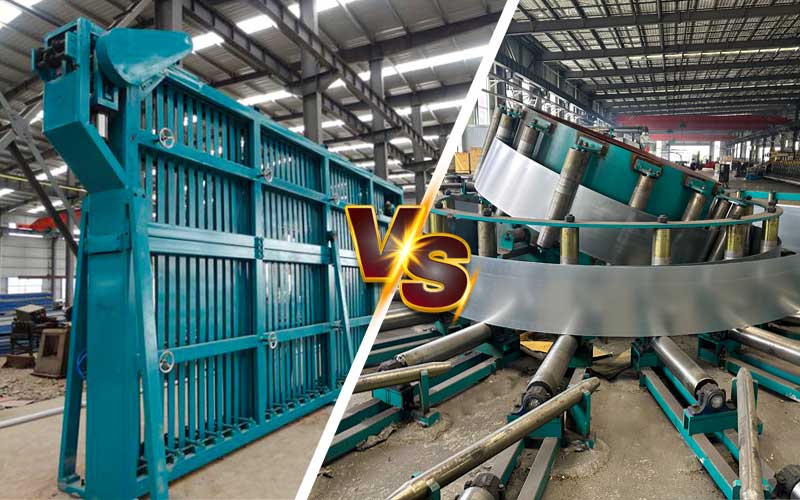
Vertical Accumulator vs. Horizontal Accumulator in Tube Mill Lines
In high speed tube and pipe manufacturing, continuous production is essential for maximizing throughput and minimizing downtime. Accumulators, also known as strip storage systems or loopers, play a critical role in tube mill lines by storing a reserve of strip material during the coil-joining process. This allows the mill to continue running at full speed while a new coil is welded to the tail end of the previous one, eliminating the need to stop the line entirely.
Two primary accumulator configurations are used in the industry: vertical accumulators and horizontal accumulators. Each design offers distinct advantages depending on production speed, strip thickness, plant layout, and product specifications. This article examines both systems in detail to help manufacturers determine which configuration best suits their tube mill line.
The Role of Accumulators in Tube Mill Lines
Before comparing the two designs, it is important to understand the function an accumulator serves within the overall production line. As strip stock is uncoiled and fed into the forming section of a tube mill, the accumulator stores a buffer of material often several hundred meters between the uncoiler and the forming stands. When the current coil runs out, the strip tail is welded to the head of a new coil while the mill continues to draw material from the stored reserve, ensuring uninterrupted, continuous operation of the forming, welding, sizing, and cutting stations downstream.
Vertical Accumulators
Design and Operating Principle
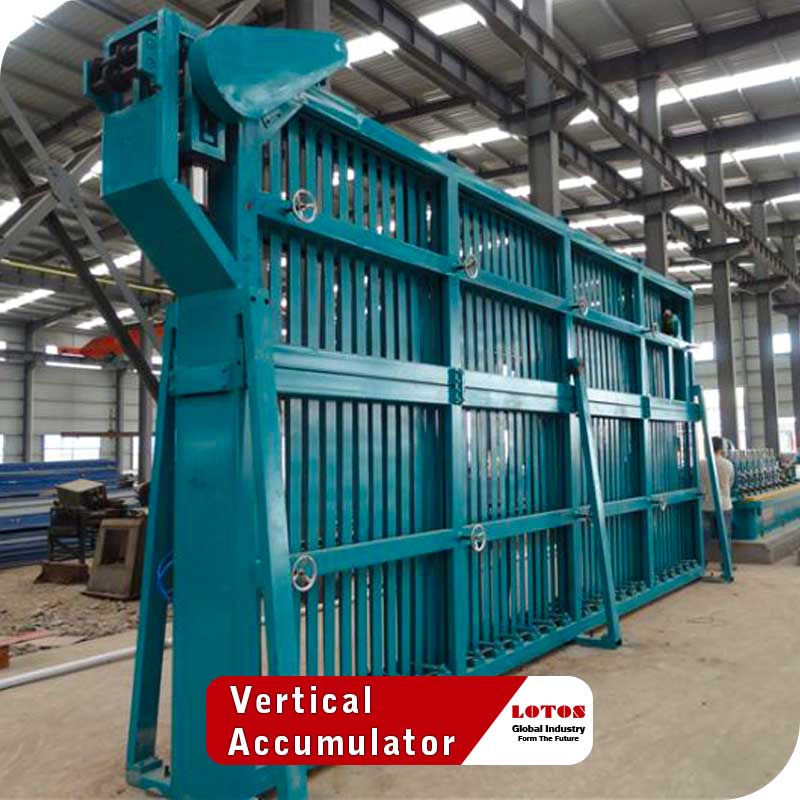
A vertical accumulator stores strip material by looping it upward in a series of vertical passes, typically guided by a moving carriage or trolley that travels up and down within a tall structural frame. The strip is threaded back and forth over fixed and movable rollers, with the movable roller set rising as material accumulates and descending as it is consumed.
Key Advantages
- Compact Footprint: Because the storage loops are arranged vertically, this design requires significantly less floor space than a horizontal system, making it well suited for facilities with limited plant area.
- Higher Storage Capacity per Unit Area: The vertical orientation allows a large volume of strip to be stored within a relatively small ground footprint, which is particularly beneficial for high-speed lines requiring substantial buffer reserves.
- Suitable for High-Speed Lines: Vertical accumulators are commonly used in mills producing smaller-diameter, thinner gauge tubes at high line speeds, where a large buffer volume is needed without expanding the mill’s horizontal length.
Key Limitations
- Height Requirements: The design demands considerable overhead clearance, which may not be feasible in facilities with limited ceiling height.
- Structural Complexity: The vertical frame, carriage mechanism, and associated safety guarding typically require more robust structural engineering and higher installation costs.
- Maintenance Access: Elevated components can be more difficult to access for inspection, lubrication, and maintenance compared to ground-level horizontal systems.
Horizontal Accumulators
Design and Operating Principle
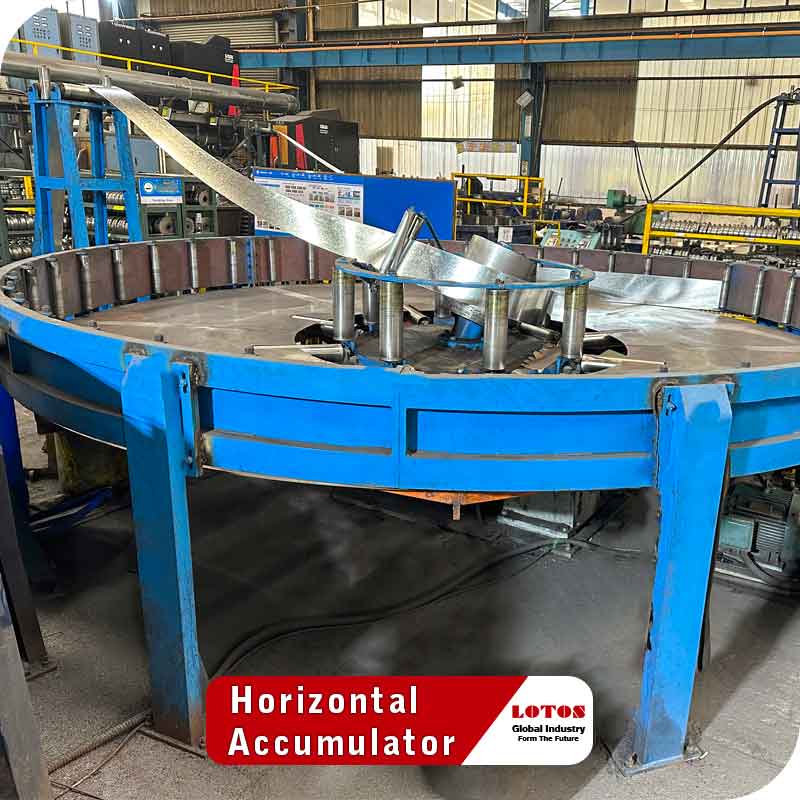
A horizontal accumulator stores strip material along a horizontal plane, typically using a series of fixed and traveling roller carriages mounted on rails or a track system. The strip loops back and forth horizontally, with the traveling carriage moving along the length of the accumulator bed as material is stored or released.
Key Advantages
- Lower Height Profile: Horizontal accumulators are well suited for facilities with restricted ceiling clearance, as the storage system extends lengthwise rather than vertically.
- Simplified Maintenance: With components positioned at or near ground level, inspection, adjustment, and repair tasks are generally more accessible and less time-consuming.
- Structural Simplicity: The horizontal configuration often involves a less complex support structure, which can reduce both capital cost and installation time.
- Common for Heavier Gauges: Horizontal accumulators are frequently favored in mills processing thicker or heavier strip material, where the strip’s rigidity and weight are more easily managed in a horizontal orientation.
Key Limitations
- Larger Floor Space Requirement: The horizontal layout requires a longer building footprint, which can be a limiting factor in facilities with constrained plant dimensions.
- Lower Storage Density: For a given amount of stored strip, a horizontal accumulator generally occupies more ground area than a vertical unit of equivalent capacity.
Selecting the Right Accumulator for Your Tube Mill Line
The choice between a vertical and horizontal accumulator should be guided by several operational considerations:
- Available Plant Space: Facilities with limited floor area but adequate ceiling height are generally better suited to vertical systems, while plants with ample horizontal space but restricted overhead clearance favor horizontal designs.
- Strip Gauge and Material Characteristics: Heavier or thicker strip material is often more efficiently handled by horizontal accumulators, while thinner gauges are commonly accommodated by vertical systems.
- Line Speed and Buffer Requirements: High speed production lines that require substantial strip reserves without expanding their footprint typically benefit from the compact storage density of vertical accumulators.
- Capital and Maintenance Budget: Horizontal accumulators may offer lower upfront structural costs and easier long-term maintenance, which can be a decisive factor for budget-conscious operations.
- Future Line Expansion: Manufacturers planning to scale production or integrate additional processing stations should evaluate how each accumulator type affects overall line layout and flexibility.
Conclusion
Both vertical and horizontal accumulators serve the same fundamental purpose within a tube mill line, enabling continuous, uninterrupted production during coil changeovers but they achieve this through different structural approaches, each with its own set of trade-offs. Vertical accumulators offer superior space efficiency and are well suited to high speed, thin gauge applications, while horizontal accumulators provide easier maintenance access and are often preferred for heavier gauge strip processing.
Selecting the appropriate accumulator configuration requires a careful assessment of plant layout, production speed, material specifications, and long term operational goals. Manufacturers seeking to optimize their tube mill line’s efficiency and reliability should consult with experienced equipment engineers to determine which accumulator design best aligns with their specific production requirements.
FAQ :
Yes. The accumulator must be properly matched to the tube mill’s production speed and strip consumption. Insufficient storage capacity or an improperly selected accumulator can affect continuous operation during coil changing and strip-end welding.
A vertical accumulator stores strip in multiple loops arranged vertically. The strip enters the accumulator, forms loops around the storage section, and is continuously discharged toward the forming and welding sections while a new coil is being prepared and joined.
A horizontal accumulator stores strip in loops arranged along a horizontal path. It provides a continuous strip supply to the tube mill while allowing operators to perform coil-end welding and coil change operations without stopping the main production line.
The accumulator is generally installed after the uncoiling and strip preparation section and before the forming section, depending on the specific tube mill layout. Its purpose is to maintain continuous strip feeding while coil changes and strip-end welding are performed.