

TCT and HSS Circular Saw Blades for Steel Tube
In continuous tube and pipe production, the cut off station determines the final length accuracy, end quality and overall line efficiency. Whether the tube mill uses a flying cut off saw, a rotary cold saw or an orbital system, the saw blade is the primary consumable that governs cut quality, burr formation, downtime and operating cost.
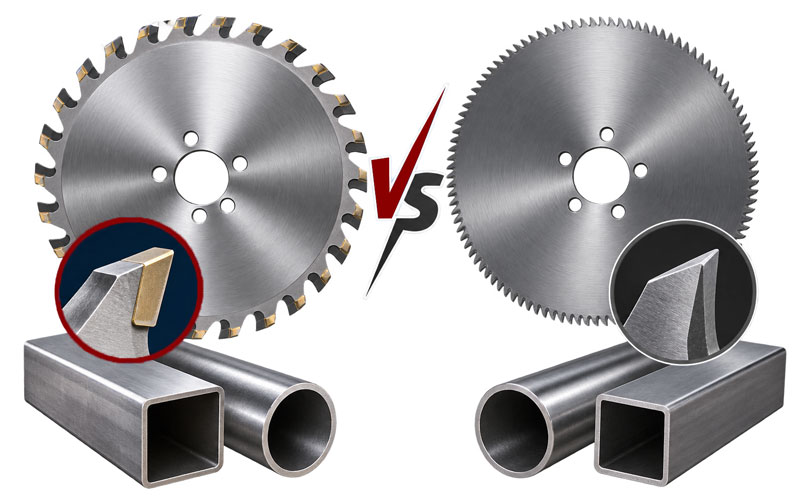
Two blade technologies dominate the industry: HSS (High Speed Steel) saw blades and TCT (Tungsten Carbide Tipped) saw blades. Each has distinct metallurgical characteristics, performance envelopes and economic profiles. Selecting the correct type for a given tube mill is a technical decision that should be based on tube material, wall thickness, line speed, machine rigidity and production volume.
This article provides a structured comparison of TCT and HSS saw blades for tube mill applications, in order to support informed selection.
1. What Is an HSS Saw Blade?
An HSS saw blade is manufactured from high speed steel, an alloy steel containing tungsten, molybdenum, chromium, vanadium and cobalt. The teeth are formed directly from the blade body, which is then heat treated to achieve the required hardness.
Key characteristics:
- Typical hardness of approximately 62–65 HRC after heat treatment
- Good toughness and resistance to chipping
- Ability to be resharpened multiple times
- Common variants include standard HSS (M2) and cobalt-alloyed grades (M35, M42) with improved heat resistance
- Surface treatments such as steam tempering, TiN or TiAlN coating may be applied to extend life
HSS blades are generally used at lower cutting speeds and are widely applied in cold saw machines and older or lower-rigidity cut-off systems.
2. What Is a TCT Saw Blade?
A TCT saw blade has a steel body (plate) onto which individual tungsten carbide tips are brazed at each tooth position. Tungsten carbide is a composite of tungsten carbide particles bonded with cobalt, offering very high hardness and wear resistance.
Key characteristics:
- Carbide hardness of approximately 1,300–1,700 HV, significantly above that of HSS
- Excellent wear resistance and retention of the cutting edge at elevated temperatures
- Capability for high cutting speeds and high feed rates
- Available with specialised tooth geometries for steel, stainless steel and non-ferrous tubes
- Resharpening is possible, generally at specialised facilities using diamond grinding equipment
TCT blades are the preferred solution in modern high speed tube mills, particularly where flying cut off systems and continuous production are involved.
3. Technical Comparison
| Parameter | HSS Saw Blade | TCT Saw Blade |
|---|---|---|
| Cutting edge material | High-speed steel | Tungsten carbide tips |
| Hardness | ~62–65 HRC | ~1,300–1,700 HV (carbide) |
| Wear resistance | Moderate | Very high |
| Heat resistance | Up to approx. 600 °C | Higher; retains hardness at elevated temperatures |
| Toughness / impact resistance | High | Lower; sensitive to vibration and shock |
| Suitable cutting speed | Low to medium | Medium to very high |
| Tool life between sharpenings | Shorter | Considerably longer |
| Cut surface quality | Good | Very good to excellent, with reduced burr |
| Initial purchase cost | Lower | Higher |
| Cost per cut (high volume) | Higher | Lower |
| Resharpening | Simple, widely available | Requires specialised diamond grinding |
| Machine rigidity requirement | Low to moderate | Moderate to high |
4. Performance in Tube Mill Cutting
4.1 Cutting Speed and Productivity
Tube mills operate continuously, and the cut off system must synchronise with line speed. TCT blades support significantly higher peripheral cutting speeds, allowing shorter cut times and higher line speeds. HSS blades, being limited by heat build-up and edge wear at higher speeds, are generally better suited to lower-speed lines or applications where the tube is stopped for cutting.
4.2 Tool Life and Downtime
Blade changes on a tube mill cause line stoppage, scrap and lost output. Because TCT blades retain their edge much longer, the frequency of blade changes is reduced substantially. In high-volume production, the extended interval between changes usually outweighs the higher purchase price of the blade.
4.3 Cut Quality, Burr and End Finish
Tube ends must often meet strict requirements for squareness, burr height and surface finish, particularly when downstream processes include welding, threading, bending or hydraulic fitting assembly. TCT blades produce cleaner cuts with lower burr formation and reduced deformation of thin-wall tube ends. HSS blades tend to develop wear more quickly, which increases burr size and may lead to tube end distortion over the blade’s service life.
4.4 Tube Material Considerations
- Carbon steel tube (low and medium carbon): Both blade types are applicable. TCT is preferred for high-volume, high-speed lines.
- Stainless steel tube: Work hardening and heat generation make TCT with appropriate tooth geometry and cooling advantageous. HSS may be used at reduced speeds.
- High strength or alloy steel tube: TCT blades are generally recommended due to their superior wear resistance.
- Aluminium and non-ferrous tube: TCT blades with suitable geometry are commonly used to prevent material adhesion and achieve a clean cut.
- Galvanised or coated tube: Abrasive coatings accelerate wear on HSS blades; TCT provides better durability.
4.5 Wall Thickness and Tube Profile
Thin wall tube requires fine pitch teeth and stable cutting to avoid vibration and deformation, while thick wall tube requires greater tooth strength and chip space. Both HSS and TCT blades can be produced in a range of tooth pitches and geometries, but the selection must be matched to wall thickness, tube diameter and profile (round, square or rectangular).
5. Economic Analysis: Cost per Cut
The initial price of a TCT saw blade is higher than that of an HSS blade. However, an evaluation based solely on purchase price does not reflect actual operating cost. The relevant metric is cost per cut, which considers:
- Blade purchase price
- Number of cuts achieved per blade and per sharpening cycle
- Resharpening cost and frequency
- Downtime for blade changes
- Scrap generated during changeovers and by declining cut quality
- Cost of secondary deburring operations
In high volume tube mill production, the longer life and consistent cut quality of TCT blades typically result in a lower cost per cut. In low volume, intermittent or small batch production, or where the machine cannot support carbide tooling, HSS blades may remain the more economical option.
6. Machine and Process Requirements
For TCT blades:
- A rigid machine structure with minimal vibration
- Well-maintained spindle bearings and flange assemblies
- Accurate blade clamping and runout control
- Appropriate lubrication or cooling, such as mist or flood coolant, where required
- Correct feed rate control, since carbide is sensitive to impact and chipping
For HSS blades:
- Tolerant of lower machine rigidity
- Suitable for lower speeds with adequate coolant supply
- Well suited to machines designed originally for HSS cold sawing
Using a TCT blade on a machine with excessive vibration or poor clamping can result in tip chipping and premature failure, negating its advantages.
7. Selection Guidelines
A TCT saw blade is recommended when:
- The tube mill operates at medium to high line speeds
- Production volumes are high and continuous
- Minimal burr and high end quality are required
- Long service intervals and reduced downtime are priorities
- The machine has adequate rigidity and stability
An HSS saw blade is recommended when:
- Line speeds are low or cutting is performed with the tube stationary
- Production runs are short or varied
- The machine has limited rigidity or is of older design
- Initial tooling cost must be minimised
- In-house sharpening capability is available
8. Maintenance and Best Practices
- Inspect blades regularly for tooth wear, chipping, cracks and plate damage.
- Resharpen at appropriate intervals. Operating a blade beyond its optimal wear limit reduces cut quality and shortens total blade life.
- Verify blade runout and flange condition at each blade change.
- Optimise cutting parameters, including speed, feed and coolant delivery, for the specific tube material and dimensions.
- Use correct tooth geometry matched to wall thickness and material.
- Store blades properly to prevent tooth damage and plate deformation.
- Record performance data, such as cuts per blade and sharpening cycles, to support cost-per-cut analysis.
Conclusion
Both HSS and TCT saw blades have a legitimate place in tube mill operations. HSS blades offer toughness, lower initial cost and easy resharpening, making them suitable for lower speed and lower volume applications. TCT blades provide superior wear resistance, higher cutting speeds, longer tool life and better cut quality, which makes them the preferred choice for modern, high speed and high volume tube mills.
The optimal selection depends on tube material, wall thickness, line speed, machine condition and production volume. A cost-per cut evaluation, rather than a comparison of purchase price alone, provides the most reliable basis for the decision.
FAQ:
Yes. TCT blades can be resharpened several times using diamond grinding wheels, provided sufficient carbide remains on the tooth.
Yes, with the correct tooth geometry, cutting parameters and cooling. Machine rigidity is important to avoid chipping.
Not in every case. In low-volume production or on machines lacking rigidity, HSS may deliver a lower total cost.
For high speed, high volume tube mills, TCT saw blades are generally superior because of their longer life and cleaner cuts. HSS blades remain suitable for lower speed or lower volume operations.