

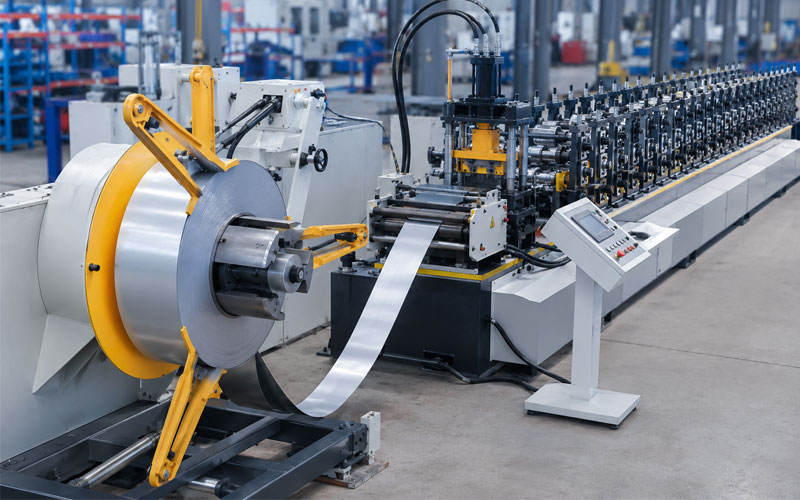
Solar Mounting System Roll Forming Machine
The rapid growth of the solar energy industry has significantly increased the demand for durable and high-precision mounting structures. Among the most widely used structural components are CZU solar channels, which provide exceptional strength, flexibility, and ease of installation for photovoltaic (PV) support systems.
A CZU Solar Channel Roll Forming Process enables manufacturers to produce consistent, high-quality profiles at high production speeds with minimal material waste. By combining servo punching, precision roll forming, and automatic cutting, this manufacturing method has become the preferred solution for modern solar mounting system production.
At LOTOSFORMING, we design and manufacture fully automatic CZU Solar Channel Roll Forming Machines that deliver reliable performance, accurate dimensions, and efficient production for customers worldwide.
What Is a CZU Solar Channel?
A CZU Solar Channel is a cold-formed steel profile used in photovoltaic mounting structures. Its adjustable geometry allows it to function as a C Channel, Z Channel, or U Channel, making it suitable for a wide range of solar support applications.
These profiles are commonly manufactured from:
- Galvanized Steel
- Pre-Galvanized Steel
- Hot-Dip Galvanized Steel
- High-Strength Structural Steel
CZU solar channels are widely used in:
- Ground-mounted solar farms
- Rooftop solar mounting systems
- Carport solar structures
- Agricultural photovoltaic systems
- Utility-scale solar power plants
What Is the CZU Solar Channel Roll Forming Process?
The CZU Solar Channel Roll Forming Process is a continuous cold roll forming method that transforms a flat steel coil into a finished solar mounting profile through a sequence of precisely engineered forming stations.
Unlike conventional fabrication methods, roll forming produces complex cross-sections continuously without interrupting production, making it ideal for large-volume manufacturing.
Complete CZU Solar Channel Roll Forming Process
1. Steel Coil Loading
Production begins by loading the galvanized steel coil onto the hydraulic decoiler.
The decoiler:
- Supports the steel coil
- Unwinds material smoothly
- Maintains constant feeding tension
- Prevents coil deformation
Proper coil feeding is essential for maintaining profile accuracy throughout the production process.
2. Servo Feeding and Leveling
The steel strip passes through a servo feeding and leveling system.
Its functions include:
- Removing coil curvature
- Eliminating residual stress
- Improving strip flatness
- Providing accurate feeding length
A high-quality leveling system ensures dimensional consistency during roll forming.
3. Servo Punching Process
Before entering the roll forming machine, the steel strip passes through the punching station.
Typical punching operations include:
- Mounting holes
- Elongated slots
- Connection holes
- Assembly holes
- Drainage holes
Modern CZU production lines use servo-controlled hydraulic punching to achieve:
- High positioning accuracy
- Fast production speed
- Consistent hole spacing
- Reduced material deformation
Punching before forming minimizes distortion and improves hole accuracy.
4. Roll Forming
The punched strip enters the roll forming section, where multiple roller stations gradually shape the steel into the required profile.
Each forming stand performs only a small amount of deformation, reducing internal stress and ensuring a smooth profile surface.
The roll forming section provides:
- Excellent dimensional accuracy
- Smooth profile edges
- Stable production
- High-speed continuous forming
The number of forming stations depends on:
- Material thickness
- Profile complexity
- Steel strength
- Production speed
5. Profile Calibration
After the primary forming stations, calibration rollers fine-tune the profile dimensions.
Calibration improves:
- Width accuracy
- Height consistency
- Straightness
- Twist correction
- Surface finish
This step ensures that every CZU solar channel meets engineering specifications.
6. Automatic Flying Cut Off
Once the required length is reached, the flying cut-off system cuts the profile without stopping the production line.
Advantages include:
- Continuous production
- High cutting accuracy
- Clean cut surfaces
- Increased productivity
- Reduced production downtime
Servo-controlled flying cut-off systems are commonly used in modern CZU roll forming lines.
7. Automatic Product Collection
Finished solar channels are transferred to an automatic receiving table where they are:
- Collected
- Counted
- Stacked
- Prepared for packaging
Automatic stacking reduces manual labor while protecting the finished profiles from scratches.
Main Components of a CZU Solar Channel Roll Forming Line
A complete production line typically consists of:
- Hydraulic Decoiler
- Servo Feeding System
- Precision Leveling Machine
- Servo Hydraulic Punching Unit
- Roll Forming Machine
- Calibration Section
- Flying Cut-Off Machine
- Automatic Receiving Table
- PLC Control Cabinet
- Hydraulic System
Each component contributes to maintaining production efficiency and product quality.
Materials Processed
A CZU Solar Channel Roll Forming Machine can process various materials, including:
- Galvanized Steel
- Hot-Dip Galvanized Steel
- High-Strength Steel
- Mild Steel
- Pre-Galvanized Steel
Material thickness typically ranges from 1.5 mm to 4.0 mm, depending on project requirements.
Advantages of the CZU Solar Channel Roll Forming Process
High Production Efficiency
Continuous roll forming enables high speed manufacturing while maintaining consistent product quality.
Excellent Dimensional Accuracy
Servo feeding and precision rollers ensure tight tolerances throughout production.
Low Material Waste
Continuous forming minimizes scrap and optimizes material utilization.
Flexible Production
Quick tooling adjustments allow manufacturers to produce multiple CZU profile sizes on a single production line.
Superior Surface Quality
Gradual forming minimizes scratches and preserves galvanized coatings.
Lower Production Costs
Automation reduces labor requirements while increasing production capacity.
Applications of CZU Solar Channels
CZU solar channels are used in numerous renewable energy projects, including:
- Solar panel mounting systems
- Utility-scale photovoltaic plants
- Commercial rooftop installations
- Residential solar projects
- Solar carports
- Ground-mounted solar structures
- Industrial photovoltaic systems
Their high strength and corrosion resistance make them suitable for demanding outdoor environments.

Automation and Intelligent Control
Modern LOTOSFORMING production lines feature advanced automation, including:
- PLC-controlled operation
- Touch-screen Human Machine Interface (HMI)
- Servo feeding control
- Automatic production monitoring
- Fault diagnosis system
- Recipe storage for different profile sizes
- Production data recording
These intelligent features improve operational efficiency and reduce setup time.
Why Choose LOTOSFORMING?
LOTOSFORMING is a professional manufacturer of roll forming equipment with extensive experience in producing CZU Solar Channel Roll Forming Machines for global customers.
Our solutions provide:
- Fully automatic production lines
- High-speed roll forming technology
- Servo punching systems
- Precision flying cut-off
- Customized machine configurations
- High-quality roll tooling
- PLC automation and intelligent control
- Professional installation and commissioning
- Worldwide technical support
- One-year warranty and long-term after-sales service
Our engineering team customizes each production line according to the customer’s profile design, material specifications, and production capacity requirements.
Conclusion
The CZU Solar Channel Roll Forming Process is a highly efficient manufacturing method for producing precision solar mounting profiles with outstanding consistency and productivity. By integrating servo feeding, accurate punching, progressive roll forming, profile calibration, and flying cut-off technology, manufacturers can achieve reliable, high-volume production while maintaining strict quality standards.
Whether you are manufacturing C, Z, or U solar channels for rooftop systems, ground-mounted installations, or utility-scale photovoltaic projects, a LOTOSFORMING CZU Solar Channel Roll Forming Machine delivers the precision, flexibility, and automation needed to meet the growing demands of the global solar industry.
FAQ:
The roll forming section gradually shapes the flat steel strip into the required CZU profile using multiple precision roller stations. Progressive forming reduces stress on the material and produces accurate, high-quality profiles.
Key benefits include:
- High production speed
- Excellent dimensional accuracy
- Consistent product quality
- Low material waste
- High automation
- Reduced labor costs
- Smooth profile surface
- Long machine service life
Yes. Many modern CZU roll forming machines feature quick change tooling or adjustable roller systems, allowing manufacturers to produce multiple profile sizes with minimal setup time.
With precision tooling, servo feeding, and PLC-controlled automation, CZU Solar Channel Roll Forming Machines produce profiles with excellent dimensional consistency and repeatable hole positioning, meeting the requirements of modern solar mounting systems.
A CZU Solar Channel is a structural steel profile used in photovoltaic (PV) mounting systems. Its versatile design allows it to function as a C, Z, or U channel, making it suitable for various solar panel support applications.