
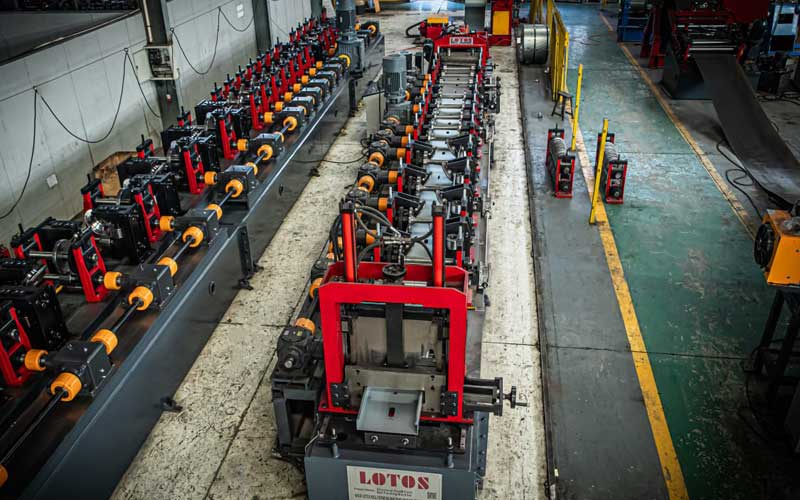
What is stud and track roll forming machine?
The Heavy Duty Structural Track Roll Forming Process is a continuous cold-forming method used to manufacture high-strength steel tracks for structural framing and light steel construction. Compared with conventional light gauge framing tracks, heavy-duty structural tracks are designed for applications requiring greater load-bearing capacity, dimensional stability, and structural performance.
A modern Heavy Duty Structural Track Roll Forming Machine integrates coil handling, leveling, precision feeding, punching, progressive roll forming, cutting, and finished-profile handling into a continuous automated production line. LOTOSFORMING develops customized roll forming solutions according to the required track profile, material thickness, punching pattern, production speed, and finished length.
What Is a Heavy-Duty Structural Track?
A Heavy Duty Structural Track is a cold-formed steel framing component designed to work with structural studs. The track provides a supporting and connecting member at the top and bottom of a framed wall or structural assembly.
Depending on the project, structural tracks can be manufactured with customized:
- Web width
- Flange height
- Lip dimensions
- Material thickness
- Punching patterns
- Profile length
- Hole and slot configurations
Heavy-duty structural tracks are commonly used in light steel framing (LSF), structural steel framing, modular construction, prefabricated buildings, commercial buildings, and industrial structures.
Heavy Duty Structural Track Roll Forming Process
The complete manufacturing process generally follows this sequence:
Steel Coil → Decoiling → Leveling → Servo Feeding → Pre-Punching → Roll Forming → Post-Punching → Cutting → Run-Out → Stacking
Each stage performs a specific function to ensure accurate and consistent production.
1. Steel Coil Loading and Decoiling
Production starts with loading the steel coil onto the decoiler. The decoiler supports the coil and continuously feeds the steel strip into the roll forming line.
For heavy-duty structural track production, the coil-handling equipment must be appropriately designed for the material thickness, coil width, and coil weight.
A hydraulic or motorized decoiler can provide controlled material release and stable feeding during continuous production.
2. Leveling and Material Preparation
After decoiling, the steel strip enters the leveling section.
Steel coils naturally retain curvature after being wound. Leveling removes this curvature and improves the flatness of the strip before it reaches the forming section.
Proper leveling helps maintain:
- Profile dimensional accuracy
- Stable material feeding
- Consistent punching position
- Reduced forming deformation
- Improved finished-track straightness
For heavy-gauge material, the leveling system must provide sufficient mechanical strength to effectively process the steel strip.
3. Servo Feeding System
A precision servo feeding system controls the movement of the steel strip through the production line.
Accurate feeding is particularly important when the structural track contains repeated holes, slots, or connection openings.
The servo feeder can control:
- Feeding distance
- Punching pitch
- Hole positioning
- Production synchronization
- Material acceleration and deceleration
This enables accurate coordination between the punching system and roll forming machine.
4. Pre-Punching Process
Depending on the structural track design, punching can be performed before roll forming.
Pre-punching is suitable when holes or slots need to be created while the steel strip is still flat. This can simplify punching operations for specific profile designs.
Typical punched features may include:
- Service holes
- Connection holes
- Fastener holes
- Assembly slots
- Structural openings
The punching pattern can be customized according to the customer’s engineering drawings.
5. Progressive Roll Forming
The flat steel strip then enters the roll forming section.
The profile is progressively shaped through multiple forming stations rather than being formed in one operation. Each roller station performs a controlled amount of deformation until the final structural track geometry is achieved.
For heavy-duty structural tracks, the roll forming machine requires a rigid frame, properly engineered forming stands, and precision tooling capable of handling higher-strength and thicker steel.
Progressive roll forming provides:
- Consistent profile dimensions
- Stable forming
- Accurate flange geometry
- Reduced material stress
- High production repeatability
- Continuous manufacturing
The number and configuration of forming stations depend on the track design, material thickness, steel grade, and required production speed.
6. Post Punching
Some structural track designs require punching after the steel has been formed.
Post-punching allows specific holes or slots to be positioned directly on the finished profile.
The choice between pre-punching and post-punching depends on:
- Profile geometry
- Hole location
- Hole dimensions
- Material thickness
- Production requirements
- Required positioning accuracy
A customized production line can incorporate either method or a combination of both.
7. Track Cutting to Length
After roll forming, the continuous structural track passes through the cutting system.
A hydraulic or servo tracking flying shear can cut the formed track to the specified length while maintaining continuous production.
The cutting system is designed to provide:
- Accurate finished lengths
- Clean cutting
- Reduced production interruption
- Consistent product dimensions
- High production efficiency
Cutting parameters can be configured according to the profile geometry and material specifications.
8. Finished Track Handling and Stacking
After cutting, the finished structural tracks move onto a run-out table or automatic stacking system.
Depending on the required automation level, the line can incorporate:
- Automatic counting
- Automatic stacking
- Bundling
- Conveying
- Labeling
- Finished-product transfer
Automated handling reduces manual labor and helps maintain an organized production workflow.
Materials for Heavy Duty Structural Track Roll Forming
The material selection depends on the structural requirements of the finished track. Common materials include:
- Galvanized Steel
- Pre-Galvanized Steel
- Cold-Rolled Steel
- High-Strength Steel
- Coated Steel
Material thickness, yield strength, coil width, and surface treatment should be considered when designing the roll forming line and tooling.
Main Components of a Heavy Duty Structural Track Roll Forming Line
A typical production line can include:
Hydraulic Decoiler
Supports and unwinds heavy steel coils.
Leveling Machine
Corrects coil curvature before forming.
Servo Feeder
Provides precise material feeding and synchronization.
Hydraulic Punching System
Creates holes and slots according to the required structural design.
Roll Forming Machine
Progressively forms the flat strip into the structural track profile.
Cutting System
Cuts the continuous profile to the specified length.
Run Out Table
Transfers finished tracks away from the forming machine.
Automatic Stacking System
Collects and organizes finished profiles for handling and packaging.
PLC Control System
Coordinates the major production operations through an industrial control system and HMI.
Applications of Heavy-Duty Structural Tracks
Heavy-duty structural tracks are used in various construction and structural applications, including:
- Light Steel Frame Construction
- Structural Steel Framing
- Modular Buildings
- Prefabricated Buildings
- Commercial Construction
- Industrial Buildings
- Exterior Wall Framing
- Interior Structural Walls
- Roofing Systems
- Steel Building Systems
Their application depends on the profile design, material grade, thickness, and engineering requirements of the project.
Advantages of the Heavy-Duty Structural Track Roll Forming Process
High Production Efficiency
Continuous roll forming allows steel tracks to be manufactured at a consistent production rate with reduced manual intervention.
Excellent Dimensional Consistency
Precision forming tools and controlled feeding help maintain consistent web and flange dimensions.
Customized Punching
The punching system can be configured for different hole patterns, slots, and structural connection requirements.
Reduced Material Waste
Continuous coil processing makes efficient use of raw material and reduces unnecessary production scrap.
Automated Production
Feeding, punching, forming, cutting, and stacking can be integrated into one automated production line.
Flexible Profile Production
The machine configuration can be engineered according to different structural track dimensions and customer requirements.
Why Choose LOTOSFORMING for Heavy Duty Structural Track Roll Forming?
LOTOSFORMING provides customized Heavy-Duty Structural Track Roll Forming Machines for manufacturers requiring reliable and automated production of structural steel framing components.
The production line can be engineered according to:
- Structural track profile
- Steel thickness
- Coil width
- Material grade
- Punching pattern
- Finished track length
- Production speed
- Automation requirements
- Factory layout
With integrated decoiling, leveling, servo feeding, punching, roll forming, cutting, and stacking, a LOTOSFORMING production line provides a complete solution for high-precision structural track manufacturing.
Conclusion
The Heavy Duty Structural Track Roll Forming Process combines precision coil feeding, controlled punching, progressive cold forming, accurate cutting, and automated handling to manufacture strong and dimensionally consistent structural tracks.
For manufacturers serving the LSF and structural steel framing industries, selecting the correct roll forming configuration is essential for achieving stable production and consistent profile quality. LOTOSFORMING can customize the Heavy-Duty Structural Track Roll Forming Machine according to the required material, profile geometry, punching configuration, production capacity, and automation level.