
Packaging Machine
- Home
- Packaging Machine
Technical Guide for Roll Formed Metal Products
In metal forming production, the work does not end when the product leaves the cutting unit. Roll formed profiles, tubes, panels and sheets must be counted, stacked, protected and secured before storage or shipment. A packaging machine automates these final steps. It reduces manual handling, protects surface coatings from damage and gives a consistent, safe package for transport.
What Is a Packaging Machine?
A packaging machine is an automated or semi automated system that groups finished products and prepares them for handling and shipment. In a metal processing plant, the packaging process usually includes some or all of the following operations:
- Counting and grouping of finished pieces
- Stacking or bundling in a set arrangement
- Wrapping or protective covering
- Strapping or binding
- Labeling and marking
- Transfer to a discharge table or conveyor
Integrating the packaging machine with the production line allows the whole process to be continuous, from coil to finished package.
Types of Packaging Machines for Roll Formed Products
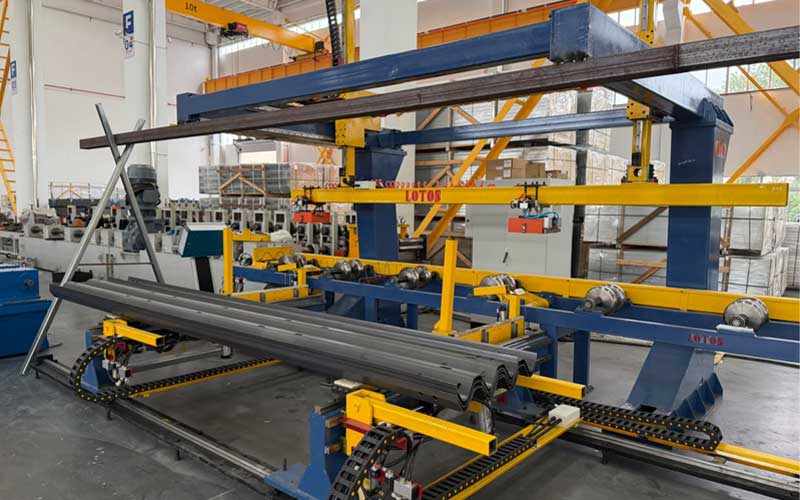
1. Automatic Stacking Machine
The stacking machine collects cut profiles or sheets from the run out table and arranges them in neat layers. It is commonly used for roofing sheets, floor deck, purlins and similar products. Stacking can be adjusted by quantity, layer count or bundle height.
2. Strapping Machine
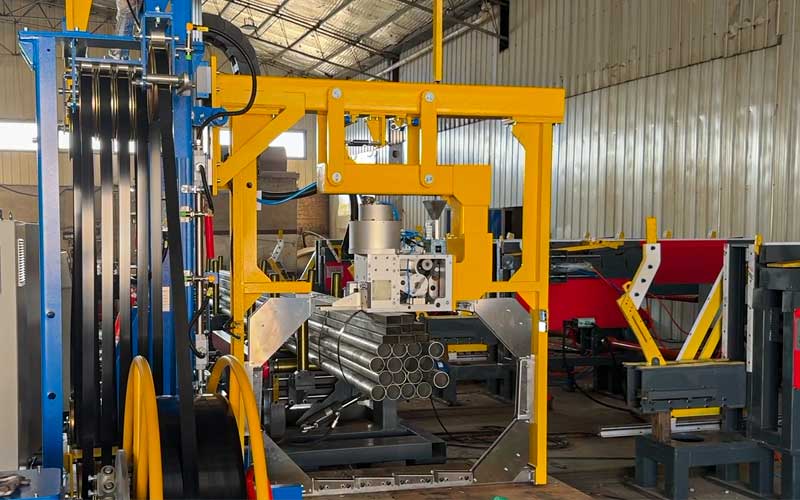
A strapping machine binds the stacked bundle with steel or PET/PP strap. It tensions the strap, seals it and cuts it automatically. It is the most common packaging step for profiles and tubes because it gives a firm bundle that can be lifted by forklift or crane.
3. Stretch Wrapping Machine
This machine wraps stretch film around the bundle or pallet. It protects the surface from dust and moisture and keeps the load stable. It is often combined with strapping for coated or pre-painted products.
4. Tube Bundling and Packing Machine
For tube mill lines, the tube packing machine collects round, square or rectangular tubes and forms them into hexagonal or rectangular bundles. The bundle is then strapped. This arrangement makes good use of space and gives a stable load.
5. Coil Packing Machine
Coil packing machines wrap and strap steel coils produced by slitting lines. They protect the coil edges and surface during storage and shipment.
Main Components of a Packaging Machine
Infeed and Conveying System
Roller or belt conveyors move the finished products from the cutting unit to the packaging station. The conveyor must match the product width, length and weight, and it must not damage the surface.
Counting and Sensing Unit
Photoelectric sensors or encoders count the pieces and detect product position. This allows each bundle to contain the required quantity.
Stacking or Bundling Mechanism
This section arranges the products in layers or shapes. Depending on the design, it may use pneumatic, hydraulic or servo-driven motion.
Strapping or Wrapping Head
The head feeds, tensions, seals and cuts the strap, or applies the film. Tension should be adjustable to suit the product and avoid deformation of thin-walled sections.
Control System
A PLC with a touchscreen is normally used. The operator selects the bundle size, quantity and strap number. The system also displays production data and fault alarms.
Discharge System
Finished bundles are moved to an output table, roller conveyor or pallet area. The discharge can be connected to a crane, forklift or automatic handling equipment.
Safety Devices
Guards, emergency stop buttons, light curtains and interlocks protect operators and meet industrial safety requirements.
Working Principle
A typical automatic packaging process follows these steps:
- Finished products leave the cutting unit and travel along the run-out conveyor.
- Sensors count the pieces and send the signal to the PLC.
- The stacking or bundling mechanism arranges the pieces into the set pattern.
- The bundle moves to the strapping or wrapping station.
- The strapping head applies the straps at set positions, then tensions, seals and cuts them.
- Finished bundles are discharged for labeling, storage or loading.
The packaging cycle can be synchronized with the line speed, so that the production line does not need to slow down.
Advantages of an Automatic Packaging Machine
- Higher productivity: continuous operation without waiting for manual bundling.
- Better product protection: controlled handling reduces scratches and deformation.
- Consistent packages: uniform bundle size and strap tension improve the quality of the delivered product.
- Lower labor demand and safer work: operators do not need to lift heavy or sharp-edged products by hand.
- Easy integration: the machine can be designed to connect directly to roll forming, tube mill or cut-to-length lines.
- Flexible settings: bundle quantity, length and strap positions can be adjusted for different products.
Applications
Packaging machines are used with the following types of equipment and products:
- Roofing sheet and wall panel roll forming lines
- Floor deck and corrugated sheet production
- Purlin, C/Z/U channel and solar channel lines
- ERW tube mill and pipe production lines
- Steel stud and light gauge steel framing lines
- Slitting and cut to length lines
- Gutter, downspout and trim production
Maintenance Recommendations
Regular maintenance supports stable operation and a long service life:
- Lubricate chains, bearings, guide rails and moving parts as scheduled.
- Check and clean sensors to keep counting accurate.
- Inspect the strapping head, cutter and sealing parts for wear.
- Verify strap tension settings regularly.
- Check air pressure, hydraulic oil level and filters where applicable.
- Test safety devices and emergency stops periodically.
- Keep a record of maintenance and replace wearing parts in time.
Conclusion
A well designed packaging machine is an important part of a complete metal production line. It protects the product, increases efficiency and gives a consistent, safe package for storage and shipment. The right machine should be selected according to the product type, dimensions, line speed and packaging requirements.
LotosForming supplies roll forming machines, tube mill lines, slitting and cut to length lines and matching auxiliary equipment. Contact our team with your product details and output requirements to receive a customized packaging solution and quotation.
FAQ:
Yes, within the designed range. Adjustable guides, stacking settings and PLC recipes allow the machine to handle different lengths, widths and bundle quantities.
Depending on the machine design, steel strap, PET strap or PP strap can be used. The choice depends on the weight of the bundle and the required strength.
Please provide the product drawing or sample size, material and thickness, line speed, bundle requirements, packaging material and local power supply.
Yes. The machine can be designed to receive products from the run-out table and operate in sequence with the production line.
Yes. The conveying and stacking parts can be designed to protect the surface, and options such as protective film, paper or edge protectors can be added.