Our Products

Complete Guide to High Speed Tube and Pipe Production Solutions

A tube mill line is the core production system for manufacturing welded steel tubes and pipes at industrial scale. From structural square tubes to precision stainless steel pipes, a well engineered tube mill line determines output speed, dimensional accuracy, weld quality, and long-term operating cost. This guide explains how tube mill lines work, their main components, the tube types they produce, and the criteria for choosing the right line for your business.

What Is a Tube Mill Line?

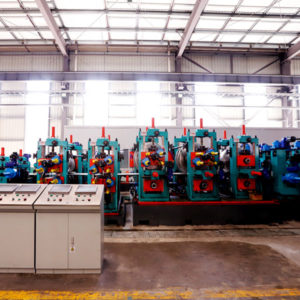
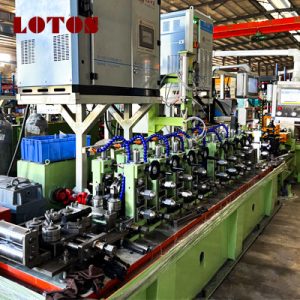
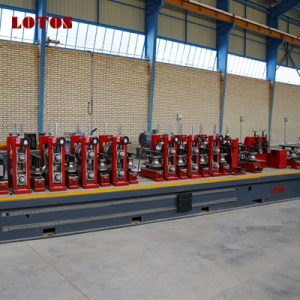
A tube mill line (also called a tube mill, pipe mill, or ERW tube mill) is a continuous production line that converts flat steel strip into finished tube. The strip is progressively formed into a round profile, welded along the seam, sized, shaped if required, and cut to length, all in one uninterrupted process.

Tube mill lines are widely used in industries such as:

  • Construction and structural engineering
  • Automotive and transportation
  • Furniture and home appliances
  • Agricultural machinery
  • Oil, gas, and water pipelines
  • Solar mounting and energy infrastructure
  • Fencing, scaffolding, and general fabrication

How to Choose the Right Tube Mill Line

Selecting a tube mill line is a long-term investment. Consider the following factors before purchasing.

1. Product Range

Define the tube shapes, diameters, and wall thicknesses you plan to produce, both now and in the near future. This determines the mill size, number of stands, and tooling requirements.

2. Material Type and Grade

Carbon steel, stainless steel, and galvanized strip each call for different welding methods, forming parameters, and roll materials.

3. Production Capacity

Calculate your target output in meters or tons per hour. Line speed, mill power, and accumulator capacity should match your demand.

4. Quality Requirements

Standards for tolerance, weld strength, and surface finish vary by application. Pipelines, automotive parts, and furniture tubing each have different demands.

5. Tooling and Roll Design

Roll quality affects both product quality and changeover time. Look for suppliers with proven roll design expertise and quick-change tooling systems.

6. Automation Level

Consider PLC controls, automatic length measurement, data recording, and remote diagnostics to improve efficiency and reduce operator dependence.

7. Supplier Support

Reliable installation, commissioning, operator training, spare parts supply, and after-sales service are as important as the machine itself.

Why Choose Lotos Forming for Tube Mill Lines?

Lotosforming specializes in the design and manufacture of tube mill lines and complete roll forming solutions for global customers. Our approach combines engineering precision with practical production experience:

  • Customized line design matched to your tube sizes, materials, and output targets
  • Precision engineered tooling with optimized roll design for stable forming and long service life
  • Robust machine construction built for continuous, high speed industrial operation
  • Advanced control systems for accurate, repeatable, and efficient production
  • Complete line solutions, from uncoiling to cutting and packing, with compatible auxiliary equipment
  • Dedicated technical support, including installation guidance, training, and after-sales service

Whether you produce structural square tubes, decorative stainless pipes, or specialty profile tubes, Lotosforming delivers tube mill lines built for productivity and reliability.

How a Tube Mill Line Works

The production process follows a defined sequence, with each stage affecting the quality of the finished tube.

1. Uncoiling and Strip Accumulation

A steel coil is loaded onto the uncoiler, and the strip is fed into the line. To keep production continuous during coil changes, the line typically includes a strip end shearer, a welder for joining strip ends, and a strip accumulator (horizontal or spiral) that stores material while the joint is made.

2. Forming Section

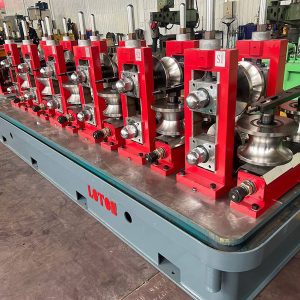
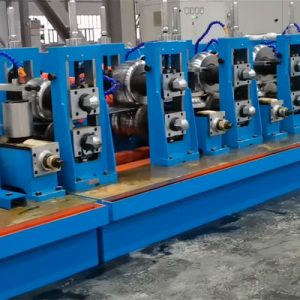
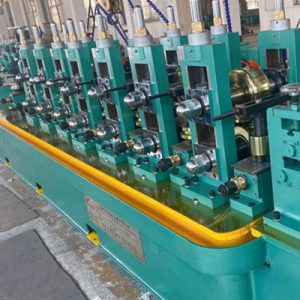
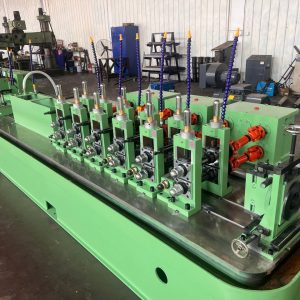
The strip passes through a series of forming stands, where precisely engineered rolls gradually bend it into an open round shape. Quality roll design is essential here. It directly influences edge condition, forming stability, and the roundness of the finished tube. The forming section generally includes breakdown, fin-pass, and side roll stands.

3. Welding

At the weld station, the open edges of the strip are heated and pressed together to form a continuous seam. Common welding methods include:

  • High-frequency (HF) induction welding, the standard for ERW carbon steel tubes
  • TIG welding, widely used for stainless steel and thin-wall tubes
  • Laser welding, for high precision, high value applications

4. Weld Seam Scarfing

For ERW production, the external (and sometimes internal) weld bead is removed by scarfing tools, leaving a smooth surface that meets finishing and coating requirements.

5. Cooling

Cooling units bring the welded tube to a stable temperature before sizing, helping preserve dimensional accuracy.

6. Sizing and Straightening

Sizing stands calibrate the tube to its final outer diameter and roundness. Turks head units then straighten the tube to control straightness and reduce twist.

7. Shaping (Optional)

For square and rectangular tubes, a shaping section transforms the round tube into the required profile, such as square, rectangular, oval, or other special shapes.

8. Flying Cut-Off

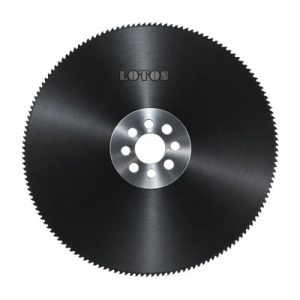
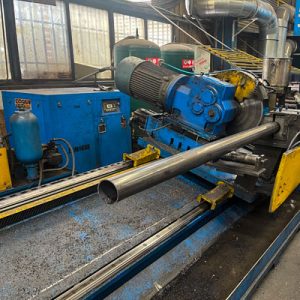
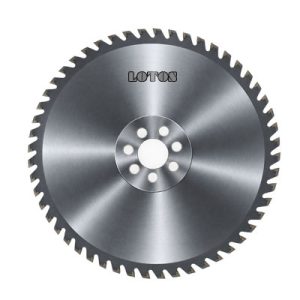
A flying cut off machine cuts the continuously moving tube to the required length without stopping the line. Saw selection, whether cold saw, TCT saw blades, or HSS saw blades, affects cut quality, blade life, and burr control.

9. Run-Out Table and Packing

Finished tubes are collected, inspected, counted, and bundled for shipment.

Types of Tube Mill Lines

Tube mill lines are generally classified by the material processed and the tube shape produced.

By tube shape:

  • Round tube mill lines
  • Square and rectangular tube mill lines
  • Special-shaped tube mill lines (oval, octagonal, D-shape, and others)

By material:

  • Carbon steel tube mill lines
  • Stainless steel tube mill lines
  • Galvanized steel tube mill lines
  • Aluminum and other non-ferrous tube mill lines

By size range:

  • Small-diameter precision tube mills
  • Medium-size general-purpose tube mills
  • Large-diameter heavy-duty pipe mills

Key Advantages of a Modern Tube Mill Line

Investing in a well-designed tube mill line offers measurable benefits:

  • High production speed. Continuous operation maximizes output per shift.
  • Consistent quality. Automated forming and welding deliver uniform wall thickness and weld integrity.
  • Material efficiency. Precise strip handling and cutting reduce scrap.
  • Flexibility. Quick-change tooling and adjustable stands allow production of multiple sizes on one line.
  • Lower operating cost. Reduced labor requirements and optimized energy use improve profitability.
  • Automation-ready. Modern lines integrate PLC control, servo systems, and monitoring for stable, repeatable production.

FAQ:

Yes. With adjustable stands and changeable roll sets, one line can produce a range of sizes and shapes, and quick-change systems reduce downtime between jobs.

High frequency welding is standard for carbon steel ERW tubes, while TIG or laser welding is preferred for stainless steel and high-precision applications.

The main factors are tube size range, material type, line speed, automation level, tooling requirements, and the auxiliary equipment included.

Both use progressive roll forming. A tube mill adds a welding station and sizing section to produce closed, welded tube, while a standard roll forming machine produces open profiles.

Drag & Drop Files, Choose Files to Upload