
Solar Channel Roll Forming Lines
- Home
- Solar Channel Roll Forming Lines
Our Products
Showing all 10 results
-
C/U Solar Automatic Machine 4mm_15 M.Min
-
CU Angular Solar Channel Roll Forming Machine 4MM_30M.Min
-
CU Solar Channel Roll Forming Machine 2.5MM_25M.Min
-
CZU Purlin Machine 3 MM_30 M/Min
-
CZU Purlin Machine 4 MM _15 M/Min
-
CZU Purlin Machine 4 MM_25 M.Min
-
High Speed Fully Automatic 3mm C/U Solar (30M/Min)
-
High Speed Fully Automatic 4 mm C/U Solar Machine (30M/Min)
-
Unistrut Channel Machine 2.5 MM
-
Unistrut Channel Roll Forming Machine 22M.Min

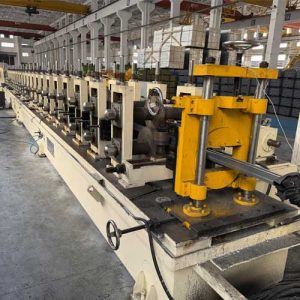
Precision Manufacturing for Photovoltaic Mounting Structures
The global expansion of solar energy has created sustained demand for durable, accurately manufactured mounting structures. Among the most important components of these systems are solar channels, including C-channels, U-channels, Z-purlins, and Omega profiles, which form the load-bearing framework that supports photovoltaic (PV) modules. A solar channel roll forming line is the production system engineered to manufacture these profiles efficiently, consistently, and at industrial scale. This article describes the function of such a line, its principal components, the profiles it produces, and the criteria for selecting a suitable solution.
What Is a Solar Channel Roll Forming Line?
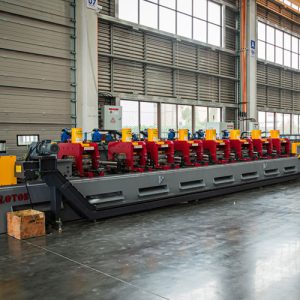
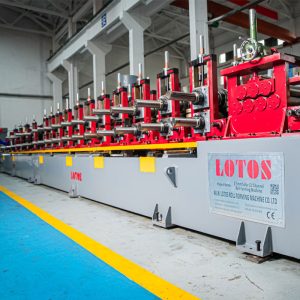
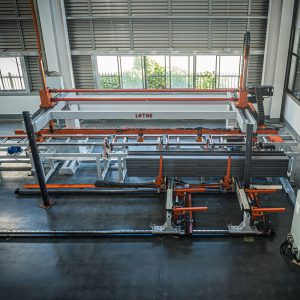
A solar channel roll forming line is a continuous manufacturing system that converts flat metal coil into finished structural profiles through a progressive series of forming stations. The coil is uncoiled, leveled, punched where required, formed to the desired cross section, and cut to length without interruption of the process.
Roll forming is the preferred method for solar mounting profiles because it offers high output, tight dimensional tolerances, minimal material waste, and uniform quality across long production runs. These characteristics are essential for large scale solar installations, where thousands of identical components must fit together precisely on site.
Solar channel roll forming lines produce profiles used in a wide range of photovoltaic support systems, including:
- Ground mounted solar racking systems
- Rooftop mounting structures
- Solar carport and canopy frameworks
- Single axis and dual-axis tracker components
- Purlins, rails, and cross-beams for module support
- Cable trays and supporting accessories for solar plants
Main Components of a Solar Channel Roll Forming Line
1. Uncoiler
The uncoiler supports and feeds the steel coil into the line. Hydraulic or motorized expansion mandrels ensure secure handling of heavy coils.
2. Feeding and Leveling Unit
This unit guides the strip and removes coil set and residual stress, ensuring that flat, stable material enters the forming section.
3. Servo Feeder and Punching Unit
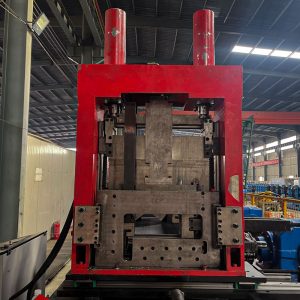
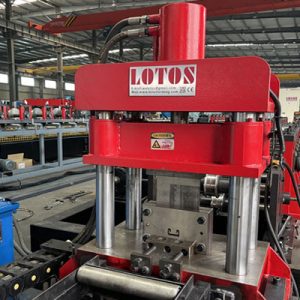
Solar profiles frequently require holes, slots, or notches for bolting and assembly. A servo feeder combined with a punching press, or an inline hydraulic punching system, produces these features with high positional accuracy. Punching before forming is common for complex hole patterns.
4. Roll Forming Section
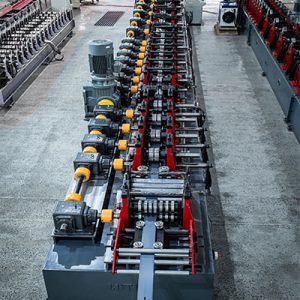
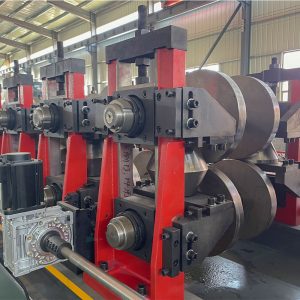
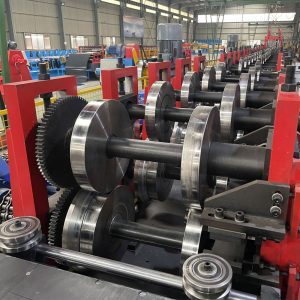
The roll forming section consists of multiple stands fitted with precision machined rollers. The strip is bent gradually, stage by stage, until the final cross-section is achieved. Roller material, heat treatment, and surface finish directly affect profile accuracy and tooling life.
5. Straightening Unit
Following forming, a straightening section corrects bow, twist, and camber, ensuring that finished profiles meet installation tolerances.
6. Cut to Length System
A hydraulic or servo driven cutting unit, often a flying cut off arrangement, cuts profiles to specified lengths without stopping the line. Accurate length control is vital for efficient on site assembly.
7. Run Out Table and Stacking
Finished channels are collected on a run-out table, inspected, and stacked or packed for shipment.
8. PLC Control System
A central PLC with touchscreen interface manages line speed, punching patterns, cutting length, and production counting, enabling repeatable production and rapid job changeovers.
Materials Processed
Solar mounting profiles are typically manufactured from materials selected for strength and corrosion resistance:
- Pre-galvanized steel (GI)
- Hot-dip galvanized steel
- Zinc-aluminum-magnesium (ZAM) coated steel
- High-strength low-alloy steel
- Aluminum, for lightweight applications
Coated materials require roll forming tooling and process settings that protect the surface coating, since damage to the zinc layer would reduce long-term corrosion protection in outdoor environments.
Advantages of a Dedicated Solar Channel Roll Forming Line
- High productivity. Continuous operation supports the volume requirements of utility-scale solar projects.
- Dimensional accuracy. Consistent profiles ensure reliable fit during installation and reduce site rework.
- Efficient material utilization. Precise cutting and forming minimize scrap.
- Production flexibility. Adjustable or quick-change tooling accommodates multiple profile sizes and thicknesses.
- Integrated processing. Inline punching, forming, and cutting reduce handling and secondary operations.
- Reduced labor cost. Automated operation lowers dependence on manual processing.
- Surface protection. Properly designed tooling preserves galvanized and coated finishes..
Key Considerations When Selecting a Solar Channel Roll Forming Line
Profile Design and Size Range
Define all profile shapes, dimensions, and hole patterns required. This determines the number of forming stations, machine width, and punching configuration.
Material Specification
Material type, yield strength, coating, and thickness range must be confirmed in advance, as they influence the machine’s structural rigidity, motor power, and tooling design.
Production Capacity
Determine the required output in meters per minute or tons per month to select an appropriate line speed and cutting method.
Tolerance Requirements
Solar installations demand precise alignment. Confirm acceptable tolerances for length, hole position, straightness, and section dimensions.
Tooling Quality
High grade tooling steel with appropriate heat treatment extends service life and maintains accuracy over long production runs.
Automation and Control
Select a control system that supports recipe storage, quick profile changeover, and production monitoring.
Supplier Capability
Evaluate the manufacturer’s engineering experience, installation support, operator training, spare parts availability, and after sales service.
Why Choose Lotos Forming?
Lotosforming is a manufacturer of roll forming equipment, offering engineered solutions for the solar mounting industry and other structural profile applications. Our solar channel roll forming lines are characterized by:
- Customized engineering based on each customer’s profile drawings, materials, and output targets
- Precision designed rollers manufactured to ensure accurate forming and extended service life
- Robust machine construction suited to continuous, high-volume production
- Integrated punching and cutting options for complete inline manufacturing
- Intelligent control systems providing accuracy, repeatability, and operational efficiency
- Comprehensive technical support, including installation, commissioning, training, and after-sales service
LotosForming is committed to supporting solar manufacturers with reliable equipment that contributes to consistent product quality and long term operational performance
FAQ :
Galvanized steel, ZAM-coated steel, high-strength steel, and aluminum are commonly used, selected according to strength and corrosion-resistance requirements.
Length is controlled by an encoder-based measuring system integrated with the PLC, allowing accurate and repeatable cut-to-length performance.
Typical profiles include C-channels, U-channels, Z-purlins, Omega sections, and slotted strut channels. Special profiles can be produced through customized tooling.
Punching can be integrated inline, either before or after forming, depending on the profile design and hole pattern requirements.