
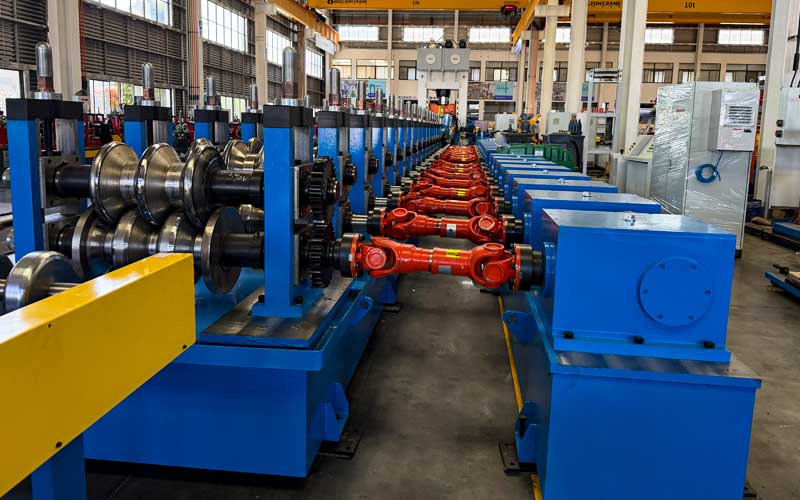
Highway Guardrail Component Manufacturing
Guard rail manufacturing is an important metal-forming process used to produce safety barriers for highways, bridges, roads, parking areas, and other transportation infrastructure. Modern guard rail systems are typically manufactured from galvanized or coated steel because they require high strength, dimensional accuracy, corrosion resistance, and long-term outdoor performance.
A complete guard rail manufacturing line uses advanced roll forming technology to transform steel coils into precisely shaped guard rail profiles. The production process can integrate decoiling, leveling, punching, roll forming, cutting, and automatic stacking to achieve consistent production and high efficiency.
What Is Guard Rail Manufacturing?
Guard rail manufacturing is the industrial process of producing steel roadside safety barriers from flat metal coils. The steel strip is continuously formed into the required guard rail profile through a series of precision-designed rollers.
The finished guard rails are installed along roads and highways to help redirect vehicles, reduce the severity of collisions, and protect drivers, passengers, pedestrians, and roadside infrastructure.
A typical guard rail production system is designed according to:
- Guard rail profile and dimensions
- Steel material grade
- Coil thickness and width
- Punching-hole pattern
- Production speed
- Required finished length
- Surface coating and corrosion protection
- Applicable safety standards
Guard Rail Manufacturing Process
A modern guard rail production line generally follows a continuous manufacturing sequence.
1. Steel Coil Loading
The production process begins with steel coils. A loading or coil handling system can be used to position the coil safely on the decoiler.
The coil specifications are selected according to the required guard rail profile, thickness, and production capacity.
2. Decoiling
The decoiler unwinds the steel strip and continuously feeds it into the production line. Depending on the line configuration, the decoiler can be hydraulic or mechanical and may include automatic expansion and braking systems.
Stable decoiling is important because fluctuations in strip tension can affect forming accuracy and punching positioning.
3. Leveling and Straightening
After decoiling, the steel strip passes through a leveling section. This process removes coil memory and reduces unwanted deformation before the material enters the forming section.
Proper leveling helps maintain stable feeding and improves the dimensional consistency of the finished guard rail.
4. Pre Punching
Guard rails normally require multiple mounting holes along their length. These holes can be produced by a hydraulic or servo-controlled punching system.
In many guard rail production lines, punching is performed before roll forming. Pre-punching allows the flat steel strip to be accurately positioned for hole patterns before it is transformed into the final profile.
The punching system can be configured according to the customer’s required:
- Hole diameter
- Hole spacing
- Number of holes
- Hole shape
- Longitudinal pitch
- Cross-sectional position
5. Roll Forming
The punched steel strip enters the guard rail roll forming machine, where multiple forming stations progressively bend the material into the required W-beam or other guard rail profile.
Instead of forming the complete shape in one operation, each roller station performs a controlled amount of deformation. This gradual forming method helps maintain profile accuracy and reduces unnecessary stress on the material.
The roll tooling is designed according to the specific guard rail profile and material specifications.
6. Cutting
After roll forming, the continuous guard rail profile is cut into the required lengths.
A hydraulic or servo-controlled cutting system can be integrated into the production line. Flying cutting technology can allow the profile to be cut without completely stopping the forming process, improving production efficiency.
7. Automatic Stacking
The finished guard rails are transferred to an automatic stacking or collection system. Proper stacking makes the products easier to handle, transport, and prepare for installation.
For high-volume production, automatic stacking can significantly reduce manual handling and improve workplace efficiency.
Main Equipment of a Guard Rail Production Line
A complete guard rail roll forming line may include the following equipment:
- Hydraulic or mechanical decoiler
- Coil loading car
- Leveling machine
- Servo feeding system
- Hydraulic or servo punching machine
- Guard rail roll forming machine
- Hydraulic or servo flying cutting machine
- Run-out table
- Automatic stacking system
- PLC electrical control system
The exact configuration depends on the guard rail profile, material thickness, production speed, and customer’s manufacturing requirements.
Guard Rail Roll Forming Machine
The guard rail roll forming machine is the core equipment used to continuously produce the required safety barrier profile.
Precision-engineered forming rollers gradually transform the flat steel strip into the final guard rail shape. The number of forming stations and tooling design depend on the profile geometry and material thickness.
A properly designed machine provides:
- Consistent profile dimensions
- Stable forming performance
- Accurate hole positioning
- High production efficiency
- Reduced material deformation
- Reliable long-term operation
Materials Used for Guard Rail Manufacturing
Steel is the primary material used for highway guard rail manufacturing because of its combination of strength, formability, and durability.
Common material considerations include:
- Carbon steel
- Galvanized steel
- Pre-coated steel
- High-strength steel
For outdoor highway applications, galvanized steel is widely used because the zinc coating provides protection against corrosion.
The material grade and thickness should be selected according to the applicable project specifications and safety requirements.
Pre-Punching vs Post Punching
The location of the punching process is an important consideration when designing a guard rail production line.
Pre-Punching
In pre-punching, holes are produced while the steel strip is still flat, before it enters the roll forming section.
Advantages include:
- Accurate hole positioning
- Easier punching of complex patterns
- Reduced forming distortion around holes
- Suitable for continuous production
Post-Punching
In post-punching, holes are created after the material has been formed into the guard rail profile.
This approach can be useful for certain specialized profiles and hole configurations, but the punching equipment must be designed to accommodate the formed section.
The best solution depends on the guard rail profile, hole geometry, material thickness, and production requirements.
Quality Control in Guard Rail Manufacturing
Quality control is essential because guard rails are safety-related infrastructure products. Manufacturers should inspect both the raw material and finished profiles throughout the production process.
Important quality-control parameters include:
- Steel thickness
- Material width
- Profile dimensions
- Hole diameter
- Hole spacing
- Hole position
- Finished length
- Straightness
- Surface condition
- Forming consistency
The final products should comply with the technical specifications and applicable standards required for the intended market and application.
Applications of Manufactured Guard Rails
Guard rails manufactured using roll forming technology are used in a wide range of transportation and infrastructure projects, including:
- Highways
- Expressways
- Rural roads
- Bridges
- Curved road sections
- Mountain roads
- Road intersections
- Parking areas
- Industrial facilities
- Roadside safety systems
Depending on the project, guard rails can be combined with posts, spacers, bolts, terminals, and other safety barrier components.
Advantages of Automated Guard Rail Manufacturing
An automated guard rail production line can provide several advantages compared with conventional manufacturing methods.
High Production Efficiency
Continuous roll forming enables manufacturers to produce long lengths of guard rail profiles efficiently from steel coils.
Consistent Product Quality
Precision tooling and automated control help maintain stable profile dimensions throughout production.
Integrated Punching
Automatic punching can produce mounting holes according to predefined patterns without extensive manual processing.
Reduced Labor Requirements
Automatic feeding, forming, cutting, and stacking reduce manual material handling.
Flexible Production
A properly engineered machine can be configured for different guard rail profiles and production specifications.
Reduced Production Waste
Continuous coil processing can improve material utilization compared with processes that require extensive individual blank preparation.
Why Choose LOTOSFORMING for Guard Rail Manufacturing?
LOTOSFORMING provides customized roll forming solutions for steel profile manufacturing, including guard rail production lines. The machine configuration can be engineered according to the customer’s required profile, material thickness, punching pattern, production speed, and finished length.
A complete guard rail manufacturing solution can integrate decoiling, leveling, servo feeding, punching, roll forming, cutting, and automatic stacking into one continuous production system.
LOTOSFORMING focuses on precision roll forming technology, reliable machine construction, customized engineering, and technical support for customers in international markets.
Conclusion
Guard rail manufacturing requires accurate forming, reliable punching, precise cutting, and consistent quality control to produce safety barriers suitable for demanding road and infrastructure applications.
A modern guard rail roll forming machine provides an efficient solution for converting steel coils into finished guard rail profiles through a continuous automated process. By integrating decoiling, leveling, punching, roll forming, cutting, and stacking, manufacturers can achieve higher productivity, consistent product quality, and reduced manual handling.
For manufacturers planning a new guard rail production project, selecting the appropriate machine configuration based on profile design, steel thickness, material grade, punching requirements, production speed, and applicable standards is essential for achieving reliable long-term production.
FAQ:
A guard rail roll forming machine is commonly used to continuously produce W-beam and other steel guard rail profiles. The complete production line can also include a decoiler, leveling system, punching machine, cutting system, and automatic stacking equipment.
Yes. The roll forming tooling and machine configuration can be designed according to the required guard rail profile. Different profiles may require different roller tooling and production configurations.
The main advantages include continuous production, high forming accuracy, integrated punching, consistent product dimensions, reduced manual handling, efficient material utilization, and reliable production for large-volume guard rail manufacturing.
A guard rail roll forming machine is commonly used to continuously produce W-beam and other steel guard rail profiles. The complete production line can also include a decoiler, leveling system, punching machine, cutting system, and automatic stacking equipment.