
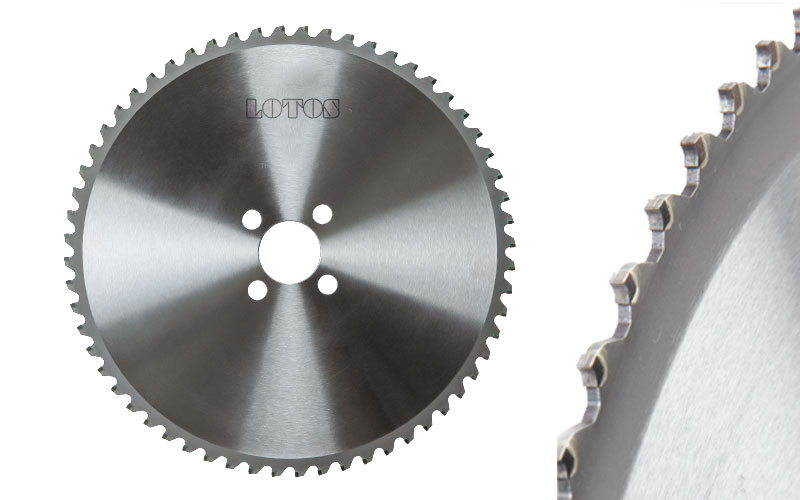
1. What Is an HSS Cold Saw Blade Blank?
A cold saw blade blank is the unfinished circular body of a saw blade. It has been cut, heat treated, flattened, and ground to its final diameter, thickness, and bore, but it has not yet received its teeth, tooth relief angles or surface coating. Blanks are subsequently processed into finished blades by tooth milling or grinding, sharpening, steam treatment or coating, and final inspection.
The term “cold saw” refers to the cutting method. The blade removes material in the form of chips that carry heat away from the workpiece, so that both the blade and the material remain relatively cool, in contrast with abrasive cutting.
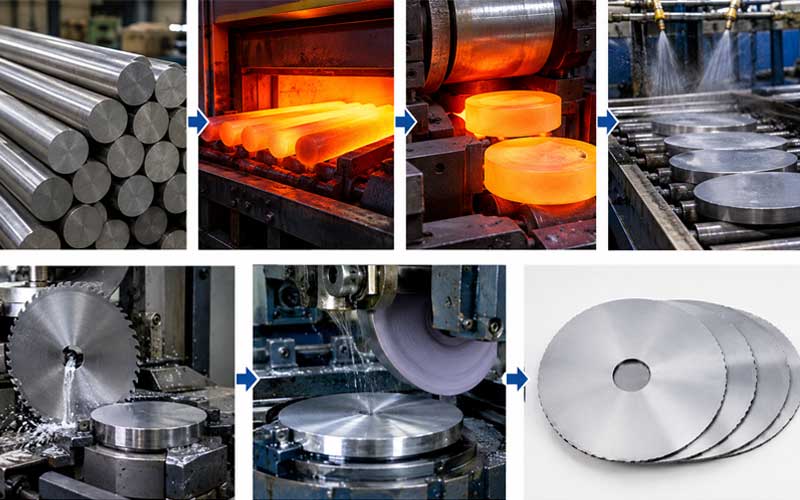
2. Raw Material Selection
The manufacturing process starts with the selection of the steel. HSS blanks are commonly produced from grades such as M2 (HS6-5-2) and, for more demanding applications, grades with higher cobalt or vanadium content such as M35 (HS6-5-2-5). The steel is supplied as cold rolled or hot rolled plate or strip with a controlled thickness and a certified chemical composition.
The principal criteria for material selection are:
- Chemical composition: carbon, tungsten, molybdenum, vanadium, chromium and cobalt contents determine hardness, wear resistance and red hardness.
- Cleanliness: low levels of non-metallic inclusions reduce the risk of cracking during heat treatment and in service.
- Carbide distribution: a fine and uniform carbide structure improves toughness and edge retention.
- Flatness and thickness tolerance of the plate: these reduce the stock that must be removed in later grinding stages.
3. Blanking and Cutting of the Disc
The round disc is cut from the steel plate. Depending on the diameter, thickness and production volume, the following methods are used:
- Laser cutting: provides accurate contours with a narrow heat-affected zone and is flexible for different diameters.
- Water jet cutting: avoids thermal effects entirely and is suitable for thicker or more sensitive materials.
- Wire EDM or fine blanking: used where very precise contours are required.
The disc is cut with an allowance in diameter and thickness so that material can be removed during subsequent machining and grinding. The centre bore and any drive or pin holes are normally produced at this stage, either undersized for later finishing or directly to a close tolerance.
4. Rough Machining and Stress Relief
Cutting processes introduce internal stress into the disc. If these stresses are not relieved, they may cause distortion during heat treatment. For this reason, the disc may undergo rough grinding and a stress-relief operation before hardening. This stage prepares a uniform and stable starting condition for the critical heat treatment that follows.
5. Heat Treatment
Heat treatment is the most decisive step in blank production. It converts the soft, annealed steel into a hard and wear resistant structure, and it is also the stage at which most dimensional distortion occurs. A typical sequence comprises:
- Preheating: the discs are heated in stages to reduce thermal shock.
- Austenitising: the discs are heated to a high temperature, commonly above 1200 degrees Celsius for HSS, in a vacuum or controlled atmosphere furnace to dissolve alloying carbides into the matrix.
- Quenching: rapid cooling, using gas or oil, transforms the structure to martensite. Controlled quenching is essential for limiting distortion.
- Tempering: multiple tempering cycles, typically two to three, relieve stress, transform retained austenite and develop the final working hardness, commonly in the range of approximately 62 to 66 HRC depending on the grade and application.
The discs are often held under pressure, using fixtures or press quenching, so that they remain as flat as possible throughout cooling.
6. Straightening and Flattening
Even with careful control, hardened blanks may show slight deformation. They are therefore inspected and corrected through precision straightening and tensioning operations. Flatness is critical because any residual warp leads to lateral runout, noisy cutting, poor cut quality, and uneven tooth loading.
In some designs, the blank is also lightly tensioned so that it maintains stability under the thermal and centrifugal loads encountered at working speed.
7. Precision Grinding
After heat treatment, the blank is ground to its final dimensions. Typical operations include:
- Double-disc or surface grinding of both faces to achieve the specified thickness, parallelism, and flatness
- Outside diameter grinding to achieve concentricity with the bore
- Bore grinding to the required tolerance, ensuring accurate mounting on the machine arbor
- Finishing of drive holes and slots to match the flange or the machine configuration
The result is a blank with tight dimensional control and a uniform surface finish. For cold saw blades, a small side clearance or a thin-kerf design may also be incorporated at this stage to reduce friction and material loss.
8. Surface Preparation and Marking
The blank surface is cleaned to remove grinding residue and oils. Depending on the specification, the surface may be left bright or treated with a protective finish. Laser marking is applied to identify the diameter, thickness, bore, material grade and batch. Expansion slots or noise-reduction features may also be added if required by the blade design.
9. From Blank to Finished Cold Saw Blade
After inspection, the blank proceeds to tooth production. The teeth are milled or ground, with the profile, pitch and angles selected for the material being cut, for example thin-walled tube, solid bar or stainless steel. The blade may then be steam tempered or coated with titanium based layers such as TiN, TiCN or TiAlN to reduce friction and extend life, before final sharpening and packing.
11. Factors That Define a High Quality Blank
- Consistent, certified steel with a fine carbide structure
- Controlled heat treatment with minimal distortion
- Tight tolerances in thickness, flatness, diameter and bore
- Uniform hardness across the whole disc
- Clean surfaces free from cracks, burns and grinding marks
- Full traceability and batch documentation
12. Conclusion
The production of HSS cold saw blade blanks is a precise, multi stage process in which material selection, heat treatment and grinding each play a decisive role. A well made blank provides the flat, stable, and uniform foundation on which accurate teeth can be formed, and this is what ultimately delivers clean cuts, longer blade life and lower cost per cut.
Lotosforming supplies cutting solutions and tooling for tube mill and roll forming applications. To discuss blade diameter, material grade and tolerance requirements for your cutting line, please contact the LotosForming team for a technical consultation.
FAQ:
The teeth of an HSS cold saw blade can be re-sharpened several times, provided that the blank remains flat and within its minimum diameter limit.
Poor flatness causes runout, vibration and uneven tooth wear, which reduces cut quality and shortens blade life.
M2 (HS6-5-2) is the most common grade. M35 (HS6-5-2-5) with added cobalt is selected for harder materials and higher cutting temperatures.
A blank is the ground disc without teeth. A finished blade has milled or ground teeth, and often a surface treatment or coating.