
Hydrostatic Testing Machine
- Home
- Hydrostatic Testing Machine
Pipe Hydro Testing Machine
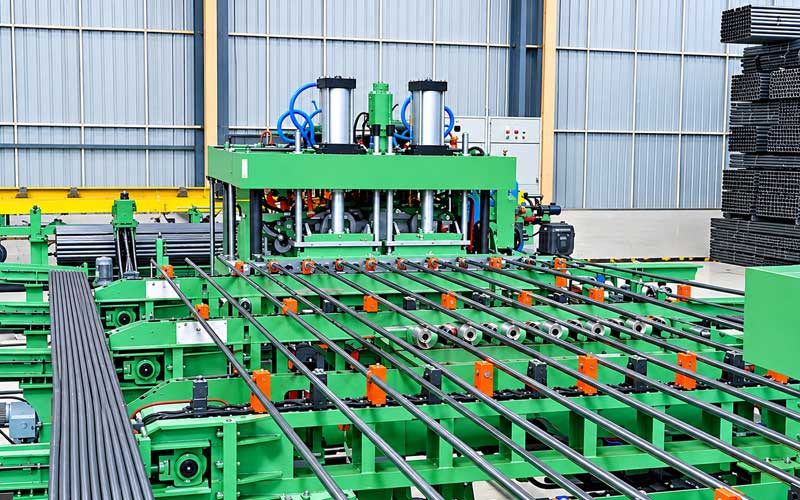
A hydrostatic testing machine is a pressure verification system used to confirm the structural integrity, leak tightness, and pressure bearing capacity of tubes, pipes, vessels, and other closed components. In welded and seamless tube manufacturing, hydrostatic testing remains one of the most reliable non destructive methods for validating product quality before delivery.
What Is a Hydrostatic Testing Machine?
A hydrostatic testing machine fills a sealed test piece with a liquid, typically water or a water-based medium, and raises the internal pressure to a specified test value. The pressure is held for a defined duration while the system monitors for pressure drop, leakage, visible deformation, or rupture.
Water is the preferred medium because it is practically incompressible. Should a failure occur, the stored energy released is considerably lower than in pneumatic testing, which makes the method inherently safer for operators and equipment.
Working Principle
The testing cycle generally follows these stages:
- Loading and positioning: The tube is conveyed to the test station and aligned with the sealing heads.
- Clamping and sealing: Hydraulic or mechanical sealing heads close both ends of the tube.
- Filling and venting: Water fills the tube while trapped air is expelled, since residual air compromises accuracy and safety.
- Pressurization: A high-pressure pump raises the internal pressure to the specified test value at a controlled rate.
- Dwell (holding) period: The pressure is maintained for the required time while sensors record any variation.
- Pressure release and drainage: The pressure is relieved in a controlled manner and the water is drained.
- Evaluation and marking: The result is recorded, and the tube is classified as accepted or rejected.
Key Technical Parameters
When specifying a hydrostatic testing machine, the following parameters should be evaluated:
- Maximum test pressure: Typically ranges from several MPa to over 100 MPa, depending on tube specification.
- Tube diameter range: Defines the minimum and maximum outside diameter the machine can accommodate.
- Tube length range: Determines the working length of the test bench.
- Pressure holding time: Adjustable according to the applicable standard or customer requirement.
- Pressurization rate: Must be controllable to avoid shock loading.
- Pressure accuracy: Governed by sensor class and calibration.
- Cycle time: Directly affects production throughput.
- Degree of automation: Ranges from manual operation to fully automatic, line-integrated systems.
Test Pressure Calculation
The test pressure is generally derived from the tube geometry and the allowable stress of the material. A commonly used formula is:
P = (2 × S × t) / D
Where:
- P = test pressure (MPa)
- S = allowable stress, usually a defined percentage of the material yield strength (MPa)
- t = nominal wall thickness (mm)
- D = outside diameter (mm)
The exact stress factor and holding time must always follow the applicable product standard or the purchaser’s specification.
Applicable Standards
Hydrostatic testing is required by numerous international and industry standards for tubes and pipes, including those governing:
- Carbon steel and low-alloy steel pipes
- Stainless steel tubes
- Line pipes for oil and gas transmission
- Boiler and heat exchanger tubes
- Structural and mechanical tubing, where specified
Manufacturers should verify the applicable standard for each product, as test pressure, hold time, and acceptance criteria vary between specifications.
Applications
Hydrostatic testing machines are used across a wide range of industries:
- Tube and pipe manufacturing: Final inspection of welded (ERW, HFW) and seamless tubes
- Oil and gas: Verification of line pipes and casing
- Boilers and heat exchangers: Testing of pressure-bearing tubes
- Pressure vessels and cylinders: Proof and burst testing
- Automotive and hydraulic components: Leak testing of tubes, hoses, and fittings
- Construction and infrastructure: Testing of water, gas, and fire-protection piping
Integration with Tube Mill Lines
In a modern tube production line, the hydrostatic testing machine is positioned downstream of the forming, welding, sizing, and cutting sections. Integrating it into the line offers several advantages:
- Continuous, automated handling of tubes from the cutting unit to the test station
- Reduced manual intervention and improved operator safety
- Automatic sorting of accepted and rejected tubes
- Digital recording of test results for traceability and quality documentation
For HF welded tube mills, hydrostatic testing complements in-line weld inspection methods such as eddy current testing, providing a final confirmation of weld seam integrity under pressure.
Advantages of Hydrostatic Testing
- High reliability: Detects leaks, weld defects, and wall weaknesses that other methods may overlook.
- Safety: The incompressible medium stores little energy compared with gas.
- Simplicity: The principle is straightforward and well established.
- Traceability: Modern systems log pressure curves and test data automatically.
- Compliance: Meets the mandatory requirements of most pressure-related product standards.
Selection Criteria
When choosing a hydrostatic testing machine, manufacturers should consider the following:
- Product range: Confirm that diameter, wall thickness, and length ranges match current and planned production.
- Pressure capacity: Select a maximum pressure with an adequate safety margin above the highest required test value.
- Production rate: Match the cycle time to the output of the tube mill.
- Sealing system design: Quick-change sealing heads reduce downtime during size changeovers.
- Control and data management: Prefer systems with programmable recipes, data storage, and report generation.
- Safety features: Verify protective enclosures, interlocks, and pressure relief devices.
- Maintenance requirements: Easy access to seals, pumps, and filters lowers the long term cost of ownership.
- Supplier experience: Choose a manufacturer with proven experience in tube mill lines and auxiliary equipment.
Maintenance Recommendations
To ensure consistent accuracy and a long service life, the following practices are recommended:
- Calibrate pressure sensors and gauges at regular intervals.
- Inspect and replace sealing elements on schedule.
- Maintain clean, filtered water to protect pumps and valves.
- Check hydraulic oil quality and level in the clamping system.
- Verify the function of safety devices and emergency stops periodically.
- Keep a documented maintenance log for audit and traceability purposes.
Conclusion
The hydrostatic testing machine is an indispensable quality assurance asset in tube and pipe manufacturing. By subjecting each product to controlled internal pressure, it verifies weld integrity, wall strength, and leak tightness, thereby protecting both end users and the manufacturer’s reputation. Selecting a machine with appropriate pressure capacity, sealing flexibility, automation, and data recording capability allows producers to meet international standards while maintaining efficient, reliable production.
For tailored tube mill solutions and auxiliary testing equipment, LotosForming offers professional engineering support to match your production requirements.
FAQ:
Eddy current testing is an in-line, non-destructive method that detects surface and near-surface defects in the weld seam. Hydrostatic testing subjects the entire tube to internal pressure and confirms its overall strength and leak tightness. The two methods are complementary and are frequently used together.
Sealing is achieved by hydraulic or mechanical sealing heads, which may be of the plug, face-seal, or clamp type. Quick-change sealing heads are recommended where frequent size changeovers are required.
Essential safety features include a protective enclosure, door interlocks, pressure relief valves, emergency stop devices, and overpressure protection within the control system.
Consider the tube diameter and length range, maximum test pressure, required cycle time, sealing system design, degree of automation, data management capability, and safety features. Consult an experienced manufacturer to ensure compatibility with your tube mill line.
The machine can test welded tubes (including ERW and HFW), seamless tubes, stainless steel tubes, boiler and heat exchanger tubes, line pipes, and structural or mechanical tubing. The tube diameter, wall thickness, and length must fall within the working range of the machine.