
Pipe End Facing and Beveling Machine
- Home
- Pipe End Facing and Beveling Machine
Pipe End Facing Machine
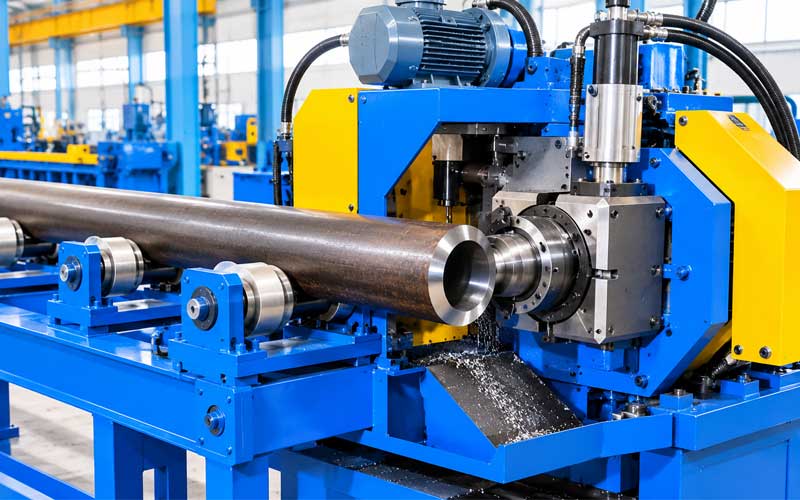
A pipe end facing and beveling machine is a precision tool used to square the end of a pipe and machine a defined bevel profile onto it before welding. In pipe fabrication, tube mill finishing, pressure piping, and structural work, the quality of the weld preparation directly determines the strength, integrity, and appearance of the finished joint.
What Is a Pipe End Facing and Beveling Machine?
A pipe end facing and beveling machine performs two related machining operations:
- Facing: Cutting the pipe end to a flat, perpendicular surface relative to the pipe axis. This removes burrs, distortion, and irregularities left by sawing or cutting.
- Beveling: Machining an angled profile on the pipe end so that two pipes, or a pipe and a fitting, form a groove suitable for full penetration welding.
Both operations are commonly completed in a single setup, which improves accuracy, shortens cycle time, and reduces handling.
Why Weld Preparation Matters
Poor end preparation is a leading cause of weld defects. A correctly faced and beveled pipe end provides the following benefits:
- Consistent root gap and fit-up, allowing uniform weld penetration.
- Reduced risk of defects such as lack of fusion, porosity, and incomplete penetration.
- Lower filler metal consumption, because the groove geometry is controlled.
- Improved productivity, since less manual grinding and rework is required.
- Compliance with welding procedure specifications (WPS) and applicable standards for pressure and structural piping.
Working Principle
The machine clamps the pipe securely, either on its inside diameter (ID) or outside diameter (OD), and a rotating cutting head carrying one or more tool inserts is fed toward the pipe end. As the head rotates, the inserts machine the face and the bevel simultaneously. Feed is applied manually, pneumatically, hydraulically, or by servo drive, depending on the machine design.
The principal stages of operation are:
- Clamping and centering of the pipe to ensure concentricity.
- Setting of cutting depth and bevel geometry.
- Rotation of the cutting head at the specified speed.
- Controlled feed to produce the face and bevel profile.
- Retraction and release of the finished workpiece.
Main Types of Pipe End Facing and Beveling Machines
1. Portable Clamshell Machines
Split frame designs that mount directly onto the pipe. They are suited to on-site work, pipeline construction, and maintenance, where the pipe cannot be moved to a workshop.
2. ID-Mounted Portable Machines
Clamped inside the pipe bore with an expanding mandrel. They are compact and effective for pipes of varying wall thickness and are commonly used in fabrication shops and field operations.
3. Stationary (Fixed) Machines
Bench or floor mounted machines for workshop production. They provide high rigidity, repeatable accuracy, and high throughput for batch processing.
4. Automatic and CNC Machines
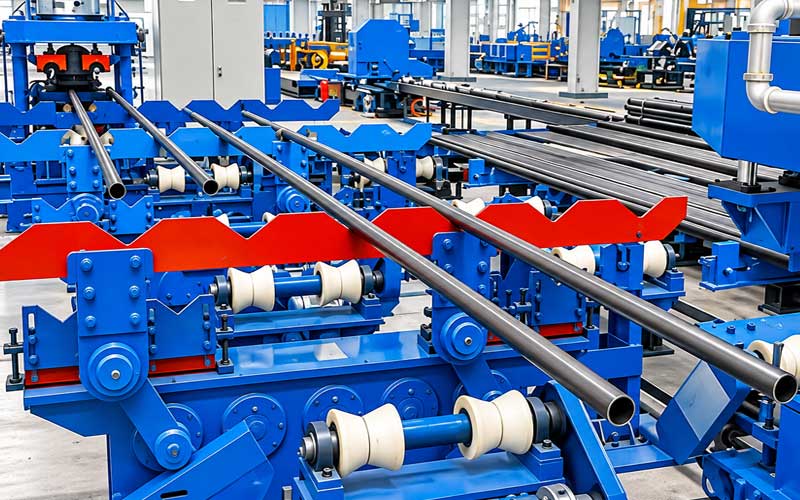
Equipped with servo feed, programmable bevel parameters, and automatic clamping. They are used in tube mill finishing lines and high volume production where consistency and speed are essential.
Key Technical Parameters
When evaluating a pipe end facing and beveling machine, the following specifications should be reviewed:
- Pipe diameter range: Defines the minimum and maximum OD or ID capacity.
- Wall thickness capacity: Determines the maximum material removal and bevel depth.
- Bevel angle range: Typically adjustable from 0° to 45° or beyond, depending on the model.
- Motor power and spindle speed: Must be matched to material hardness and tool type.
- Feed method: Manual, pneumatic, hydraulic, or servo-controlled.
- Clamping system: Mechanical, hydraulic, or pneumatic; affects concentricity and cycle time.
- Surface finish and perpendicularity tolerance: Critical for automated welding and thin-wall applications.
- Material compatibility: Carbon steel, stainless steel, alloy steel, and, in some cases, duplex or nickel alloys.
Materials and Tooling
The cutting tools used for end facing and beveling are generally indexable carbide inserts, selected according to the material being processed. Carbide grades with appropriate coatings provide long tool life and stable cutting performance on carbon steel and stainless steel. For stainless and alloy grades, which are prone to work hardening, sharp inserts, adequate feed, and rigid clamping are necessary to avoid surface glazing and tool wear.
Machining the bevel also offers a distinct advantage over thermal cutting or grinding: it produces a cold-cut surface with no heat affected zone, no oxide layer, and no need for additional cleaning before welding.
Applications
Pipe end facing and beveling machines are used across many industries:
- Tube and pipe mill finishing operations
- Oil and gas pipeline construction and maintenance
- Power generation and boiler fabrication
- Petrochemical and process piping
- Shipbuilding and offshore structures
- Structural steel and construction
- Hydraulic and pneumatic tubing manufacture
Selection Guidelines
To choose a suitable machine, manufacturers should consider the following criteria:
- Pipe specifications: Diameter, wall thickness, and material grade.
- Required bevel profile: Angle, root face, and any special geometries stipulated by the WPS.
- Production volume: Occasional use favors portable machines, while continuous production favors stationary or CNC models.
- Working environment: Workshop installation versus on-site operation.
- Level of automation: Integration with feeding, conveying, and handling systems in a production line.
- Operator safety and ergonomics: Guarding, noise level, and ease of adjustment.
- Maintenance and service support: Availability of spare tooling, technical documentation, and after-sales service.
Maintenance Recommendations
Regular maintenance extends machine life and preserves accuracy:
- Inspect and replace cutting inserts at the first sign of wear.
- Lubricate guideways, spindles, and feed mechanisms according to the manufacturer’s schedule.
- Check clamping components for wear to maintain concentricity.
- Keep the machine clean of chips and coolant residue.
- Verify bevel angle and perpendicularity periodically with gauges.
Conclusion
A pipe end facing and beveling machine is an essential piece of equipment for any operation that depends on high quality welded joints. By delivering accurate, repeatable, and clean weld preparation, it improves joint integrity, reduces rework, and increases overall productivity. Selecting a machine that matches the pipe range, bevel requirements, and production demands of the application is the key to achieving reliable results.
FAQ:
Concentricity is achieved through a rigid clamping system, either on the inside or outside diameter of the pipe, using mechanical, hydraulic, or pneumatic clamping.
Indexable carbide inserts are the standard choice. They offer long tool life and stable performance, and they can be replaced quickly when worn.
Inspect and replace inserts regularly, lubricate guideways and spindles according to the manufacturer’s schedule, check clamping components for wear, remove chips and residue, and periodically verify bevel angle and perpendicularity.
Consider the pipe diameter and wall thickness, required bevel profile, production volume, level of automation, working environment, and the availability of technical support and spare parts. For specific recommendations, please contact LotosForming with your technical requirements.
These machines can process carbon steel, stainless steel, alloy steel, and, with suitable tooling, duplex and nickel alloys. The tool grade and cutting speed should be matched to the material.