
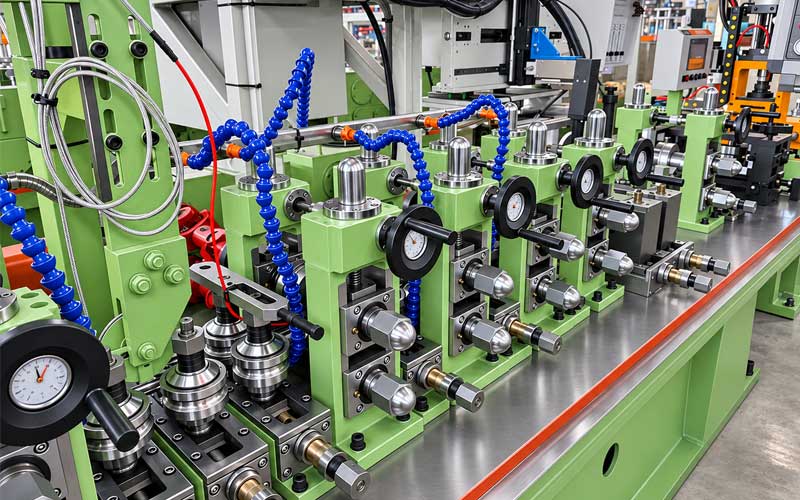
Solving Tube Mill Problems
A tube mill is a continuous production line that converts flat steel strip into welded tube through uncoiling, forming, welding, sizing, straightening, and cutting. Because each stage depends on the accuracy of the previous one, a minor deviation at the entry of the line frequently appears as a visible defect at the exit. Effective troubleshooting therefore requires a systematic approach that identifies the root cause rather than treating the symptom.
Why Systematic Troubleshooting Matters in a Tube Mill ?
Unplanned downtime, excessive scrap, and inconsistent tube quality directly increase production costs. In most cases, tube mill defects originate from a limited number of root causes:
- Inconsistent strip quality
- Misalignment of the mill centerline
- Worn or incorrectly set forming rolls
- Unstable welding parameters
- Insufficient preventive maintenance
Addressing these fundamentals resolves the majority of production issues and extends equipment life.
1. Strip Quality and Edge Defects
Typical symptoms: edge waves, burrs, uneven strip width, unstable forming and poor weld quality.
Common causes:
- Poor slitting quality at the coil supplier
- Coil set or camber after uncoiling
- Variation in material thickness or mechanical properties
- Contamination such as rust, oil or scale on the strip
Recommended solutions:
- Define strip width tolerance, edge condition and thickness tolerance in the coil purchasing specification.
- Inspect the strip edges before the coil is loaded onto the uncoiler.
- Use a leveling unit when the material is thick, high-strength or heavily stressed.
- Keep the strip surface clean to ensure stable forming and welding.
2. Strip Tracking and Mill Centerline Misalignment
Typical symptoms: strip drifting to one side, uneven edge height, surface scratches and a seam that wanders from its position.
Common causes:
- An entry guide that is not aligned with the mill centerline
- Unequal roll gaps on the left and right sides
- Poorly prepared strip-end joints
- Foundation settlement or loose stand anchoring
Recommended solutions:
- Align the entry guide and every forming stand to a single, verified centerline.
- Check that the roll gap is equal on both sides of each stand.
- Ensure that strip-end welds are flat and ground smooth before they pass through the mill.
- Inspect stand anchor bolts and the machine base periodically.
3. Forming Section Defects
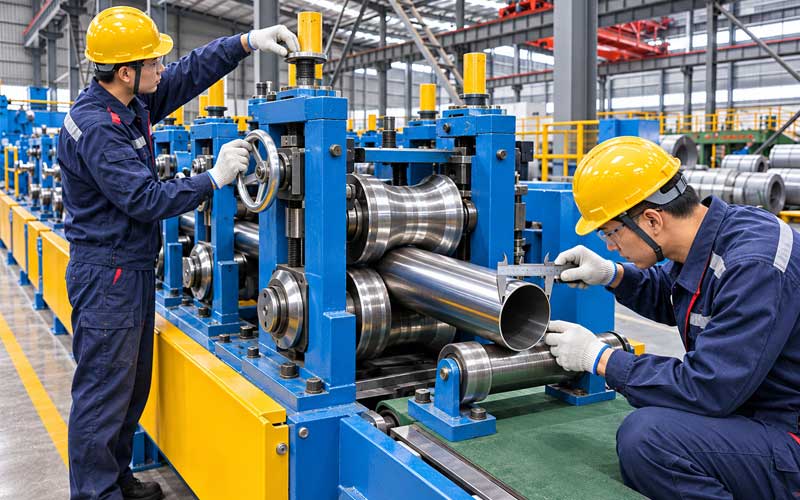
The forming section progressively shapes the flat strip into an open tube. Poor setup in this area affects every downstream process.
Best practices:
- Set the rolls stand by stand according to the manufacturer’s setup sheet.
- Distribute the forming load evenly instead of overloading a few stands.
- Inspect roll surfaces on a fixed schedule and record the wear pattern.
5. Weld Bead Scarfing and Burr Removal
Typical symptoms: rough internal or external bead, chatter marks, tool breakage and inconsistent bead height.
Common causes:
- Dull or chipped scarfing tools
- Incorrect tool height or angle
- Insufficient support from the backing rolls
- An unstable weld bead produced upstream
Recommended solutions:
- Replace or resharpen scarfing tools according to a defined schedule.
- Set tool height precisely and verify the backing roll support.
- Correct welding stability first, because an irregular bead cannot be scarfed consistently.
6. Sizing, Turk’s Head and Straightening Problems
Typical symptoms: out of round tubes, diameter variation, bow, twist, and surface marks.
Common causes:
- Worn sizing rolls
- Misaligned sizing or Turk’s head stands
- Excessive sizing reduction
- Incorrect straightening roll adjustment
Recommended solutions:
- Measure the sizing rolls regularly and replace them when the finished diameter begins to drift.
- Align all stands to the same centerline and check their parallelism.
- Distribute the sizing reduction across the stands instead of concentrating it in one.
- Adjust the straightening rolls in small increments and verify the result after each change.
7. Cutting Problems (Flying Saw and Cold Saw)
Typical symptoms: burrs on the tube ends, inaccurate length, angled cuts, abnormal noise and short blade life.
Common causes:
- A blade type or tooth geometry that does not suit the tube material and wall thickness
- Worn or dull blades
- Insufficient clamping force
- Poor synchronization between the saw carriage and the tube speed
- Inadequate coolant or lubricant
Recommended solutions:
- Select the correct blade type, such as HSS or TCT, for the tube material and wall thickness.
- Replace blades before burr formation becomes severe.
- Verify the clamp pressure and the alignment of the saw carriage.
- Calibrate the length measuring system and the speed tracking.
- Ensure that coolant reaches the cutting zone continuously.
8. Surface Scratches and Marks
Common causes:
- Dirty, scored or rough rolls
- Metal chips or foreign particles on the strip or rolls
- Sharp edges on guides and contact points
- Insufficient lubrication in the forming section
Recommended solutions:
- Keep the rolls clean and polished.
- Remove chips and debris from the mill area on a regular basis.
- Maintain the correct emulsion concentration and flow.
- Inspect every guide and contact point for burrs or sharp edges.
9. Mechanical and Electrical Faults
Common causes:
- Poor lubrication of bearings and gearboxes
- Worn bearings or loose fasteners
- Sensor or wiring faults
- Motor overload
Recommended solutions:
- Follow a documented preventive maintenance program for lubrication, bearings and drive components.
- Monitor motor current and temperature to detect overload early.
- Keep critical spare parts in stock, including rolls, bearings, saw blades, scarfing tools and sensors.
- Train operators to recognize early warning signs such as unusual noise, vibration and heat.
Conclusion
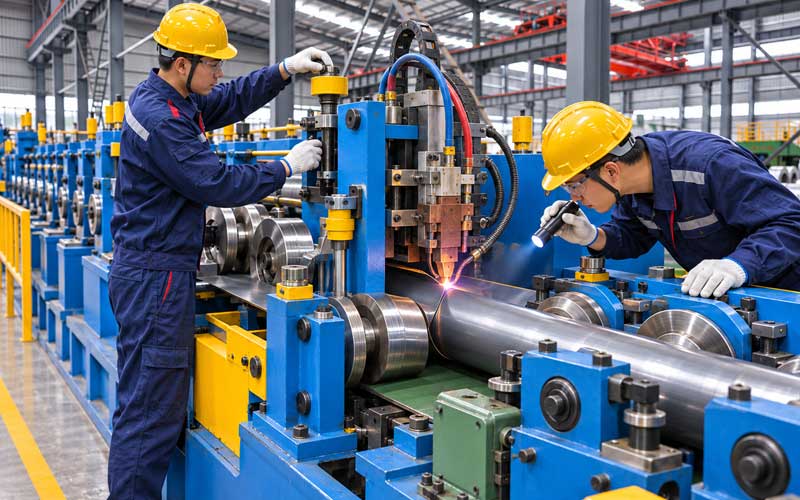
The majority of tube mill problems arise from a small group of causes: inconsistent strip quality, misalignment, worn tooling, unstable welding parameters, and insufficient maintenance. A disciplined setup procedure, scheduled inspections, and well trained operators reduce scrap, improve tube quality, and extend the service life of the equipment.
FAQ:
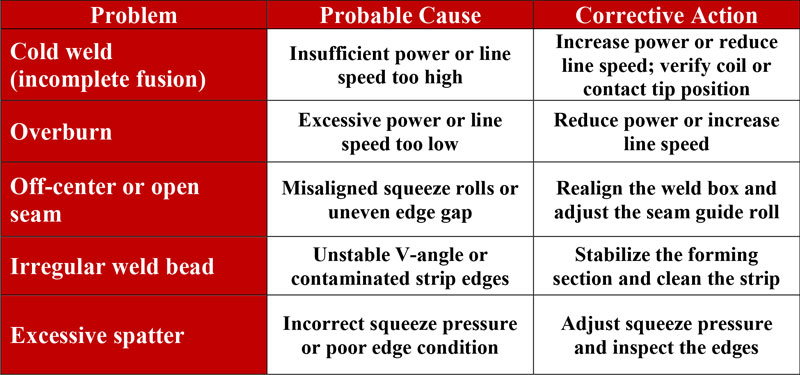
An off center seam typically results from misaligned squeeze rolls, an uneven edge gap, or an incorrect seam guide setting. Realigning the weld box and checking the forming stands correct it.
Burrs usually indicate a dull saw blade, unsuitable tooth geometry, weak clamping, or poor synchronization between the saw and the tube speed. Replacing the blade on schedule and choosing the correct blade type, such as HSS or TCT, improves the cut quality.
In most cases, yes. Correct setup, alignment, tooling maintenance, and stable process parameters resolve most problems without major equipment changes.
The most common problems are strip edge defects, strip tracking errors, forming defects, weld seam faults, irregular weld beads, out of round tubes, burrs after cutting, and surface scratches. Most of them originate from poor strip quality, misalignment, worn rolls, or unstable welding parameters.
Edge waves are mainly caused by poor slitting quality, coil set or uneven strip tension.Specifying strict strip tolerances, inspecting coils before loading and using a leveling unit for thick or stressed material help prevent them.