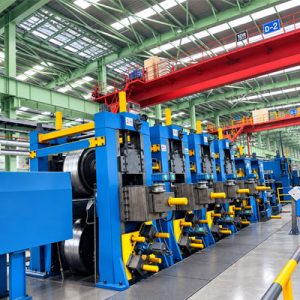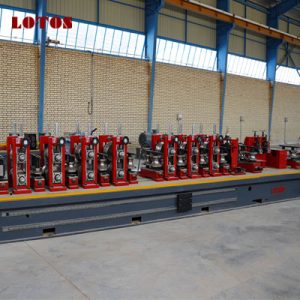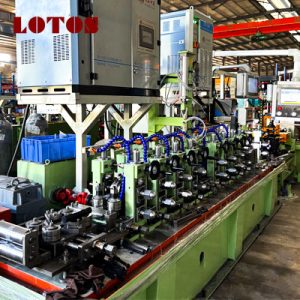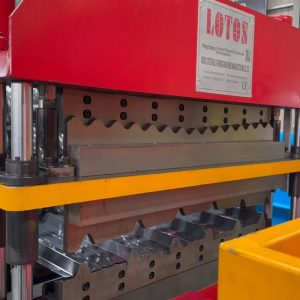
Product description
working flow :
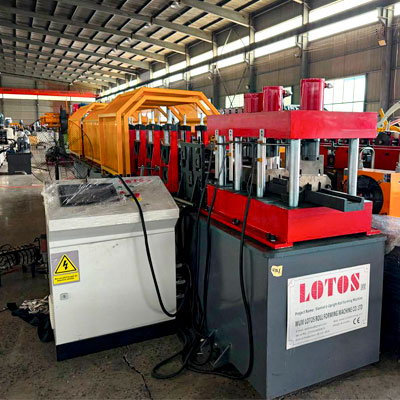
Hydraulic Decoiler → Feeding Guide →Roll Forming Machine →Online Punch Unit → Hydraulic Stop Cutting Die (45 degree Cut) → Out put Table
Ⅴ. Each part technical parameter
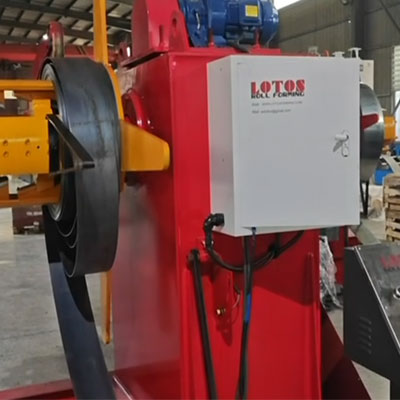
1. Hydraulic Decoiler | ||
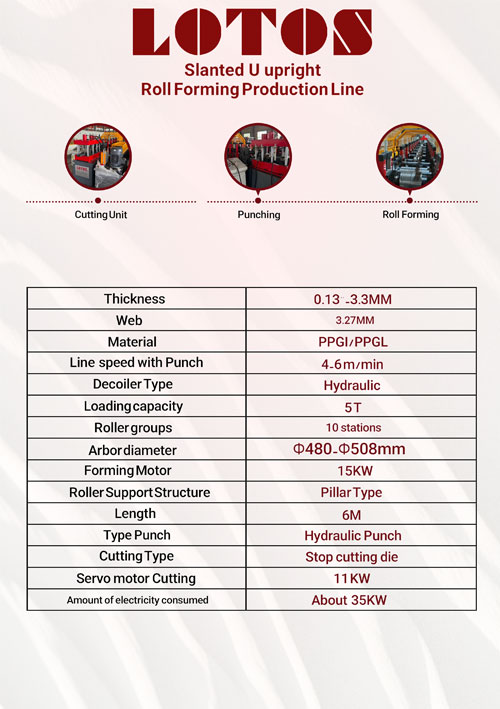
1.1 | Loading capacity | 5T |
1.2 | Steel coil I.D. | Φ480-Φ508mm |
1.3 | Steel coil O.D | Max Φ1400mm |
1.4 | Cantilever width | 400mm |
1.5 | Function | Motorized unwinding, hydraulic expansion |
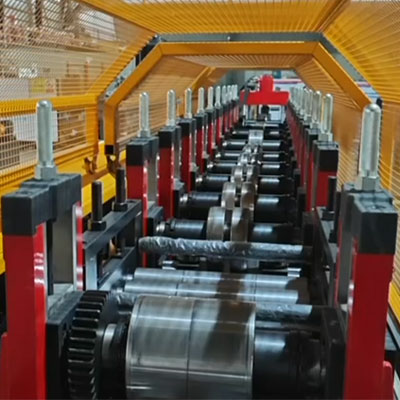
2. Roll Forming Machine | ||
2.1 | Roller groups | 10 stations of forming rollers |
2.2 | Roller material | GCr15 with heat treatment, hardness 58-62° |
2.3 | Roller shaft dia. | Φ85mm |
2.4 | Shaft material | 40CR with quenching and tempering |
2.5 | Motor | 15KW, Siemens BEIDE |
2.6 | Transmission way | 180# Gearbox transmission |
2.7 | Machine frame body | Integrated welded plate housing frame |
2.8 | Roller supporter | Casting pillar stands |
3. Punch Unit | ||
3.1 | Punch method | Hydraulic stop online punch |
3.2 | Punch die | 1 die, for web holes |
3.3 | Die material | CR12MOV |
3.4 | Remark | Isolated punch frame |
4. Cutting Unit | ||
4.1 | Cutting method | Hydraulic stop cutting die |
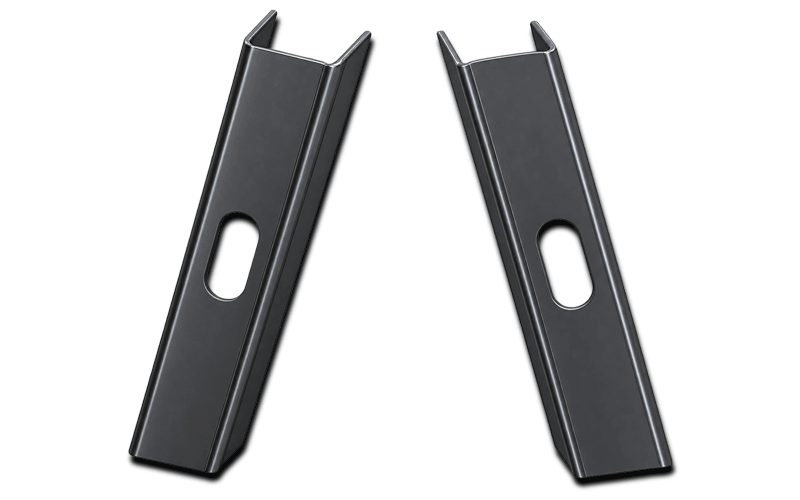
4.2 | Cutting die | l 2 SETS, 45 degree cut l For left/right side (driver/passenger side) l Adjustable |
4.3 | Die material | CR12MOV |
FAQ :
A Slanted U Upright Roll Forming Machine is a specialized roll forming system used to manufacture slanted U channel upright profiles from metal coils. The machine progressively bends the strip through multiple forming stations to achieve the required U-shaped cross-section and slanted geometry.
These profiles are commonly used in trailer manufacturing, particularly for structural upright and side-frame components. Depending on the design, they can also be used in truck bodies, agricultural equipment, industrial frames, and other sheet-metal structures.
Yes. The production line can be designed to produce the required slanted upright geometry automatically. The exact forming method depends on whether the slant is created during roll forming, through post-forming bending, or through a dedicated cutting and bending process.
The achievable accuracy depends on the material, profile geometry, tooling design, machine construction, and production parameters. A properly engineered roll forming line provides highly repeatable dimensions and consistent profile geometry throughout production.