
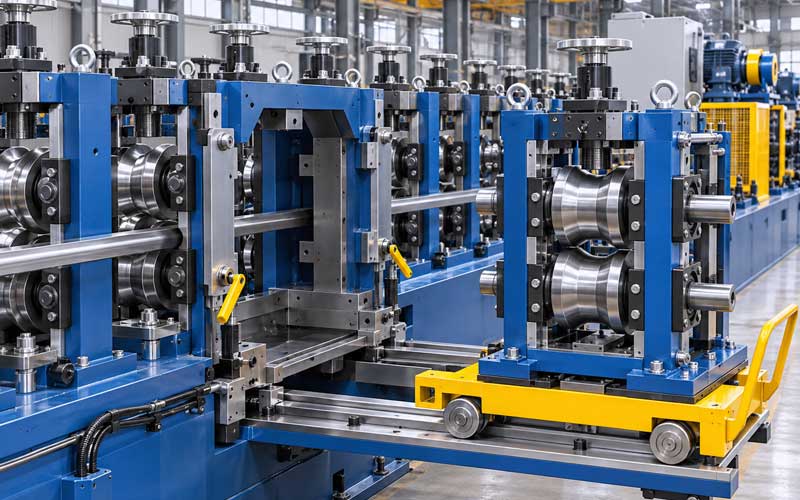
Quick Roll Changing System in Tube Mills
In electric resistance welded (ERW) tube and pipe production, a change of product size or profile requires the replacement of forming, fin-pass, welding, sizing, and Turk’s head rolls. On a conventional tube mill, this changeover is labour-intensive. It involves disassembling roll shafts, removing and re-spacing rolls, re-establishing the pass line, and carrying out trial runs to confirm the setting.
A tube mill roller quick change system is an engineered tooling and mechanical arrangement that reduces this downtime. By standardising roll mounting, pre-setting tooling away from the mill, and using rapid clamping and positioning devices, such a system allows a complete roll set to be exchanged in a fraction of the conventional time while maintaining setting repeatability.
Limitations of Conventional Roll Changeover
Understanding the problem clarifies the value of a quick change system. In a conventional changeover, the following issues are typical:
- Extended downtime. Roll removal, cleaning, assembly of the new roll set and fine adjustment are performed sequentially on the mill, and the line produces nothing in the meantime.
- Dependence on operator skill. Pass line height, roll gap and stand alignment are set manually, so results vary between operators and shifts.
- Setting inconsistency. Because every changeover is a new manual set-up, the same tube size can be produced with differing roll positions, causing variable weld quality and dimensional tolerance.
- High scrap during trials. Trial adjustment on the running mill consumes strip material and time.
- Safety exposure. Handling heavy rolls, shafts and spacers manually increases the risk of injury and tooling damage.
These limitations become more costly as order quantities decrease and product variety increases.
Operating Principle
The central principle of a quick change system is the separation of tooling preparation from machine operation. Rather than assembling and adjusting rolls on the mill, the roll set is prepared, measured, and pre set offline while the mill continues to produce. When the production order changes, the prepared tooling is exchanged as a unit or through rapid-release mounting, and the mill resumes with minimal fine tuning.
This is achieved through four enabling concepts:
- Standardised interfaces. Roll stands, shafts and bearing housings use fixed, repeatable mounting references.
- Pre-setting. Roll gap, spacing and alignment are established and verified in a tooling preparation area.
- Rapid clamping. Mechanical, hydraulic or pneumatic devices replace multiple fasteners and manual adjustments.
- Positional repeatability. Locating features such as dowels, tapers or keyed seats return the tooling to its defined position every time.
Main Configurations
Quick change systems are applied in several forms, depending on the mill type, the product range and the investment level.
Quick Change Roll Shaft Assembly
Each roll shaft is prepared with its rolls and spacers assembled and locked, and the complete shaft assembly is exchanged within a fixed stand. This reduces the number of components handled at the mill.
- Suited to mills where stand frames remain permanently installed.
- Moderate tooling investment.
- Requires a precise shaft locating and retention design.
Quick Release Clamping on Roll Shafts
Conventional shaft nuts are replaced with quick release devices such as hydraulic nuts, bayonet-type locking, or split collar clamping. Rolls are still replaced individually, but the time spent loosening and tightening is reduced.
- Lowest investment, and suitable for retrofitting existing mills.
- Moderate time reduction.
- Continues to depend on the correct spacer and roll arrangement.
Combination with Flexible Forming Technologies
Quick change tooling is often combined with flexible forming concepts, for example, direct forming of square and rectangular sections or common roll set approaches, in which one roll set covers a range of sizes. Together, these reduce both the frequency and the duration of changeovers.
Technical Design Considerations
Rigidity and Accuracy
A quick change interface must not compromise the stiffness of the roll stand. Any clearance introduced for ease of exchange must be controlled through precision locating features; otherwise roll deflection or position drift may degrade tube quality, particularly at the weld and sizing stages.
Repeatability of Positioning
The system should return the roll set to its pre-set position within the tolerances required for the product. Locating tolerances, surface finish of mounting faces and the cleanliness of the interfaces are all decisive factors.
Load and Torque Capacity
Clamping and coupling elements must withstand the forming forces, drive torque, and shock loads present during production. Safety margins should reflect the heaviest wall thickness and highest-strength material the mill is intended to process.
Compatibility with Existing Equipment
When retrofitting, designers should verify the following:
- Stand centre distances and pass line height
- Shaft diameters, key dimensions and bearing arrangement
- Drive coupling and gearbox interface
- Available floor space for tooling storage and the pre-setting area
Materials and Surface Treatment
Locating surfaces and clamping elements require appropriate hardness and wear resistance to maintain accuracy over many exchange cycles. Roll material and heat treatment should be selected according to the strip material being formed.
Safety
Guarding, interlocks, lifting provisions, and clearly defined exchange procedures should be integrated into the design. Hydraulic and pneumatic circuits require pressure monitoring and fail-safe locking.
Operational Benefits
The practical advantages of a properly engineered quick change system include the following:
- Reduced changeover time. Offline preparation shifts most set-up work away from the critical path, increasing the proportion of the shift spent producing.
- Improved consistency. Pre-set tooling reduces dependence on individual operator judgement and gives more consistent weld and dimensional quality.
- Lower scrap and trial loss. Because the roll set arrives at the mill already adjusted, less strip is consumed during set-up.
- Greater production flexibility. Shorter changeovers make small batches and frequent size changes economically practical.
- Better tooling management. Identified, stored, and maintained roll sets extend tooling life and simplify inspection.
- Improved working safety. Reduced manual handling of heavy components lowers the risk of injury and roll damage.
The actual reduction in changeover time depends on the mill type, the configuration chosen and the degree of standardisation of the tooling.
Implementation Workflow
A typical implementation proceeds through the following stages:
- Analyse the product range. Define the tube sizes, wall thicknesses and profiles to be produced, and the planned frequency of changes.
- Select the configuration. Choose the cassette, shaft-assembly or quick clamp approach based on production mix and budget.
- Design the interfaces. Establish locating, clamping, and drive connection details, and verify them against the mill’s loads.
- Establish the pre-setting process. Provide a measuring and assembly area, with documented setting data for each product.
- Commission and validate. Verify positional repeatability and product quality across repeated exchanges.
- Train personnel. Standardise the exchange procedure and the tooling inspection routine.
Maintenance Recommendations
- Clean all locating and mounting faces before each exchange.
- Inspect dowels, tapered seats and clamping elements for wear at regular intervals.
- Check hydraulic and pneumatic components for leakage and correct pressure.
- Record roll set usage and regrind history to plan tooling renewal.
- Store roll sets protected from corrosion and impact, with clear identification.
Selection Checklist
When evaluating a tube mill roller quick change system, consider the following questions:
- How many size or profile changes are performed per week or month?
- What is the acceptable changeover duration for the production plan?
- Is the system intended for a new mill or for retrofitting an existing one?
- What range of tube diameters, wall thicknesses, and materials must it handle?
- Is space available for a tooling preparation area and storage?
- What tooling investment is justified by the expected gain in productive time?
- Does the supplier provide engineering support, documentation and after-sales service?
Conclusion
The tube mill roller quick change system addresses one of the principal sources of lost productivity in tube and pipe manufacturing: changeover downtime. Through standardised interfaces, offline pre setting, rapid clamping and repeatable positioning, it improves machine utilisation, product consistency and working safety. The most suitable configuration depends on the product mix, the mill design and the available investment, which makes careful analysis at the specification stage essential.
For manufacturers seeking to increase flexibility and efficiency, a well engineered quick change solution is a practical and measurable improvement to the tube production line. To discuss a configuration suited to your mill and product range, contact the engineering team at LotosForming.
FAQ:
In many cases, yes. Feasibility depends on the existing stand design, shaft dimensions, bearing arrangement and drive interface. Quick release clamping is generally the simplest retrofit, while cassette systems may require more extensive modification.
It should not. A properly engineered interface controls any clearance introduced for ease of exchange through precision locating elements. Rigidity is a core design requirement, particularly at the welding and sizing stages where position errors directly affect tube quality.
The reduction depends on the mill type, the configuration selected and the degree of tooling standardisation. Cassette systems typically give the shortest changeover, while quick release clamping gives a more moderate reduction at lower investment.
Minor adjustment may still be required, especially at the welding and sizing stations. It is, however, substantially reduced compared with a conventional set-up.
Compare the tooling cost against the productive time gained, using the number of changeovers per month, the current changeover duration and the value of lost output. Cassette systems require separate tooling for each size range, so the product mix has a strong influence on the economics.