
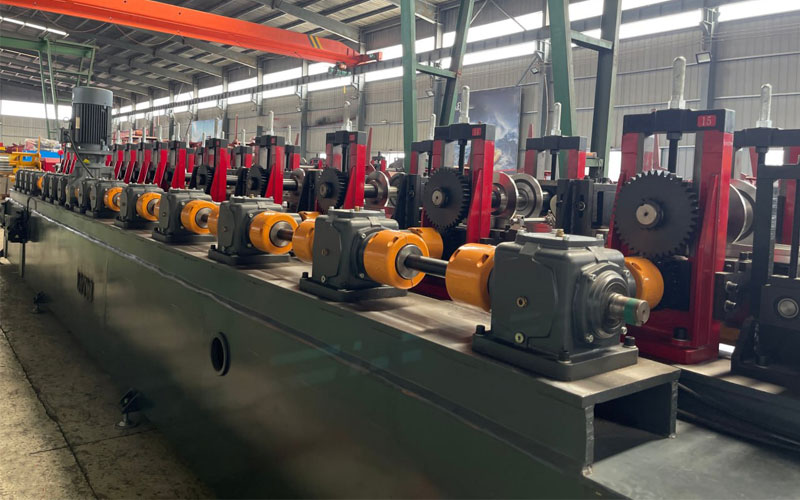
Stud And Track Machine Manufacturers
The demand for high-quality metal stud and track making machines continues to grow as lightweight steel framing becomes increasingly popular in residential, commercial, and industrial construction. A reliable stud and track roll forming machine enables manufacturers to produce accurate C-shaped studs and U-shaped tracks with consistent dimensions, high production efficiency, and excellent repeatability.
Among the available solutions in China, LOTOSFORMING provides a range of metal framing roll forming systems designed for different material thicknesses, profile dimensions, punching requirements, and production capacities.
Below are five major types of metal stud and track making machines suitable for different production requirements.
1. Standard Metal Stud and Track Making Machine
The standard Metal Stud and Track Making Machine is designed for manufacturers producing conventional C-shaped studs and U-shaped tracks for drywall partitions, ceilings, interior walls, and lightweight steel framing.
The production process generally includes:
Decoiling → Leveling → Servo Feeding → Punching → Roll Forming → Cutting → Output
The roll forming section gradually transforms the steel strip into the required stud or track profile while maintaining dimensional accuracy throughout the process.
Typical advantages include:
- Continuous roll forming production
- Stable profile dimensions
- Automatic length measurement
- Servo-controlled feeding
- Automatic punching options
- Hydraulic or servo tracking cutting
- PLC-based control system
- Fast profile changeover options
This type of machine is suitable for manufacturers requiring a reliable solution for standard metal framing profiles.
2. High-Speed Metal Stud and Track Roll Forming Machine
For manufacturers focused on increasing production capacity, a High-Speed Metal Stud and Track Roll Forming Machine can provide higher output while maintaining consistent profile quality.
High-speed production requires coordinated operation between the feeding, roll forming, punching, and cutting systems. The machine must maintain accurate synchronization to prevent dimensional errors during continuous production.
A high-speed configuration can include:
- Automatic decoiler
- Precision leveling system
- Servo feeding
- High-efficiency punching system
- Multi-pass roll forming stations
- Servo tracking cutting system
- Automatic discharge
- PLC and touchscreen control
The machine can be configured according to the required material thickness, profile size, line speed, and punching pattern.
For large-volume drywall framing production, high-speed roll forming technology can significantly improve manufacturing efficiency.
3. Heavy-Duty Structural Stud and Track Making Machine
For load-bearing applications, manufacturers may require a Heavy Duty Structural Stud and Track Making Machine capable of processing thicker and wider steel strips.
Structural studs and tracks are commonly used in applications where greater load capacity and structural performance are required. Therefore, the roll forming machine must have a robust frame, high-strength tooling, and a stable transmission system.
A heavy-duty system typically features:
- Reinforced machine frame
- High-strength forming rolls
- Heavy-duty transmission
- High-capacity decoiler
- Precision leveling
- Servo feeding
- Automatic punching
- Hydraulic or servo cutting
- PLC control system
The roll tooling is particularly important for heavy-gauge applications. Proper roll design helps control material deformation and ensures the finished profile maintains the required dimensions.
This type of machine is suitable for producing structural C studs and U tracks used in stronger lightweight steel framing systems.
4. Automatic Metal Stud and Track Making Machine with Punching
A Metal Stud and Track Making Machine with Automatic Punching integrates profile forming with automated hole punching. This configuration is particularly useful when studs require service holes, connection holes, or other predefined punching patterns.
Depending on the product design, punching can be arranged before or after roll forming.
Pre-Punching
Pre-punching is performed before the steel strip enters the roll forming section.
Decoiling → Leveling → Punching → Roll Forming → Cutting
This method is suitable when the punching pattern must be accurately positioned relative to the incoming flat strip.
Post-Punching
Post-punching is performed after the profile has been formed.
Decoiling → Leveling → Roll Forming → Punching → Cutting
Post-punching can be useful when holes need to be positioned directly on the finished profile.
The punching method should be selected according to the profile geometry, hole dimensions, material thickness, production speed, and required positioning accuracy.
5. Quick Change Metal Stud and Track Making Machine
A Quick Change Metal Stud and Track Making Machine is designed for manufacturers who need to produce multiple stud and track specifications on the same production line.
Profile changeover is an important consideration for manufacturers producing different sizes or configurations. A properly designed quick-change system can reduce downtime and improve overall equipment utilization.
Depending on the machine configuration, profile changes may involve:
- Roll forming tooling adjustment
- Punching tooling replacement
- Cutting die replacement
- Guide adjustment
- PLC parameter adjustment
For certain multi-profile configurations, the roll forming section can be designed to accommodate several specifications while the required tooling is changed in the punching and cutting sections.
This approach can provide greater production flexibility while reducing the need for multiple independent production lines.
How Does a Metal Stud and Track Making Machine Work?
A typical metal stud and track production line uses a continuous roll forming process.
1. Decoiling
The steel coil is loaded onto the decoiler. The decoiler continuously supplies the raw material to the production line.
2. Leveling
The leveling unit removes coil-set and improves the flatness of the steel strip before it enters the forming section.
3. Feeding
A servo feeding system controls the material movement and provides accurate positioning for punching and forming operations.
4. Punching
Required holes, slots, or service openings are produced according to the programmed design.
5. Roll Forming
The strip passes through multiple roll forming stations. Each station gradually bends the material until the final stud or track geometry is achieved.
6. Cutting
The finished profile is cut to the programmed length using a hydraulic or servo tracking cutting system.
7. Output
The finished studs or tracks are transferred to the output table for collection, bundling, or subsequent packaging.
Key Factors When Choosing a Metal Stud and Track Making Machine
Before purchasing a metal stud and track roll forming machine, manufacturers should evaluate several technical parameters.
Material Thickness
The machine should be designed according to the actual thickness range of the steel coil. Heavier material requires stronger forming stations, transmission components, and machine structures.
Profile Dimensions
The width, height, flange dimensions, lip configuration, and other profile parameters directly affect the roll tooling design.
Production Speed
Production speed should be selected according to the required output and profile complexity. Higher speeds require accurate synchronization between feeding, punching, forming, and cutting systems.
Punching Requirements
The number, size, location, and frequency of holes should be considered when selecting the punching configuration.
Cutting Accuracy
The cutting system should provide accurate finished lengths without significantly affecting production speed.
Automation
PLC control, touchscreen operation, servo feeding, automatic punching, automatic cutting, and production parameter storage can improve operating efficiency.
Why Choose LOTOSFORMING for Metal Stud and Track Production?
LOTOSFORMING focuses on the design and manufacture of metal stud and track roll forming machines for construction and lightweight steel framing applications.
The equipment can be engineered according to different requirements, including:
- Stud and track dimensions
- Material thickness
- Steel grade
- Production speed
- Punching configuration
- Cutting method
- Profile quantity
- Automation requirements
LOTOSFORMING can also provide customized roll tooling and production-line configurations for manufacturers requiring specific stud and track profiles.
For customers producing different types of metal framing products, selecting the appropriate machine configuration is essential for achieving stable production, accurate dimensions, and efficient operation.
Conclusion
Choosing the right metal stud and track making machine in China requires careful consideration of material thickness, profile dimensions, production speed, punching requirements, cutting accuracy, and automation level.
The five major configurations discussed above—standard, high-speed, heavy-duty structural, automatic punching, and quick-change metal stud and track machines—can address different production requirements.
With customized engineering, precision roll tooling, automated control systems, and complete production-line integration, LOTOSFORMING provides solutions for manufacturers seeking efficient and reliable metal stud and track production equipment.