
Complete Guide to CU Solar Channel Roll Forming
CU Solar systems are widely used in modern photovoltaic (PV) mounting structures because they provide a practical solution for supporting solar panels on rooftops, ground-mounted systems, and other solar installations. The production of high quality CU Solar channels requires accurate roll forming technology capable of maintaining dimensional consistency, structural strength, and high production efficiency.
For manufacturers looking to produce solar mounting profiles, a CU Solar Channel Roll Forming Machine offers an automated and reliable method for converting steel coils into finished structural channels.
What Is CU Solar?
CU Solar is a type of solar mounting channel/profile designed to provide structural support in photovoltaic installation systems. The profile typically combines a C shaped structural section with additional formed features that improve stiffness, connection capability, and load-bearing performance.
CU Solar profiles are commonly manufactured from galvanized steel, pre-galvanized steel, or other corrosion-resistant materials. Depending on the project requirements, manufacturers can produce different dimensions, thicknesses, hole patterns, and profile configurations.
The exact cross-sectional geometry of a CU Solar profile depends on the solar mounting system and engineering requirements.
CU Solar Channel Roll Forming Machine
A CU Solar Channel Roll Forming Machine is a continuous production line that transforms a steel coil into a finished CU Solar profile through a series of precisely engineered forming rollers.
A typical production process includes:
Decoiling → Leveling → Servo Feeding → Punching → Roll Forming → Flying Cutting → Finished Profile Collection
The configuration can be customized according to the required profile, material thickness, hole pattern, production speed, and cutting length.
How Does CU Solar Roll Forming Work?
The CU Solar manufacturing process is generally divided into several stages.
1. Coil Loading and Decoiling
The steel coil is loaded onto the decoiler, which continuously supplies strip material to the production line.
Depending on the coil weight and material specifications, the decoiler may be designed with hydraulic expansion, automatic centering, or other functions to improve material handling.
2. Leveling
The strip passes through a leveling unit to remove coil memory and improve flatness.
Proper leveling is important because excessive strip deformation can affect:
- Profile dimensions
- Hole positioning
- Roll forming stability
- Cutting accuracy
- Final assembly
3. Servo Feeding
A servo feeding system controls the precise movement of the steel strip through the line.
For applications requiring accurate hole positioning, servo feeding provides better control of the material length and punching position.
4. Online Punching
Depending on the customer’s requirements, the CU Solar line can incorporate an online punching system.
The punching unit can produce:
- Mounting holes
- Slots
- Connection holes
- Drainage holes
- Customized hole patterns
Punching can be configured before or after the roll forming section depending on the profile design and production requirements.
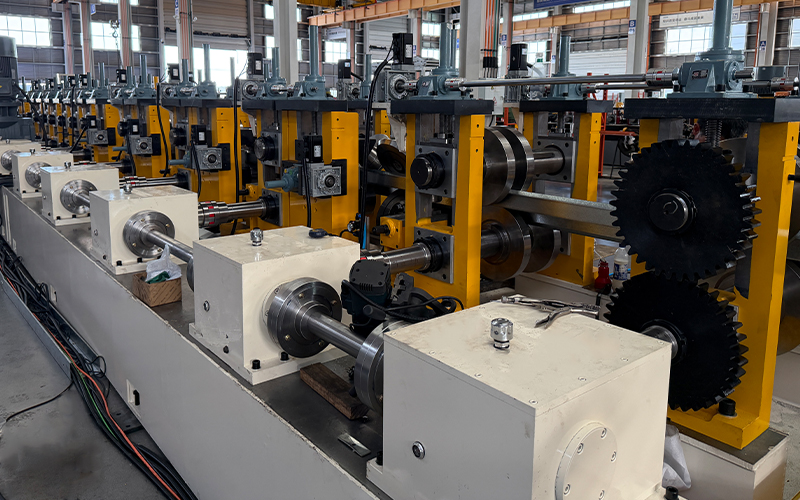
5. Roll Forming
The strip then enters the roll forming section.
Multiple forming stations gradually bend the flat steel strip into the required CU Solar cross-section. Instead of forming the profile in a single operation, the deformation is distributed across several roller stands.
This gradual forming process helps maintain:
- Profile dimensional accuracy
- Straightness
- Surface quality
- Consistent geometry
- Production stability
6. Flying Cutting
After the profile reaches the required length, a flying cutting system can cut the continuously formed profile without requiring the complete line to stop.
Flying shear technology is particularly useful for higher-speed production because it can improve productivity while maintaining accurate cutting lengths.
7. Finished Profile Collection
The finished CU Solar channels are transferred to an output table or collection system.
Depending on production requirements, automatic stacking and packaging systems can also be integrated into the line.
Typical CU Solar Material and Production Requirements
CU Solar profiles can be produced from different grades and thicknesses of steel according to structural requirements.
For example, a CU Solar channel line may be designed for material thicknesses such as 2.0 mm, 2.5 mm, 3.0 mm, or 4.0 mm, depending on the machine configuration and profile design.
Production speed also depends on:
- Material thickness
- Profile geometry
- Number of forming stations
- Punching pattern
- Cutting method
- Required dimensional tolerance
- Coil quality
- Automation level
For example, LOTOSFORMING has developed CU Solar channel solutions with production configurations reaching approximately 30–40 m/min, depending on the specific profile and material requirements.
Advantages of CU Solar Roll Forming
High Production Efficiency
Roll forming is a continuous process, making it suitable for large-volume solar mounting profile production.
Consistent Profile Dimensions
Precisely manufactured forming rollers help maintain consistent dimensions throughout long production runs.
Flexible Profile Design
The machine can be engineered for different CU Solar cross-sections, hole patterns, and dimensional requirements.
Integrated Punching
Online punching eliminates the need for a separate punching operation in many production configurations.
Accurate Cutting
Flying cutting technology can provide precise finished lengths while reducing production interruptions.
Reduced Material Waste
Continuous roll forming uses the steel strip efficiently, helping manufacturers reduce material waste compared with some batch manufacturing processes.
CU Solar vs Traditional Solar Mounting Profiles
CU Solar profiles are designed to provide a combination of strength, rigidity, installation convenience, and material efficiency.
Compared with simple flat or conventional structural sections, a formed CU Solar channel can provide a more engineered cross-section for transferring loads and connecting solar mounting components.
The appropriate profile depends on the structural calculations, installation environment, panel arrangement, wind and snow loads, and connection requirements of the solar project.
Applications of CU Solar Channels
CU Solar channels can be used in various photovoltaic mounting applications, including:
- Rooftop solar mounting systems
- Ground-mounted PV systems
- Commercial solar installations
- Industrial photovoltaic projects
- Solar support frames
- PV panel structural systems
- Solar carports
- Agricultural solar installations
The profile can be customized to suit different structural and installation requirements.
How to Choose a CU Solar Roll Forming Machine
Before purchasing a CU Solar roll forming machine, manufacturers should define the following specifications:
1. Profile Drawing
The first and most important requirement is the final CU Solar profile drawing.
The drawing should include all critical dimensions and tolerances.
2. Material Thickness
The machine must be designed according to the maximum and minimum steel thickness required.
3. Material Width
The incoming strip width determines the required roll tooling and forming configuration.
4. Hole Pattern
If online punching is required, the punching system should be designed according to the exact hole diameter, slot dimensions, spacing, and tolerance.
5. Production Speed
The required output in meters per minute should be established before selecting the machine configuration.
6. Cutting Length
The cutting system should accommodate the required finished profile lengths.
7. Automation Requirements
Manufacturers can select different automation levels, including PLC control, touchscreen operation, servo feeding, automatic punching, flying cutting, and automatic stacking.
Why Choose LOTOSFORMING for CU Solar Production?
LOTOSFORMING provides customized roll forming solutions for solar mounting profiles and other structural steel applications.
A CU Solar production line can be engineered according to the customer’s:
- Profile drawing
- Steel grade
- Material thickness
- Coil width
- Punching requirements
- Production speed
- Cutting length
- Automation requirements
The machine design can integrate decoiling, leveling, servo feeding, punching, roll forming, flying cutting, PLC control, and finished-product handling into one continuous production system.
For manufacturers entering the solar mounting structure market, selecting the correct roll forming configuration is essential for achieving stable production and consistent product quality.
Conclusion
CU Solar channels are an important component of modern photovoltaic mounting structures. Their combination of structural performance, standardized manufacturing, and installation flexibility makes them suitable for a wide range of solar projects.
A properly engineered CU Solar Channel Roll Forming Machine enables manufacturers to produce these profiles continuously with accurate forming, online punching, precise cutting, and high production efficiency.
FAQ:
CU Solar channels are commonly manufactured from galvanized or other corrosion-resistant steel. The appropriate material grade and thickness depend on the structural application.
Production speed depends on the profile, material thickness, punching requirements, and machine configuration. Certain LOTOSFORMING CU Solar configurations can achieve approximately 30–40 m/min.
Yes. The roll tooling and punching system can be designed according to the customer’s profile drawing and required hole pattern.
CU Solar and Strut Channel are both used in solar mounting and structural applications, but their cross-sectional designs, dimensions, connection methods, and intended applications can differ. The correct choice depends on the engineering and installation requirements.