
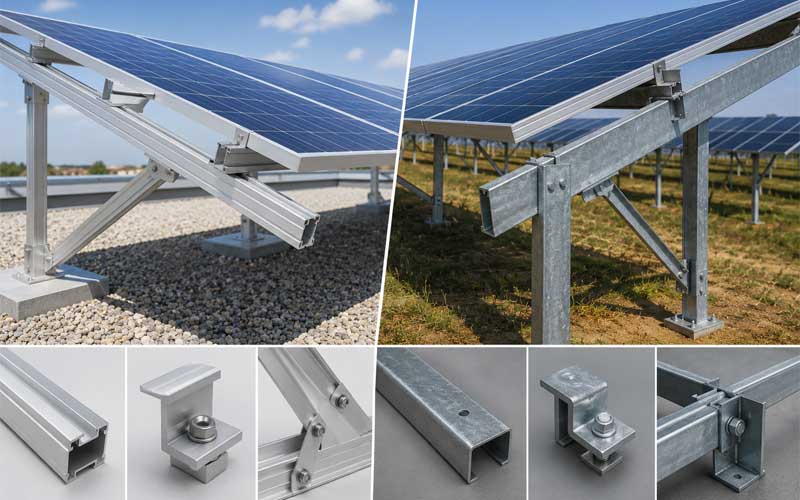
Aluminum vs Steel for Solar Mounting
Choosing the right solar mounting structure is one of the most important decisions in
designing and installing solar power plants. A well designed structure must withstand the
weight of solar panels while resisting wind loads, snow loads, temperature fluctuations,
and harsh environmental conditions.
Among the most widely used materials for solar mounting systems, galvanized steel and
aluminum are the two leading options. Each offers unique advantages depending on the
project’s requirements, including location, environmental conditions, budget, expected
service life, and installation type.
The knowledge-based company Lotos Sanat Asia, through its specialized brand Lotos
Forming, designs and manufactures advanced roll forming production lines for producing
high precision solar mounting profiles that comply with international industrial standards.
What Are Steel Solar Mounting Structures?
Steel solar mounting structures are commonly manufactured from galvanized steel sheets
and are widely used in utility-scale solar power plants and industrial projects. Their high
mechanical strength and durability make them ideal for demanding applications.
The galvanized coating significantly improves corrosion resistance and extends the service
life of the structure, even in challenging environments.
Advantages of Steel Solar Structures
• Excellent mechanical strength
• High load-bearing capacity
• Superior resistance to wind and snow loads
• Cost-effective for large-scale projects
• Ideal for ground-mounted solar power plants
• Suitable for roll forming manufacturing processes
• Available in various dimensions and thicknesses
• Long service life when properly protected
Limitations
• Heavier than aluminum structures
• Higher transportation requirements due to weight
• Potential corrosion if the protective coating is severely damaged over time
What Are Aluminum Solar Mounting Structures?
Aluminum solar mounting structures are primarily used for rooftop solar installations and
projects with strict weight limitations. Their naturally high corrosion resistance makes them
particularly attractive for humid or coastal environments.
Advantages of Aluminum Solar Structures
• Lightweight construction
• Outstanding corrosion resistance
• Easy transportation and installation
• Faster assembly processes
• Attractive appearance
• Reduced maintenance requirements
• Suitable for residential and commercial rooftop projects
Limitations
• Higher initial material costs
• Lower strength in some heavy-duty applications
• Greater sensitivity to deformation if improperly designed
Type of Solar Project Ground-mounted solar farms, industrial installations, agricultural solar projects, and Rooftop systems each have different structural requirements that directly influence
material selection.
Budget Considerations Material costs, transportation expenses, installation requirements, and long-term maintenance costs should all be evaluated during the decision-making process.
Expected Service Life Both galvanized steel and aluminum structures can provide excellent durability when properly designed, manufactured, and maintained according to industry standards.
The Role of Roll Forming in Manufacturing Steel Solar Structures
Roll forming is one of the most advanced manufacturing technologies used for producing steel solar mounting profiles. In this continuous process, steel coils pass through multiple forming stations to achieve the desired profile shape without introducing excessive
stresses into the material.
Advantages of Roll Forming Technology
• High dimensional accuracy
• Consistent product quality
• Reduced material waste
• High production speed
• Precise punching and cutting capabilities
• Lower manufacturing costs
• Continuous and efficient production
• Excellent repeatability for mass production
Advantages of LotosForming Roll Forming Production Lines
As part of the knowledge-based company Lotos Sanat Asia, LotosForming develops
advanced roll forming solutions specifically designed for manufacturing solar mounting profiles and structural components.
Key Features Include:
• Customized machine design based on customer requirements
• Production capability for C, U, Z, and customized solar profiles
• High-precision roll forming technology
• Advanced PLC and HMI control systems
• Automatic punching systems
• Servo Flying Cut technology for precise cutting operations
• Consistent product quality
• Reduced raw material waste
• Optimized energy consumption
• Installation, operator training, and technical support services
• High speed and reliable industrial production performance
LotosForming’s roll forming lines help manufacturers improve productivity while meeting the growing demands of the renewable energy industry.
Which Solar Mounting Structure Is the Better Choice?
There is no universal answer for every solar project. If mechanical strength, cost-effectiveness, and industrial-scale applications are your
priorities, galvanized steel solar mounting structures are often the preferred solution.
Alternatively, if lightweight construction, rapid installation, and superior corrosion
resistance are essential, aluminum structures may offer significant advantages.
The final selection should always be based on engineering calculations, environmental conditions, project specifications, and long-term performance requirements.
Conclusion
Both galvanized steel and aluminum solar mounting structures play critical roles in modern solar power systems. Steel structures offer exceptional strength, durability, and economic advantages for large-scale projects, while aluminum structures provide lightweight performance and outstanding corrosion resistance for rooftop applications. Selecting the right material and manufacturing technology is essential for ensuring the long term success and reliability of any solar energy project.