
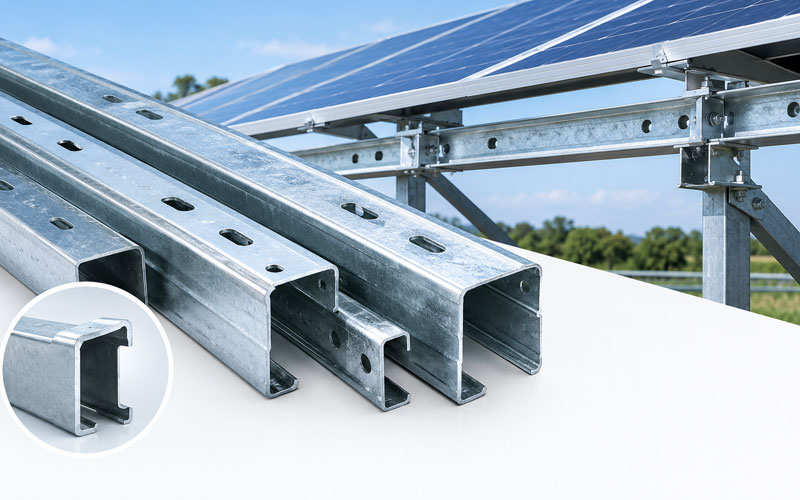
Cold Rolled Galvanized Steel Profile C Steel Strut Channel Purlins
Heavy duty hot-dipped galvanized C purlins are structural cold-formed steel profiles designed to provide strong, durable, and reliable support for solar mounting systems. With their high load-bearing capacity, corrosion resistance, and efficient material utilization, C purlins are widely used in photovoltaic (PV) structures installed on industrial roofs, commercial buildings, solar carports, and utility-scale solar projects.
For demanding solar applications, the combination of a heavy-duty C-section and hot-dip galvanized surface treatment provides enhanced structural performance and long-term protection against environmental exposure.
What Is a Heavy Duty C Purlin for Solar?
A heavy duty C purlin is a C-shaped structural steel member manufactured through a precision roll forming process. Compared with conventional light-gauge profiles, heavy duty C purlins are designed for applications requiring greater load-bearing capability, improved structural rigidity, and longer service life.
In solar mounting systems, C purlins can serve as primary or secondary structural members supporting photovoltaic panels, rails, brackets, and other components. The profile can be manufactured in different widths, heights, thicknesses, and hole configurations according to project requirements.
Why Use Hot Dipped Galvanized Steel?
Hot-dip galvanizing provides a protective zinc coating on the steel surface. This coating helps protect the C purlin against corrosion caused by moisture, rain, humidity, and other environmental conditions.
For solar structures installed outdoors, corrosion protection is particularly important because the supporting structure is expected to remain stable for many years.
The main benefits of hot-dipped galvanized C purlins include:
- Excellent corrosion resistance
- Long-term outdoor durability
- High structural strength
- Good resistance to moisture and weather exposure
- Reduced maintenance requirements
- Suitable for harsh environmental conditions
- Consistent surface protection
The appropriate zinc coating thickness should be selected according to the environmental conditions and structural requirements of the project.
Heavy Duty C Purlin Structure for Solar Applications
The C-shaped cross-section provides an efficient balance between structural strength and material consumption. Its geometry increases resistance to bending while maintaining a relatively lightweight profile.
Typical design factors include:
- Purlin width and height: Determined by structural loading and installation requirements.
- Steel thickness: Selected according to span, applied loads, and required strength.
- Material grade: Structural steel grades may be selected according to applicable standards and project specifications.
- Lip design: Reinforced lips can improve section rigidity and dimensional stability.
- Punching configuration: Holes can be produced for bolting, brackets, and assembly components.
- Galvanizing specification: The zinc coating is selected based on the required corrosion protection.
Applications of Heavy Duty C Purlins in Solar Systems
Heavy duty galvanized C purlins can be used in a wide range of photovoltaic structures.
Rooftop Solar Mounting
C purlins can provide structural support for rooftop photovoltaic installations, particularly on industrial and commercial buildings where stronger structural members may be required.
Solar Carports
For solar carport structures, heavy duty C purlins can be incorporated into the supporting framework to withstand the weight of the PV modules as well as environmental loads such as wind and snow.
Ground-Mounted Solar Systems
Large photovoltaic projects may use heavy structural purlins as components of ground-mounted support structures, depending on the engineering design and foundation system.
Industrial Solar Structures
Manufacturing facilities, warehouses, agricultural buildings, and other large structures can use galvanized C purlins as part of their solar mounting frameworks.
Advantages of Roll Forming for Solar C Purlins
Roll forming is an efficient manufacturing process for producing long, consistent C-shaped steel profiles. During production, a steel strip passes through a series of forming rollers that progressively shape the material into the required cross-section.
For solar C purlins, a dedicated roll forming line can integrate several operations into one continuous production process, such as:
- Decoiling
- Leveling
- Servo feeding
- Punching
- Roll forming
- Cutting
- Automatic output or stacking
This integrated process helps maintain dimensional consistency and improves production efficiency.
Automatic Punching for Solar C Purlins
Many solar mounting projects require accurately positioned holes for structural connections and accessories. An automatic punching system can produce holes according to predefined patterns before or during the roll forming process.
Depending on the product design, punching can be configured for:
- Bolt holes
- Mounting slots
- Connection holes
- Repeated photovoltaic bracket patterns
- Customized structural openings
Servo-controlled feeding and programmable punching systems help improve hole-position accuracy and repeatability.
Heavy Duty C Purlin Roll Forming Machine
A heavy duty C purlin roll forming machine is designed to continuously transform galvanized steel coils into finished C-shaped profiles.
A typical production line may include:
- Hydraulic decoiler
- Straightening and leveling unit
- Servo feeding system
- Hydraulic or mechanical punching system
- Roll forming section
- Hydraulic flying cutting system
- PLC control system
- Run-out table or automatic stacking unit
The machine configuration can be customized according to the required profile dimensions, thickness, steel grade, hole pattern, production speed, and automatic processing requirements.
Material Selection for Solar C Purlins
Material selection is an important consideration for heavy duty solar purlins. Structural steel must provide sufficient yield strength, dimensional stability, and forming performance.
Common considerations include:
- Steel grade
- Coil thickness
- Zinc coating
- Tensile and yield strength
- Forming characteristics
- Environmental exposure
- Structural loading requirements
For high load applications, thicker material and higher-strength structural steel may be required.
Structural Performance Considerations
The correct C purlin size should be determined through structural engineering calculations rather than selecting a profile based only on appearance or thickness.
Important design considerations include:
- Dead load of the solar modules
- Wind load
- Snow load
- Span length
- Purlin spacing
- Connection method
- Deflection limits
- Seismic requirements where applicable
- Corrosion environment
- Applicable building and structural standards
The final purlin dimensions and material specifications should therefore be selected according to the specific project design.
Heavy Duty Galvanized C Purlin Production with LOTOSFORMING
lotosforming provides roll forming solutions for manufacturing heavy duty galvanized C purlins for solar mounting structures. The production line can be configured for different profile sizes, steel thicknesses, hole patterns, cutting lengths, and automation requirements.
A customized C purlin roll forming line can integrate forming, punching, cutting, and automatic handling to support efficient production of consistent solar structural profiles.
The machine configuration can be developed according to the customer’s required C purlin dimensions, production capacity, raw material specifications, and photovoltaic mounting system design.
Conclusion
Heavy duty hot-dipped galvanized C purlins provide an effective structural solution for demanding solar mounting applications. Their combination of high load-bearing capacity, efficient C-section geometry, and corrosion-resistant galvanized protection makes them suitable for a wide range of photovoltaic support structures.
With a properly engineered roll forming and punching line, manufacturers can produce customized C purlins with consistent dimensions, accurate connection holes, and reliable production efficiency.
For solar steel structure manufacturers, investing in a dedicated heavy duty C purlin roll forming machine can provide the flexibility required to produce structural profiles for different photovoltaic projects.
FAQ:
C purlins are commonly used as structural members for solar panel support frames, ground-mounted solar structures, rooftop systems, and large-scale photovoltaic projects. They can support rails, brackets, and other components of the solar mounting structure.
Heavy-duty C purlins can be manufactured with greater material thickness, optimized profile dimensions, reinforced sections, and high-strength steel. These characteristics allow the profile to handle higher structural loads and longer spans when properly engineered.
The thickness depends on the project requirements and machine configuration. Heavy-duty C purlins can be produced in a range of thicknesses, with thicker material generally selected for applications requiring greater load-bearing capacity.
A hot dipped galvanized C purlin has a zinc protective coating that provides significantly better resistance to corrosion than untreated carbon steel. This is particularly useful for solar structures installed outdoors and exposed to weather.