
Materials Used for Rolling Shutter Doors
Different materials can be selected according to the application.
Galvanized Steel
Galvanized steel is widely used because of its strength and corrosion resistance.
It is suitable for:
- Industrial doors
- Warehouses
- Commercial buildings
- Security shutters
Pre Painted Steel
Pre-painted steel can provide an attractive finished surface and reduce the need for additional painting.
It is commonly used for commercial and residential applications.
Aluminum
Aluminum shutter profiles offer lightweight construction and good corrosion resistance.
They are often selected for:
- Retail stores
- Residential garages
- Commercial buildings
- Coastal environments
Types of Rolling Shutter Door Profiles
Rolling shutter door production lines can be designed for different profile types, including:
- Single layer shutter slats
- Double layer shutter slats
- Insulated shutter profiles
- Perforated shutter slats
- Flat shutter profiles
- Curved shutter profiles
- Garage door shutter profiles
- Industrial shutter profiles
The final machine configuration depends on the approved profile drawing.
Advantages of Roll Forming for Rolling Shutter Door Production
High Production Efficiency
Roll forming is a continuous manufacturing process suitable for large scale production.
Consistent Quality
Precision roller tooling helps maintain consistent dimensions and profile geometry throughout production.
Reduced Material Waste
The continuous coil-processing method can reduce material waste compared with certain batch manufacturing processes.
Flexible Production Length
The cutting system can be programmed to produce different shutter slat lengths according to customer requirements.
Custom Profile Capability
A roll forming machine can be engineered for specific shutter profile designs and dimensions.
Automatic Rolling Shutter Door Production
Modern rolling shutter manufacturing can incorporate advanced automation systems.
Depending on production requirements, a complete line may include:
- Automatic decoiling
- Servo feeding
- Online punching
- PLC control
- Automatic length measurement
- Servo or hydraulic cutting
- Automatic stacking
- Finished product packaging
Automation can improve production consistency while reducing manual operation.
How to Choose a Rolling Shutter Door Roll Forming Machine
Before selecting a machine, manufacturers should define several important technical requirements.
Profile Drawing
The machine should be designed according to the final shutter slat cross section.
Material Type
The machine configuration must be suitable for the selected material, such as galvanized steel, pre painted steel, or aluminum.
Material Thickness
Material thickness directly affects roller design, motor capacity, forming stations, and cutting requirements.
Coil Width
The incoming strip width must correspond to the required developed width of the shutter profile.
Production Speed
The required production capacity should be considered when selecting the drive system and cutting method.
Cutting Length
The machine should provide accurate length control for different shutter door sizes.
Automation Level
Manufacturers can select manual, semi-automatic, or fully automatic production configurations.
Rolling Shutter Door Roll Forming Solutions from LOTOSFORMING
LOTOSFORMING provides customized roll forming solutions for various metal profiles, including rolling shutter door slats and related structural components.
A customized rolling shutter production line can be configured according to:
- Customer profile drawings
- Material specifications
- Material thickness
- Coil width
- Required production speed
- Punching requirements
- Finished product length
- Automation requirements
Depending on the project, the production line may integrate decoiling, feeding, roll forming, punching, cutting, and finished product handling into one continuous manufacturing system.
Manufacturing Process and Roll Forming Technology
A rolling shutter door is a widely used security and access solution for commercial, industrial, residential, and warehouse applications. Its compact design, durability, and ability to open vertically make it suitable for locations where security and efficient use of space are important.
Modern rolling shutter doors are commonly manufactured from steel, galvanized steel, aluminum, or other suitable materials. For high-volume production, a Rolling Shutter Door Roll Forming Machine provides an efficient method for continuously producing shutter slats with consistent dimensions and reliable quality.
What Is a Rolling Shutter Door?
A rolling shutter door consists of multiple interconnected horizontal slats that form a flexible curtain. During operation, the curtain moves vertically and rolls around a shaft or drum positioned above the door opening.
A complete rolling shutter system may include:
- Shutter slats
- Bottom rail
- Guide rails
- Roller shaft
- Brackets
- Springs or motorized drive systems
- Locking components
- Control systems for automatic doors
The design and material selection depend on the application, required security level, door size, and environmental conditions.
How Are Rolling Shutter Door Slats Manufactured?
Rolling shutter slats are commonly produced through a continuous cold roll forming process.
The basic manufacturing process is:
Steel Coil → Decoiling → Feeding → Roll Forming → Cutting → Finished Slat Collection
Additional equipment such as punching units, embossing systems, automatic stacking equipment, and packaging systems can also be integrated into the production line.
Rolling Shutter Door Roll Forming Machine
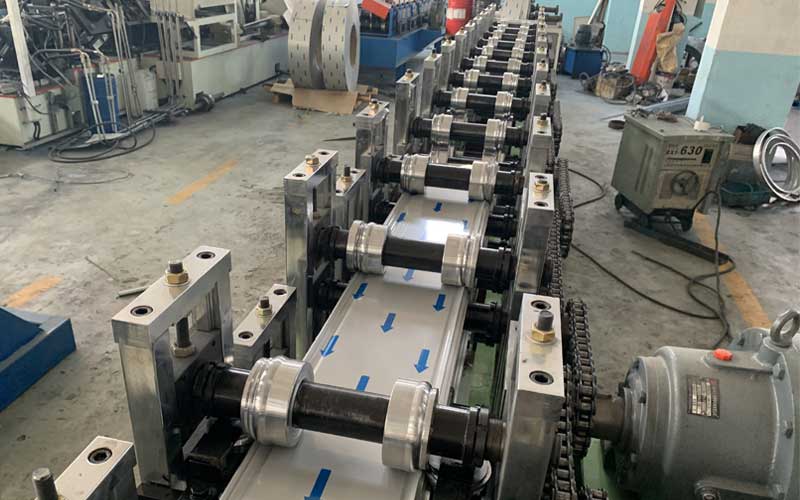
A Rolling Shutter Door Roll Forming Machine converts metal strip from a coil into the required shutter slat profile through a series of precisely designed forming rollers.
Each roller station gradually bends the strip until the final profile is achieved. This continuous process allows manufacturers to produce long quantities of shutter slats efficiently.
A typical machine configuration includes:
1. Decoiler
The decoiler holds and unwinds the steel or aluminum coil.
Depending on production requirements, the system may use:
- Manual decoilers
- Motorized decoilers
- Hydraulic decoilers
- Automatic coil loading systems
Stable material feeding is essential for maintaining consistent production quality.
2. Feeding and Guiding System
The metal strip enters a feeding and guiding section before reaching the roll forming machine.
This section helps ensure that the material remains correctly aligned during production.
Proper strip alignment can reduce:
- Profile distortion
- Uneven forming
- Material deviation
- Dimensional inconsistency
3. Roll Forming Section
The roll forming section is the main part of the production line.
A series of roller stations progressively forms the flat metal strip into the required shutter slat shape. The roller design must consider the material thickness, mechanical properties, profile geometry, and required tolerances.
High-quality roll forming tooling is important for achieving:
- Accurate profile dimensions
- Smooth surface quality
- Consistent interlocking geometry
- Stable production
- Long roller service life
4. Punching or Perforation System
Some rolling shutter door profiles require holes, slots, or perforations.
An optional punching system can be integrated into the line to produce:
- Ventilation holes
- Connection holes
- Decorative perforations
- Installation slots
The punching configuration can be customized according to the customer’s shutter profile design.
5. Cutting System
After the shutter slat reaches the required length, the profile is cut using an appropriate cutting system.
Common options include:
- Hydraulic stop cutting
- Servo-controlled cutting
- Flying cutting
The selection depends on the required production speed and finished product specifications.
6. Finished Product Collection
After cutting, the finished shutter slats are transferred to an output table or automatic collection system.
For higher production capacity, automatic stacking systems can improve efficiency and reduce manual handling.
Maintenance of Rolling Shutter Roll Forming Machines
Regular maintenance is important for maintaining production quality and extending machine service life.
Recommended maintenance procedures include:
- Inspecting forming rollers regularly
- Lubricating moving components
- Checking chain and gearbox systems
- Inspecting hydraulic components
- Checking electrical connections
- Monitoring cutting blade condition
- Verifying profile dimensions
- Maintaining proper strip alignment
Preventive maintenance can help reduce unexpected downtime and improve long-term production stability.
Conclusion
A rolling shutter door is an effective solution for security, access control, and space-efficient building design. The quality of the shutter system depends significantly on the accuracy and consistency of its individual slats.
A Rolling Shutter Door Roll Forming Machine provides manufacturers with an efficient solution for producing shutter profiles continuously from metal coils. With properly designed roller tooling, feeding equipment, punching systems, and cutting technology, manufacturers can achieve consistent product quality and improved production efficiency.
For the best results, a rolling shutter door production line should be customized according to the actual profile drawing, material specifications, required production capacity, and automation requirements.
FAQ:
Yes. The machine and forming rollers can be designed according to the customer’s shutter profile drawing, dimensions, material thickness, and production requirements.
Rolling shutter door slats are commonly manufactured from metal coils using a continuous roll forming process that includes decoiling, feeding, roll forming, cutting, and product collection.
Common materials include galvanized steel, pre-painted steel, stainless steel, and aluminum, depending on the required strength, appearance, and corrosion resistance.