
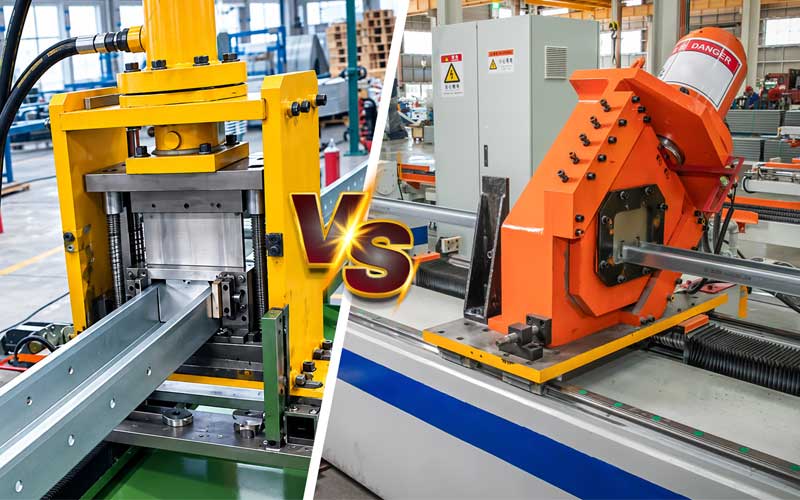
Choosing the Right Line for Solar Mounting Production
The rapid growth of utility scale and commercial solar installations has created sustained demand for steel mounting structures. At the heart of these structures are cold formed steel profiles: purlins, rails, posts and bracing members that must be produced in large volumes, to tight tolerances, and with consistent hole patterns for fast installation on site.
Two profile families dominate this market: sigma channels and C/U channels. Each requires a dedicated roll forming line, and the choice between them has direct consequences for capital investment, tooling, floor space and the range of projects a manufacturer can serve.
This article explains the differences between sigma channel roll forming lines and C/U solar channel roll forming lines, and sets out the main criteria that manufacturers should consider before investing.
What Is a Sigma Channel?
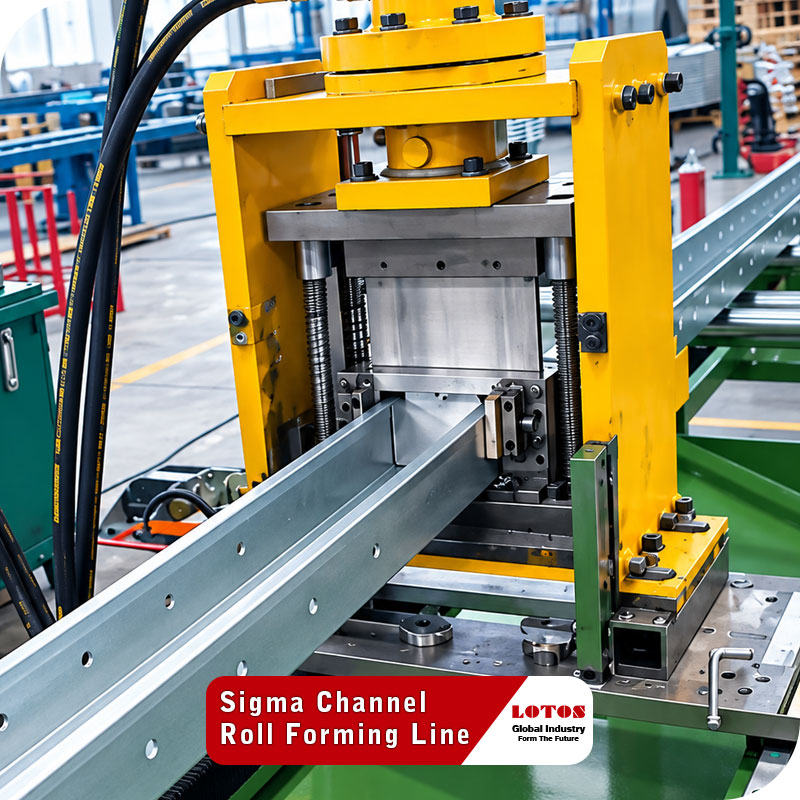
A sigma channel (often called a sigma purlin or Σ-profile) is a cold formed section whose web is not flat. Instead, the web is folded inward with additional bends, producing a cross-section that resembles the Greek letter Σ. Like a C-profile, it has two flanges and, typically, return lips.
Structural purpose of the sigma shape
The extra bends in the web serve a clear engineering function:
- Increased web stiffness, which improves resistance to local buckling.
- A more favourable position of the shear centre, which helps the section behave more predictably under load.
- A higher strength to weight ratio, allowing longer spans or lighter steel for a given load.
For these reasons, sigma profiles are widely used as purlins and main beams in ground mounted solar structures, as well as in roofing and light building construction where long spans are required.
What Are C and U Solar Channels?
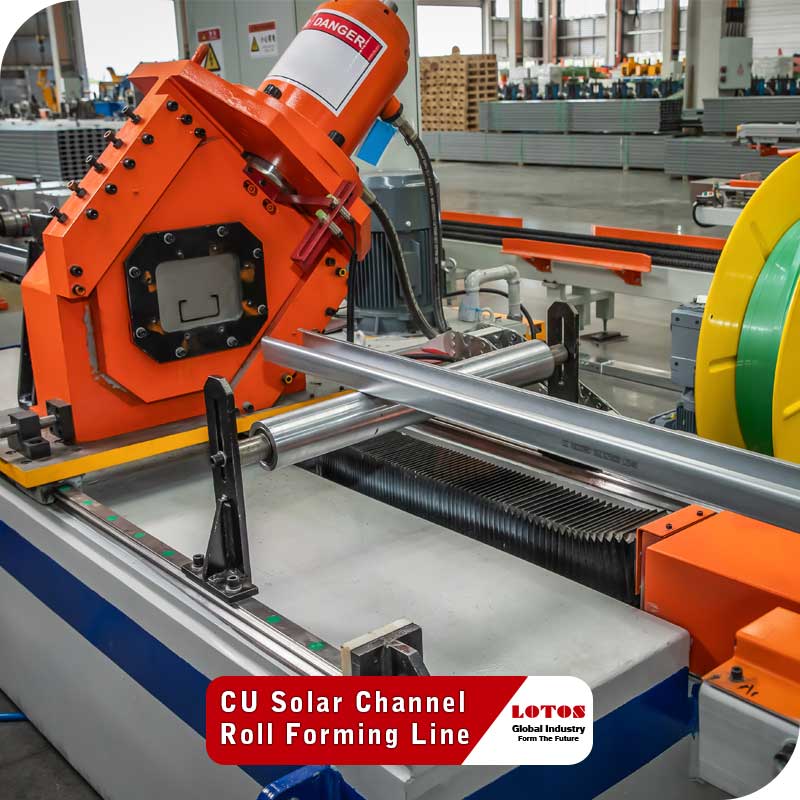
C channels have a flat web, two flanges and inward turned lips. U channels are open sections with a flat web and two flanges, usually without lips. Both are among the most common profiles in solar mounting systems, where they are used as:
- Rails and purlins supporting the PV modules
- Posts, legs and columns
- Diagonal braces and cross members
- Connecting and secondary members
Their simple geometry makes them easy to connect, punch and stack, and they are compatible with a wide variety of mounting system designs. Perforated C/U and strut profiles are also common where adjustable, bolt-together assembly is required.
How the Roll Forming Lines Differ
Both line types follow the same basic process sequence: coil feeding → straightening/leveling → punching (if required) → progressive roll forming → cutting to length → output and stacking. The differences lie in the details of each stage.
1. Number of forming stations
Every bend in a profile must be formed gradually across successive roll stands to avoid cracking, twisting or edge waviness. Because a sigma profile has more bends than a comparable C or U profile, a sigma line generally requires more forming stations and more carefully designed roll flower patterns. This increases the length of the line, the amount of tooling and the engineering effort involved in the roll design.
A C/U line, by comparison, typically needs fewer stations and is more compact for the same material thickness.
2. Roll tooling design
Roll tooling for sigma profiles is more complex because the inner web bends must be formed without disturbing the flanges and lips that have already been shaped. Precise control of springback is critical to maintaining the web geometry. For C/U profiles, roll design is more straightforward, which generally simplifies manufacturing, setup and maintenance of the tooling.
3. Size changeover and flexibility
Solar projects frequently call for different profile heights, flange widths and thicknesses. Both line types can be configured for:
- Fixed-size production, with dedicated tooling for one profile dimension, or
- Adjustable or multi-size production, where stands can be repositioned (manually or automatically) to produce a range of sizes.
Changeover is usually simpler on C/U lines because fewer geometric parameters must be adjusted. On sigma lines, a size change affects the web folds as well as the flanges, so the adjustment system must be designed with particular care.
4. Punching systems
Solar mounting profiles almost always require holes and slots for bolted connections. Punching can be integrated in two principal ways:
- Pre-punching of the flat strip before forming, which is common for both profile types.
- Post-punching after the profile is formed, used when hole positions depend on the final geometry.
Because sigma profiles are often used as long-span purlins with project-specific connection points, the punching unit and its control software must handle variable hole patterns accurately. C/U channels, especially perforated versions, often use repetitive patterns that suit high-speed pre-punching.
5. Cutting and output
Both lines generally use a flying cut-off or a stop-to-cut system. The cutting die must match the cross-section exactly to produce a clean, burr-free end; sigma dies are more complex because of the folded web. On the output side, automatic stacking and packing units are increasingly common for both line types, as they reduce manual handling of long, heavy profiles.
6. Production speed
Line speed depends on many variables: material grade and thickness, punching density, cutting method and profile complexity. As a general principle, simpler C/U profiles with repetitive punching can run at higher effective output than complex sigma profiles with dense, variable hole patterns. LOTOS offers Solar C/U lines in variants referenced at 15 and 30 m/min in its solar catalogue; actual throughput is configuration-specific and should be confirmed for each project.
Side-by-Side Comparison
| Criterion | Sigma Channel Roll Forming Line | C/U Solar Channel Roll Forming Line |
|---|---|---|
| Profile geometry | Folded web, flanges and lips (Σ shape) | Flat web; C with lips, U without |
| Typical solar use | Long-span purlins and main beams | Rails, posts, braces, secondary members |
| Structural efficiency | Higher stiffness-to-weight ratio | Good, with simpler geometry |
| Forming stations | More stations required | Fewer stations required |
| Roll tooling complexity | High | Moderate |
| Size changeover | More parameters to adjust | Generally simpler |
| Punching | Often variable, project-specific patterns | Often repetitive patterns, suits pre-punching |
| Cut-off die | More complex profile die | Simpler profile die |
| Line length and footprint | Longer | More compact |
| Investment level | Generally higher | Generally lower |
Which Line Is Right for Your Factory?
The decision should be driven by your market and product portfolio rather than by the machine alone. The following questions are a useful starting point.
Choose a sigma channel line if:
- You supply utility-scale ground-mount projects where long spans and material efficiency are important.
- Your customers or structural engineers specify sigma purlins in their designs.
- You also serve the construction sector, where sigma purlins are used in roofing and light steel buildings.
Choose a C/U solar channel line if:
- You manufacture standardised mounting kits for rooftop, carport or ground-mount systems.
- Your product range requires many secondary and connecting members in high volume.
- You need a more compact line with simpler tooling and faster changeover.
Consider both if:
Many complete solar mounting systems combine sigma purlins with C/U posts and braces. Manufacturers aiming to supply complete structures often benefit from operating both line types, or from a phased investment that begins with the profile family in greatest demand.
Key Factors to Specify Before Ordering
Whichever line you choose, the following parameters should be defined clearly with your machine supplier:
- Final profile drawings, including all dimensions and tolerances
- Material specification: steel grade, coating (e.g. pre-galvanised or zinc-magnesium) and thickness range
- Range of sizes to be produced, and the required changeover method
- Hole and slot patterns, including whether they are fixed or variable
- Required output and shift pattern
- Cutting method and length tolerance
- Output handling: manual collection, automatic stacking or packing
- Control system requirements, including recipe storage and integration with production planning
Clear technical input at this stage avoids costly redesign later and ensures the line matches real production needs.
The LOTOS Approach
LOTOS Sanat Asia designs and builds roll forming and tube mill lines for metal processing industries, including dedicated lines for solar mounting profiles. Every project follows a structured process:
- Technical consultation to define the profile, material and production targets
- Line layout and engineering, including roll flower design and punching configuration
- Manufacturing of the machine and tooling
- Factory Acceptance Test (FAT) before shipment
- Installation, commissioning and operator training
- Site Acceptance Test (SAT) and ongoing technical support
This approach allows each line to be configured around the customer’s actual profiles, whether sigma purlins, C/U channels, or perforated strut sections, rather than adapting production to a standard machine.
Conclusion
Sigma channel and C/U solar channel roll forming lines share the same fundamental process, but they serve different structural roles and involve different levels of engineering complexity. Sigma lines deliver structurally efficient long-span purlins at the cost of more forming stations and more complex tooling. C/U lines offer simplicity, compactness, and versatility for the high volume members found throughout solar mounting systems.
The right choice depends on the projects you serve, the profiles your customers specify, and your long-term growth strategy. A careful definition of profiles, materials, and output requirements at the outset is the most reliable path to a successful investment.
FAQ:
Some lines can be designed with interchangeable tooling, but because the geometries differ significantly, most manufacturers use dedicated lines for each profile family to maintain quality and productivity.
Punching is usually required for solar mounting profiles and can be integrated before or after forming, depending on the hole pattern and the profile design.
Speed depends on material thickness and grade, profile complexity, punching density and cutting method. Output figures should always be confirmed for the specific configuration.
A C channel has a flat web, while a sigma channel has additional bends folded into the web. These bends increase stiffness and make the sigma profile more efficient for long spans.