
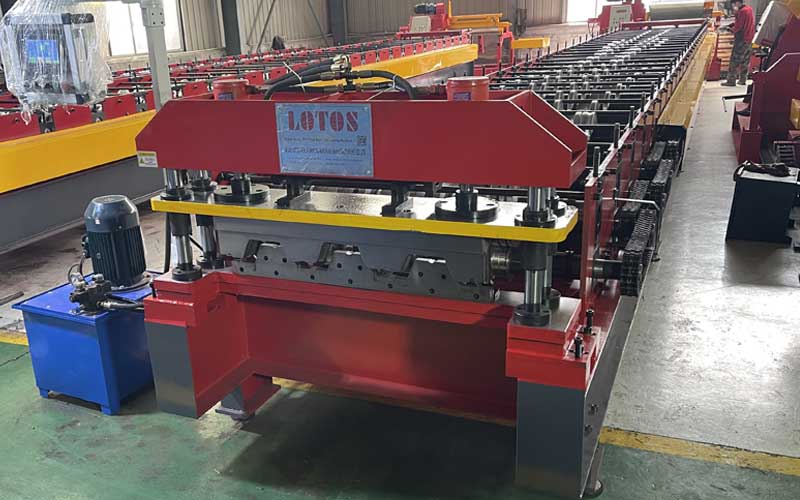
Deck Floor Roll Forming Machine
Metal floor decking is a profiled steel sheet used in building construction to form floor and roof systems. It is typically manufactured from galvanized steel coils and shaped through a floor decking roll forming machine into a ribbed or trapezoidal profile. The formed deck provides a stable platform for concrete placement and, depending on the structural design, can work together with concrete as part of a composite floor system.
Metal floor decking is widely used in commercial buildings, industrial facilities, warehouses, parking structures, and multi story steel-frame construction because it can accelerate installation while reducing the need for temporary formwork.
What Is Metal Floor Decking Used For?
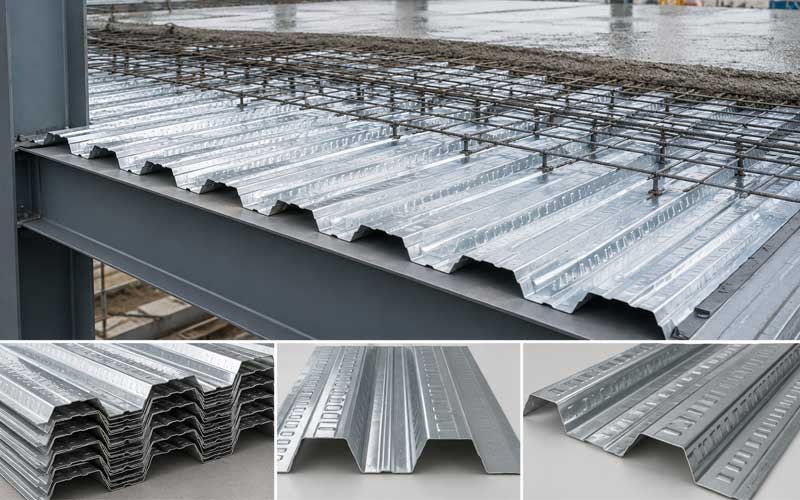
The primary function of metal floor decking is to provide a permanent or semi permanent structural form for concrete floor slabs. During construction, the profiled steel sheet is installed over structural beams or joists. Reinforcement and concrete are then placed on top of the decking.
Typical applications include:
- Commercial and office buildings
- Industrial buildings and factories
- Warehouses and logistics centers
- Multi-story residential buildings
- Shopping centers
- Steel-frame construction projects
- Multi-level parking structures
- Institutional and public buildings
The exact application depends on the decking profile, steel grade, thickness, span requirements, loading conditions, and structural design.
How Does Metal Floor Decking Work?
A typical metal floor decking system consists of several components:
Structural Steel Beams → Metal Floor Decking → Reinforcement → Concrete Slab
The profiled steel sheet is placed across the supporting beams. Its ribs increase the stiffness of the sheet and help it carry construction loads during concrete placement.
After installation, reinforcement may be positioned according to the engineering design before concrete is poured. Once the concrete cures, the steel decking can remain in place and, in a properly designed composite system, contribute to the overall performance of the floor.
The structural role of the decking should always be determined according to the applicable building codes and engineering calculations.
How Is Metal Floor Decking Manufactured?
Metal floor decking is generally produced from steel coils using a continuous roll forming process. The manufacturing line gradually changes the flat steel strip into the required decking profile without requiring conventional stamping for the entire cross-section.
A typical production process includes:
- Steel Coil Loading
- Decoiling
- Leveling
- Servo Feeding
- Roll Forming
- Punching or Embossing, if required
- Cutting to Length
- Run-Out and Stacking
The roll forming section contains a series of forming stands. Each stand progressively bends the steel until the final floor decking geometry is achieved.
What Materials Are Used for Metal Floor Decking?
Metal floor decking is commonly manufactured from galvanized steel because zinc coating provides protection against corrosion during storage, transportation, and service.
Depending on project requirements, manufacturers may process different steel grades, thicknesses, widths, and coating specifications.
Important material parameters include:
- Steel grade
- Sheet thickness
- Coil width
- Zinc coating
- Yield strength
- Profile geometry
- Required panel length
Material selection should be based on structural requirements, environmental conditions, and applicable standards.
Common Metal Floor Decking Profiles
Metal floor decking can be manufactured in different cross-sectional designs depending on structural requirements and local construction practices.
Common configurations include:
Trapezoidal Floor Decking
Trapezoidal profiles are widely used because their rib geometry provides good stiffness and efficient material utilization. They are commonly found in steel-frame floor systems.
Ribbed Floor Decking
Ribbed profiles contain longitudinal ribs that improve the stiffness of the sheet and provide a suitable surface for concrete slab construction.
Composite Floor Decking
Composite decking is designed to work structurally with the concrete slab after curing. The profile geometry can include embossments or other features that improve mechanical interaction between steel and concrete.
The appropriate profile should be selected based on span, load, slab thickness, steel thickness, and structural design requirements.
Metal Floor Decking vs Traditional Concrete Formwork
Traditional concrete formwork typically requires temporary supports and must be removed after the concrete reaches the required strength. Metal floor decking can remain in position after concrete placement and may serve as permanent formwork.
This can provide advantages in construction speed and labor efficiency. In composite floor systems, the steel deck may also contribute structurally after the concrete has cured.
However, these systems are not automatically interchangeable. The correct solution depends on structural design, project requirements, local regulations, and the intended function of the decking.
Why Roll Forming Precision Matters
The dimensional accuracy of the roll forming process directly affects the quality of the finished metal floor decking.
Important quality characteristics include:
- Profile height
- Sheet width
- Rib spacing
- Straightness
- Cutting accuracy
- Surface quality
- Hole position, when punching is required
- Consistency between production batches
Poor roll forming accuracy can lead to installation difficulties, dimensional inconsistencies, and problems during construction. For this reason, precision roll tooling, appropriate forming-pass design, accurate cutting, and reliable control systems are essential components of a high-quality floor decking production line.
Conclusion
Metal floor decking is an important component of modern steel-frame construction. Manufactured from profiled steel sheet, it provides a practical platform for concrete floor construction and can function as permanent formwork and, where specifically designed, as part of a composite structural floor system.
For manufacturers, a properly engineered metal floor decking roll forming machine is essential for producing accurate, consistent, and high quality decking profiles. The right production line can be configured according to steel thickness, profile geometry, punching requirements, production capacity, and finished panel dimensions.
LOTOSFORMING provides customized roll forming solutions for different steel construction profiles, including floor decking roll forming lines, with machine configuration tailored to the required product specifications and production requirements.
What Is a Metal Floor Decking Roll Forming Machine?
A metal floor decking roll forming machine is an industrial production line designed to manufacture profiled steel decking continuously from steel coils.
The machine progressively forms the steel strip through multiple roller stations. After the required profile is achieved, an automatic cutting system cuts the finished decking into specified lengths.
A typical production line may include:
- Hydraulic or mechanical decoiler
- Coil loading system
- Leveling unit
- Servo feeding system
- Roll forming machine
- Punching unit
- Hydraulic cutting system
- Run-out table
- Automatic stacking system
- PLC control system
The configuration can be customized according to the decking profile, material thickness, production speed, punching requirements, and finished product dimensions.
Single Layer vs. Double Layer Floor Decking Roll Forming
For manufacturers producing multiple decking profiles, a double layer floor decking roll forming machine can be an efficient production solution.
A double layer machine integrates two roll forming systems into one production line. This allows two different profiles to be produced using the same general machine platform, depending on the machine configuration.
The main advantages can include:
- Reduced equipment footprint
- Efficient use of factory space
- Production flexibility
- Reduced investment in separate machine frames
- Convenient production of two decking profiles
However, the two profiles should be carefully engineered to ensure compatibility between the roll forming stations, tooling, material specifications, and production requirements.
Advantages of Metal Floor Decking
Metal floor decking offers several advantages for modern construction.
1. Faster Construction
The decking can be installed quickly over structural steel beams, helping accelerate floor construction compared with conventional temporary formwork systems.
2. Reduced Temporary Formwork
Because the steel deck can act as permanent formwork, the need for traditional temporary supports and formwork can be reduced depending on the project design.
3. Lightweight Construction
Steel decking can provide an efficient structural solution with relatively low self-weight compared with some traditional floor construction methods.
4. Consistent Profile Quality
Roll forming provides repeatable dimensions and consistent cross-sectional geometry, which is important for large-scale construction projects.
5. Efficient Material Utilization
The ribbed geometry increases section stiffness while allowing manufacturers to produce decking from relatively thin steel sheet.
6. Compatibility with Steel Structures
Metal floor decking is particularly suitable for steel-frame buildings because the decking can be installed directly over structural steel beams.
Factors to Consider When Choosing Metal Floor Decking
Selecting the correct decking profile requires more than simply choosing a sheet thickness. Engineers and manufacturers should consider:
- Required span
- Concrete slab thickness
- Construction loads
- Permanent and live loads
- Steel grade
- Material thickness
- Profile height
- Rib geometry
- Corrosion protection
- Beam spacing
- Fire-rating requirements
- Local building standards
The final floor system should be designed and verified by qualified structural engineers.
FAQ :
Key advantages include fast installation, reduced temporary formwork, consistent profile quality, efficient material utilization, and compatibility with steel-frame structures.
Important factors include the decking profile, steel thickness, material width, production speed, required length, punching requirements, and target production capacity.
Metal floor decking is typically manufactured from steel coils using a floor decking roll forming machine, followed by cutting to the required length.
Yes. A properly designed roll forming line can be configured to manufacture different profiles, dimensions, and material thicknesses according to production requirements.