
The Ultimate Overview of Metal Forming Processes
Metal forming is one of the most important manufacturing technologies used in modern industry. From automotive parts and construction materials to household appliances and solar structures, metal forming processes are essential for producing durable and precise metal components. At LOTOSFORMING, advanced roll forming and tube mill solutions are designed to support efficient and high quality metal forming production.
Metal Forming
Metal forming is a manufacturing process that changes the shape of metal materials without removing material. Instead of cutting or machining, metal forming uses force such as compression, bending, rolling, or stretching to transform metal into the desired profile or geometry.
The metal forming process improves productivity, material utilization, and structural strength while maintaining excellent dimensional accuracy. These processes are widely used for steel, aluminum, stainless steel, copper, and galvanized materials.
Metal Forming Processes
Metal forming processes can generally be divided into two major categories:
1. Bulk Metal Forming
Bulk metal forming involves significant deformation of metal materials, usually using compressive forces. Common examples include:
- Rolling
- Forging
- Extrusion
- Drawing
These processes are typically used for producing bars, rods, pipes, and structural sections.
2. Sheet Metal Forming
Sheet metal forming focuses on shaping thin metal sheets into functional components and profiles. This category is widely used in roll forming industries.
Common sheet metal forming operations include:
- Bending
- Stamping
- Deep drawing
- Roll forming
- Punching
Sheet metal forming is highly efficient for continuous production and large-volume manufacturing.
Basics of the Metal Forming Process
The basics of the metal forming process involve applying controlled mechanical force to a metal workpiece. During deformation, the material maintains its mass while changing shape.
The key objectives of metal forming include:
- Improving mechanical strength
- Achieving precise dimensions
- Reducing material waste
- Increasing production speed
- Enhancing surface quality
Modern metal forming systems use automated controls, servo technologies, and precision tooling to ensure stable production performance.
Types of Metal Forming Operations
Roll Forming
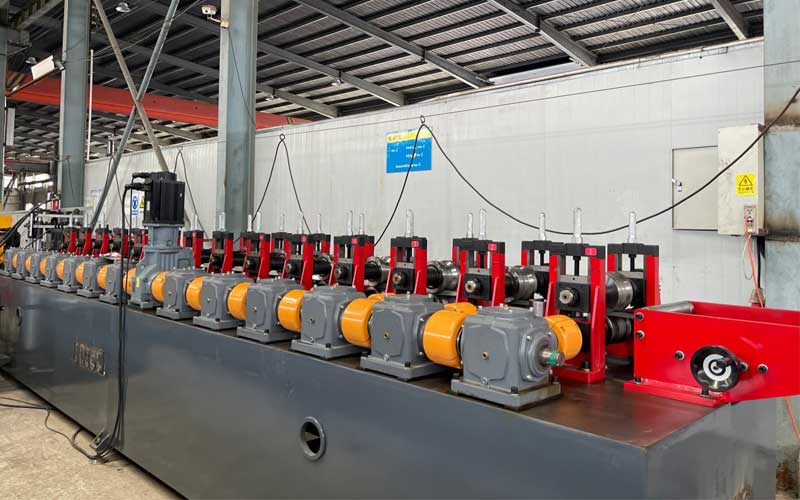
Roll forming is a continuous metal forming process where sheet metal passes through multiple roller stations to gradually achieve the final profile shape. It is commonly used for:
- Roofing panels
- C and U channels
- Solar structures
- Cable trays
- Stud and track systems
Roll forming offers high speed production with consistent accuracy.
Tube Forming
Tube forming transforms flat steel strips into round, square, or rectangular tubes using forming rolls and welding systems. Tube mills are widely used in construction, furniture, automotive, and industrial applications.
Stamping and Press Forming
Stamping uses dies and presses to shape sheet metal into complex parts. This process is ideal for mass production with repeatable precision.
Advantages of Metal Forming
Metal forming provides several industrial advantages:
- High production efficiency
- Excellent material utilization
- Strong mechanical properties
- Reduced manufacturing costs
- Consistent product quality
- Capability for automated production
These benefits make metal forming essential in modern manufacturing industries.
Applications of Metal Forming
Metal forming technologies are widely used in:
- Construction industry
- Automotive manufacturing
- Electrical equipment
- Solar energy systems
- HVAC production
- Steel furniture
- Industrial storage systems
The demand for advanced metal forming machinery continues to grow due to increasing industrial automation and infrastructure development.
Metal Forming Equipment
Modern metal forming production lines include:
- Roll forming machines
- Tube mills
- Slitting lines
- Cut to length lines
- Decoilers
- Hydraulic punching systems
- Flying cut-off systems
At LOTOSFORMING, customized metal forming solutions are engineered for high precision, stable operation, and long-term industrial performance.
Conclusion
Metal forming plays a critical role in modern manufacturing by enabling efficient and precise production of metal components. It supports a wide range of industries and continues to evolve with advanced automation and engineering technologies.
Companies like LOTOSFORMING provide industrial solutions that enhance production efficiency and support global manufacturing needs.
FAQ:
Sheet metal forming is the process of shaping thin metal sheets into specific profiles or components through bending, stamping, punching, or rolling techniques.
Metal forming improves production efficiency, material utilization, dimensional accuracy, and mechanical strength while reducing manufacturing waste and production costs.
Roll forming is a continuous metal forming process where sheet metal passes through multiple rollers to create precise profiles such as channels, roofing panels, and solar structures.
The main types of metal forming processes are bulk metal forming and sheet metal forming. These include rolling, forging, extrusion, deep drawing, and roll forming operations.
Metal forming improves production efficiency, material utilization, dimensional accuracy, and mechanical strength while reducing manufacturing waste and production costs.